Beginner Lesson
Intro to +EV Betting
Why sharp bettors care about price before picks.
The fastest way to improve as a bettor is to stop asking only who will win. A bet can win and still be bad. A bet can lose and still be correct. Expected value is the number that separates those two ideas.
A bet is +EV when your true probability is higher than the probability implied by the odds you are being offered.
What +EV actually means
Expected value is the average outcome of a bet if you could place it over and over in the same conditions. If the average is positive, the bet is +EV. If the average is negative, the bet is costing you money even when this one result happens to cash.
That distinction matters because sports betting has variance. A +120 touchdown bet can lose. A bad favorite can win. The process is about repeatedly getting paid more than the risk is worth, not about proving every individual outcome was predictable.
If a bet at +120 implies a 45.5% chance, but your fair probability is 50%, the book is paying too much. The edge is the gap between the price you got and the price the market should have charged.
Odds are probabilities in disguise
American odds can look intimidating, but they are just a different way to express probability. Negative odds show how much you need to risk to win $100. Positive odds show how much you win on a $100 stake. Once odds become probability, betting becomes comparison.
The Implied Odds Calculator is useful because it makes that translation instant. A line stops being a symbol on a sportsbook page and becomes a number you can compare to a model, a sharp book, or the Upside consensus.
Why no-vig fair odds matter
Sportsbooks build margin into every market. On a two-sided -110 market, both sides imply more than 50%, which means the full market adds up to more than 100%. That extra percentage is the hold.
To know whether a price is actually good, you need to remove that hold and find the fair number. That is what no-vig pricing does. It turns a sportsbook market into the closest available estimate of true probability.
Where +EV edges come from
Most edges come from line shopping, slower-moving books, and softer markets. One book shades a side because of customer action. Another is slow after injury news. A DFS app leaves a projection up after the sportsbook market moved. Those gaps are where expected value appears.
Upside scans those gaps across books and tools so you can start from the strongest opportunities instead of manually hunting every market.
Your first +EV session
Open the Optimizer
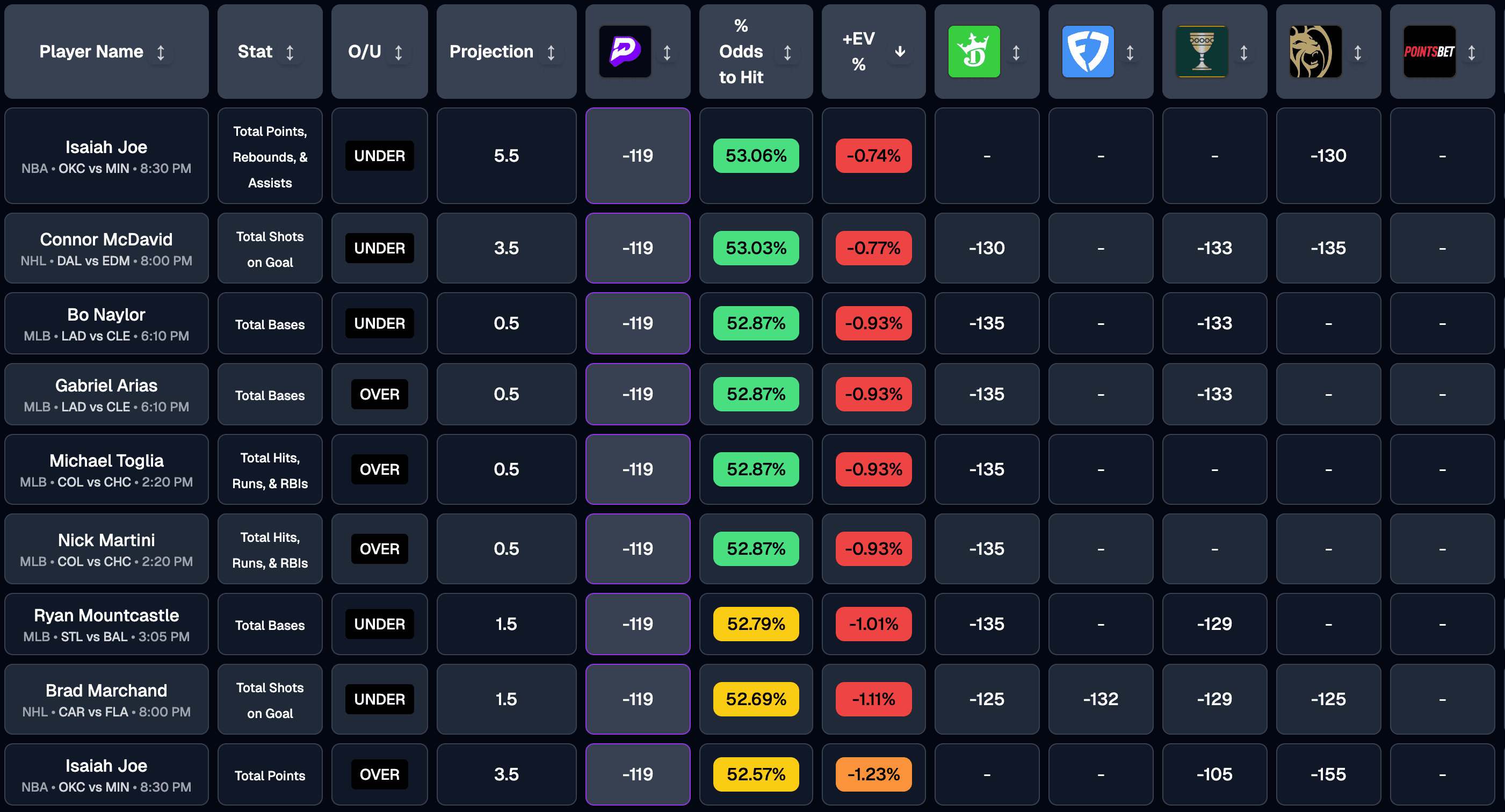
Sort by EV percentage and filter to books you can actually bet.
Check the price
Use calculators when you want to verify a row by hand.
Size conservatively
Use units or fractional Kelly until your process is proven.
The beginner goal
Your first goal is not to bet more. It is to understand why a bet is profitable before you place it. Once that idea clicks, the tools become leverage: they do the repetitive math while you focus on selection, sizing, and discipline.
What does +EV mean in betting?
It means the price is better than the true probability of the outcome. Over many similar bets, that positive gap should produce profit.
Can a +EV bet lose?
Yes. Expected value describes the long-run average, not a guarantee on one result. Losing +EV bets are part of normal variance.
Do I need to do the math manually?
You should understand the logic, but the EV, implied odds, and no-vig calculators handle the arithmetic. The Optimizer applies that math across the board automatically.
Open the +EV Optimizer
Start with live markets already ranked by expected value and learn by comparing the top rows.