Tool Tutorial
How to Use the Low Hold Tool
Find two-way markets where the built-in cost is unusually low.
The Low Hold tool scans two-sided markets and shows where the combined implied probabilities are closest to fair. That matters for promos, hedges, line shopping, and spotting markets that are nearly efficient enough to act on both sides.
Sort by hold percentage. Negative hold is an arb, near-zero hold is useful for hedging and promo conversion.
What hold means
Hold is the sportsbook margin. A normal two-sided market adds up to more than 100% because the book charges a fee through the price. The lower the hold, the less cost you pay to enter both sides of a market.
Low hold does not always mean guaranteed profit, but it does mean the market is cheap to use. That is valuable when you are hedging, converting a promo, or moving exposure across books.
What the tool does
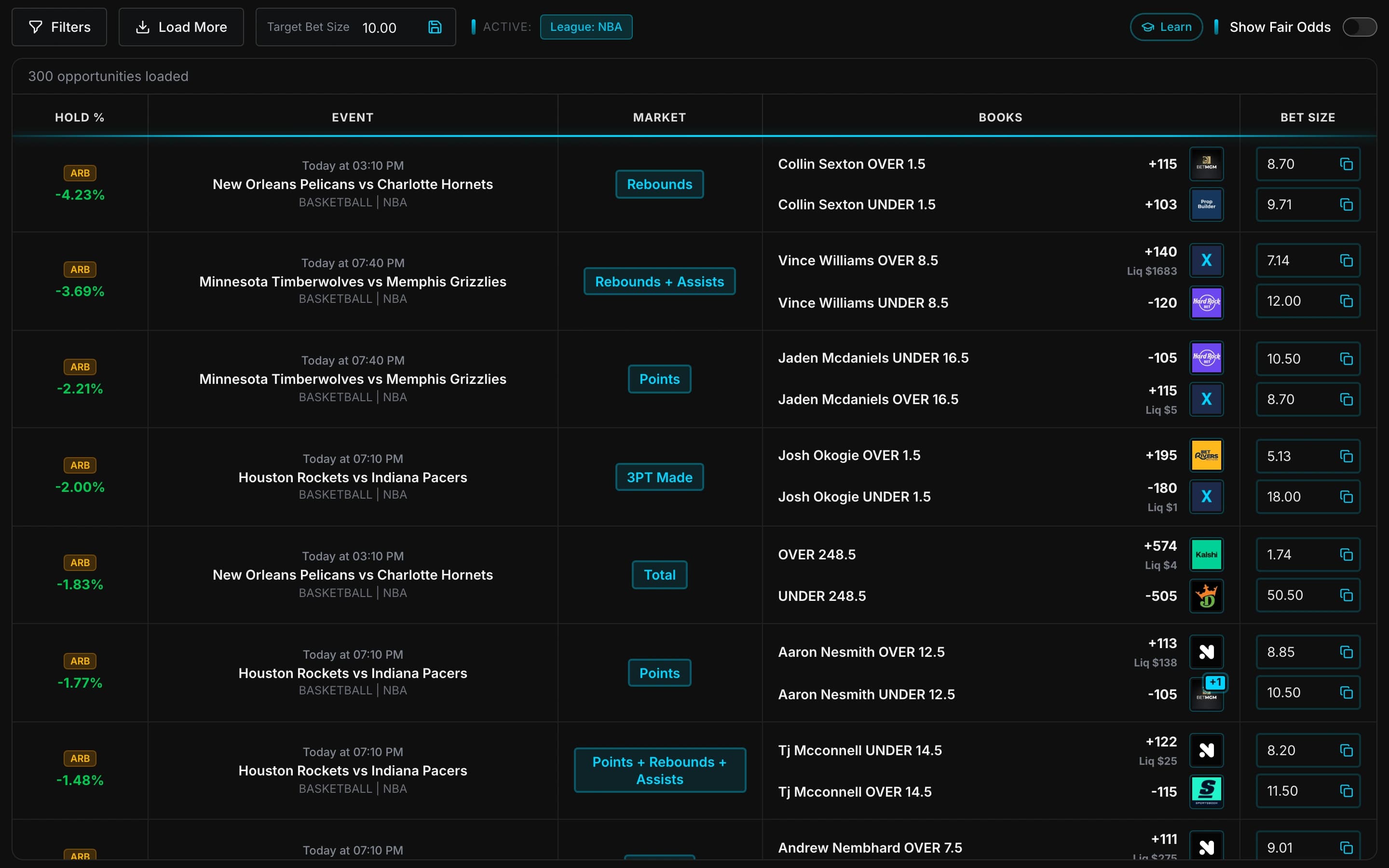
For each market, Upside finds the best price on each side and calculates the combined hold. The output is a table where the lowest-cost pairings rise to the top.
If the combined hold drops below zero, the prices create an arbitrage opportunity. If it stays slightly positive, the market is still useful for efficient hedges and promo conversions.
Hold thresholds
Both sides can lock profit.
Strong for promos and hedges.
Efficient enough for many workflows.
Usually less useful unless you need the hedge.
Reading a row
A row shows the market, each side, the book offering the best price, and the resulting hold. Expand the row when you want to see alternatives in case one book limits you or a price disappears.
Freshness matters because low-hold rows can vanish quickly. Confirm both sides before you submit either bet.
Low-hold workflow
Filter to usable books
Only include books and exchanges where you can place both sides.
Sort by hold
Start with the lowest combined hold and work downward.
Size both sides
Use the Arbitrage Calculator when the hold is negative.
When to use it
Low hold is useful for converting promotions, hedging futures or parlays, and moving bankroll exposure between books with minimal cost. It is also a good sanity check when a market looks strangely efficient.
Exchanges and prediction markets
Exchanges and prediction markets can create especially tight pairings because they do not always price like traditional sportsbooks. When those venues appear in the table, compare fees and liquidity before acting.
What is the difference between low hold and arbitrage?
Arbitrage requires negative hold. Low hold includes near-zero positive-hold markets that are still useful for hedging or promos.
Can a low-hold bet still lose money?
Yes. A positive-hold setup still has cost. The point is that the cost is lower than usual.
Why do rows disappear quickly?
Because one book moving a price can turn a near-zero hold market back into a normal market.
Open the Low Hold Tool
Find markets with unusually tight two-way pricing and act before the pairing moves.