Follow The Money
Whale Watch - SHARP Money Betting Strategy
Use sharp movement as context, not as a blind signal.
Whale Watch tracks meaningful market movement and highlights when sharp action creates a gap between fair value and the price still available at retail books. The edge is time-sensitive, so the workflow has to be fast and selective.
A sharp move is a signal. It becomes a bet only when the retail price still lags enough to create measurable edge.
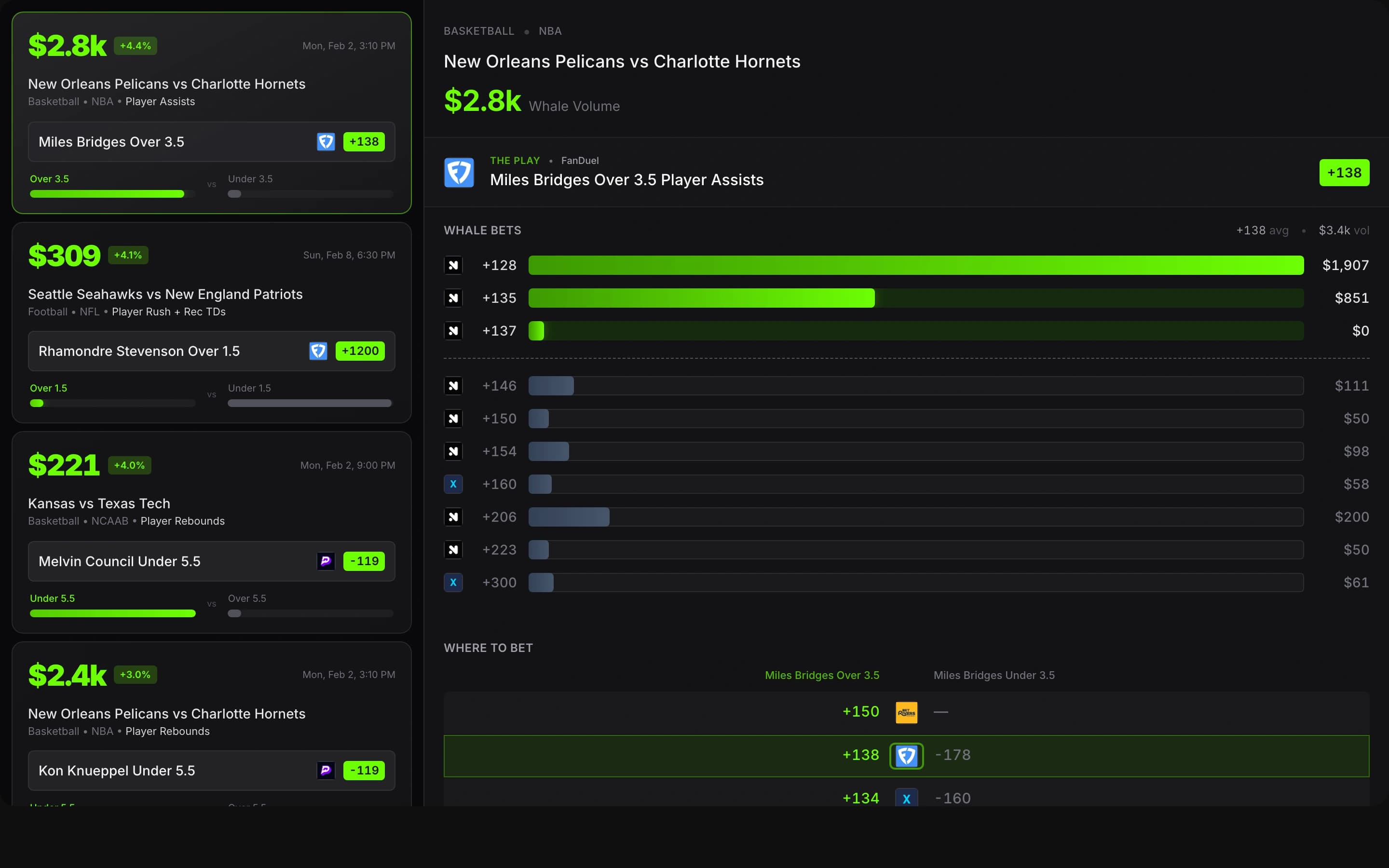
How Whale Watch works
The tool monitors market movement and compares the new fair value to prices still available elsewhere. If a retail book has not caught up, the gap appears as an actionable edge.
That gap usually has a short shelf life. The stronger and fresher the move, the more urgency there is to verify and act.
Reading the edge
Start with edge percentage, market, book, freshness, and price. A large edge with stale timing is less attractive than a smaller edge that just appeared.
Use the Odds Screen to confirm whether multiple books agree with the new fair value. If only one source is moving, be more cautious.
Edge signal strength
Often inside normal hold.
Use only with strong confirmation.
Confirm and act quickly.
When to pass
Pass when the row is stale, the edge is small, the market is about to close, or the book has already moved. Missing a stale signal is better than forcing a bad price.
Whale Watch routine
Set an edge floor
Start with a threshold that filters noise.
Confirm the market
Use Odds Screen context before firing.
Track CLV
Closing line value tells you whether you are catching real moves.
Fit it into the full process
Whale Watch should sit beside the Optimizer, not replace it. Use it for time-sensitive market movement, then size and log those bets with the same discipline you use everywhere else.
Should I follow every Whale Watch alert?
No. Treat each alert as a signal that still needs price confirmation, freshness, and bankroll-aware sizing.
How fast do these edges move?
Some close in seconds, especially at major books. If the retail book has already moved, the edge is gone.
How do I know if Whale Watch is working for me?
Track closing line value on the bets you place from Whale Watch. Positive CLV suggests you are catching real movement.
Open Whale Watch
Track sharp money movement and identify retail prices that still lag the fair market.