From Picks To Process
What Your Betting Process Should Look Like
A repeatable routine beats a hot take.
A serious betting process removes as many emotional decisions as possible. You define the bankroll, source plays from a +EV board, size them consistently, shop the best line, and review whether your prices beat the close.
Profitable betting is a system: source edge, size it, shop it, log it, and review it.
Set the bankroll first
Your bankroll is money set aside for betting, not money you need for life. Define one unit as a small percentage of that bankroll before you open any book.
That unit becomes the language for every decision. Instead of chasing losses or sizing up because a play feels strong, you risk a repeatable amount tied to edge and bankroll.
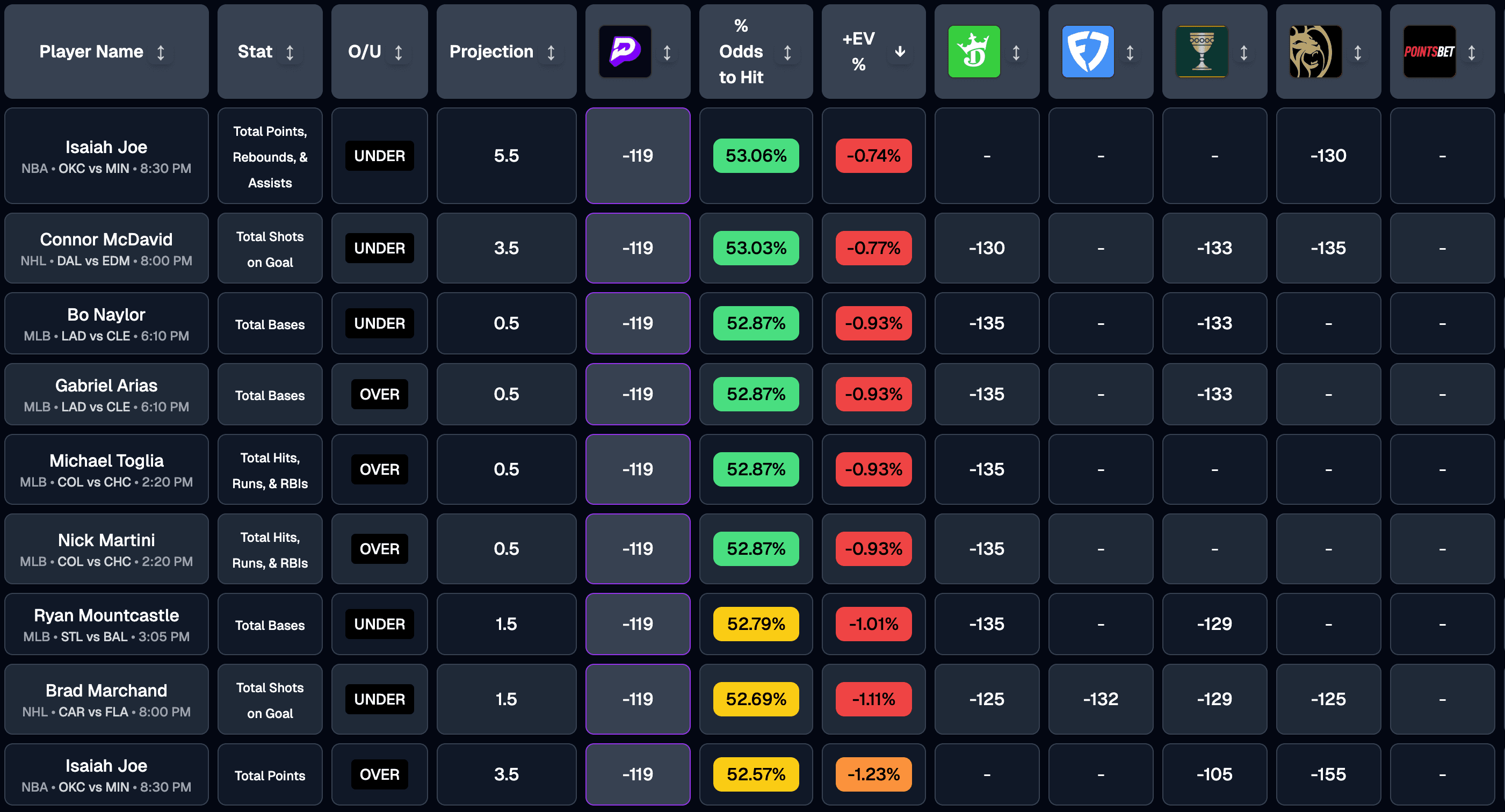
Source plays before you open the book
Recreational bettors open an app and look for something they like. A process-driven bettor opens the Optimizer first and creates a list of plays that are already priced better than fair.
The difference is subtle but important. The sportsbook becomes an execution venue, not a discovery engine.
Size with math
Flat units are fine for beginners. As the process improves, fractional Kelly lets size scale with edge without overexposing the bankroll. Full Kelly is usually too volatile for real-world estimates.
The Kelly Calculator turns edge and price into a stake suggestion, then you can round down to your unit grid.
Daily loop
Build the list
Filter the Optimizer to your books and sort by EV percentage.
Shop the price
Use the Odds Screen to make sure you are taking the best available number.
Log the bet
Record stake, line, price, result, and closing line.
Always shop the line
A slightly better price looks small on one bet and massive over a season. The Odds Screen shows where the best number is still hanging so you do not give away edge at execution.
Review weekly, not emotionally
A losing week with positive closing line value can still be a good week. A winning week with bad prices is a warning sign. Review the process, not only the result.
How large should one unit be?
Many bettors start around 1% of bankroll, then adjust once they have enough tracked results to understand variance.
Why use fractional Kelly?
It accounts for edge while reducing the volatility and model-error risk that comes with full Kelly.
What should I track?
Track book, market, line, price, stake, result, and closing line value. Those fields reveal whether the process is working.
Build today's edge list
Open the Optimizer, filter to your books, and start the day with a pre-built list of +EV opportunities.