The Math Behind Winning
3 Math-Based Strategies to Beat PrizePicks
Line discrepancies, smart correlation, and the slip type edge most users miss.
Most PrizePicks users start with a player they like and work backward into a slip. Profitable users do the opposite. They compare projections to the wider market, look for correlations that are not already priced into the multiplier, and choose entry types where the implied odds are least punishing.
You do not need to predict every game. You need a mispriced projection, correlation that still pays full price, and a slip type that does not erase the edge.
Why most PrizePicks players lose
PrizePicks looks like a fantasy product, but every projection is still a price. When a player takes an over or under without checking the rest of the market, they are accepting whatever price the platform gave them. That is exactly how casual volume gets taxed.
The lesson from the video is simple: stop treating the board like a list of predictions. Treat it like an odds screen. A projection becomes interesting only after you know where sharp books price the same player, how the leg interacts with the rest of your slip, and whether the entry type is charging too much vig.
Strategy 1: find line discrepancies
The cleanest PrizePicks edge is a projection that disagrees with the broader market. If PrizePicks lists a hitter at 1.5 total bases while several sharp sportsbooks imply a fair line closer to 2.0, the projection is no longer a hunch. It is a measurable pricing error.
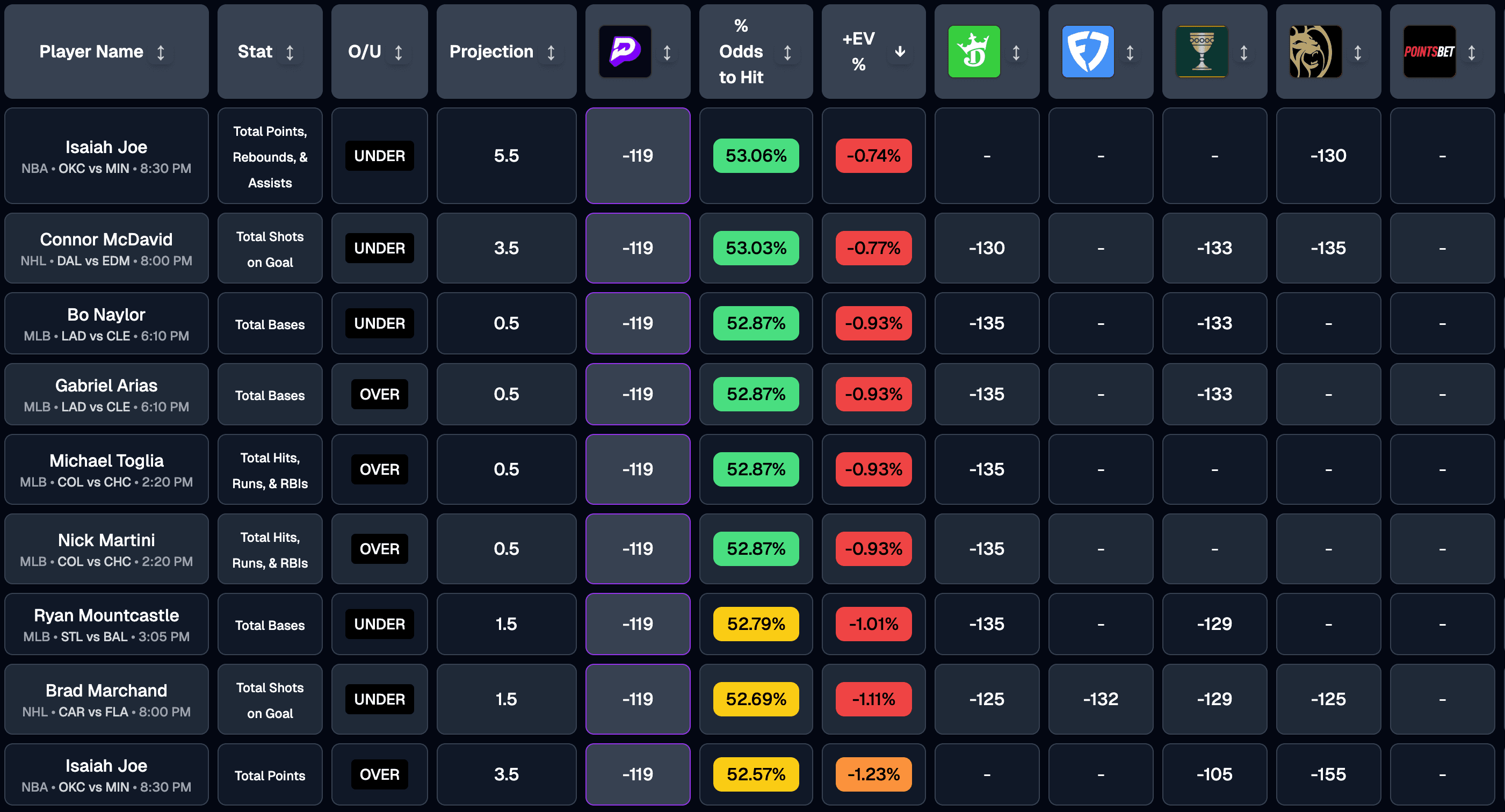
Fantasy Props exists to make that scan practical. Instead of opening five books for every player, sort by EV percentage and look for rows where the PrizePicks projection is meaningfully different from the consensus. The larger the disagreement, the less your opinion about the player matters.
Strategy 2: use correlation only when it still pays
Correlation means one leg makes another leg more likely. A quarterback passing yards over and his top receiver yards over are clearly related, so platforms often reduce the payout when you pair them. If the multiplier drops, the correlation is already priced.
The better edge is correlation that still receives the normal payout. Think pace, game script, role changes, or market-level relationships across different players and games. When two legs move together and the platform does not reduce the multiplier, the slip is being paid as if the legs were independent.
Slip type math
Feels safer, but often charges the most vig.
Lower implied cost with partial payout protection.
Works well when every leg is independently +EV.
Strategy 3: stop overpaying for short slips
A 2-leg entry wins more often, which makes it emotionally attractive. The problem is price. The multiplier on short slips often implies a worse per-leg price than larger flex entries. When the underlying legs are +EV, paying a worse price is the fastest way to give the edge back.
This is where the Parlay Calculator is useful. Convert the entry payout into implied odds, compare slip types, and choose the structure that lets the math compound instead of getting taxed at submission.
Daily PrizePicks workflow
Scan for mispriced projections
Start in Fantasy Props and sort by EV percentage.
Check correlation
Pair legs only when the relationship is real and the multiplier still pays.
Choose the entry type last
Use larger flex entries when the per-leg price is better.
Putting it together
The workflow is intentionally boring. Find rows where the market disagrees with PrizePicks, remove stale or unavailable projections, build slips where every leg stands on its own, and use the entry type that gives the best implied price. Repeat that long enough and the edge comes from volume, not from one perfect prediction.
What is the best PrizePicks entry type?
For users playing a math-driven strategy, 5-leg and 6-leg flex entries often offer a better long-run profile than 2-leg power entries because the implied cost per leg is lower.
How do I find +EV PrizePicks plays quickly?
Use Fantasy Props, filter to PrizePicks, and sort by EV percentage. Then verify the projection is still live before adding it to a slip.
Should I stack correlated PrizePicks legs?
Only when the correlation is real and the payout is not reduced enough to erase the edge. If the multiplier drops heavily, the platform has already priced the relationship.
Find live PrizePicks edges
Open Fantasy Props to compare PrizePicks projections against sharp market consensus and sort the board by EV percentage.