Low-hold market scanner
Find tighter two-way markets before you size a hedge, promo, or line-shop decision.
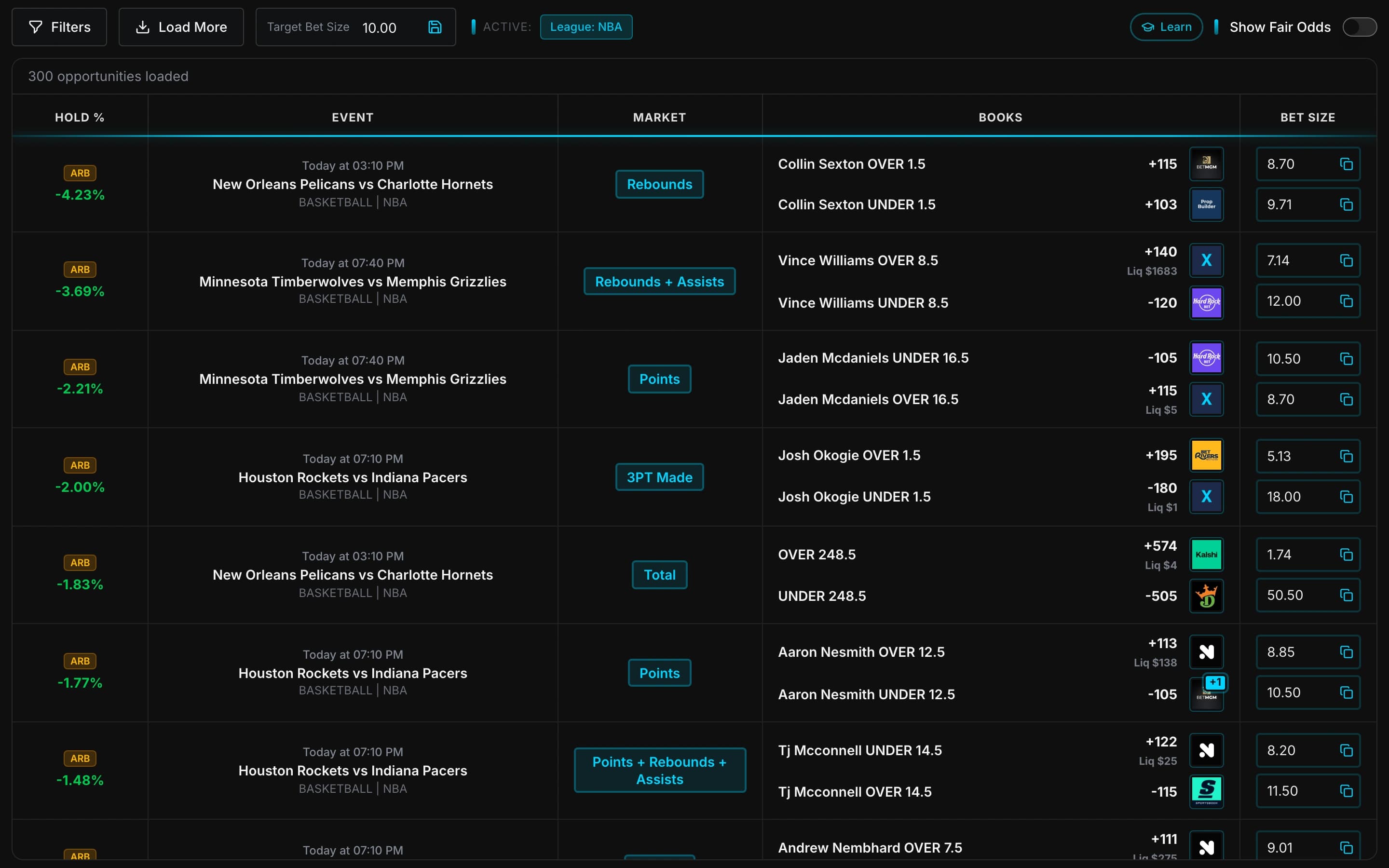
Low Hold scans two-sided markets and surfaces where the combined implied probability is closest to fair. It is built for comparing price quality, not for treating every low-hold row as a recommendation.
What it does
What Low Hold helps you review
Best fit
Who this tool is for
Markets and platforms
Coverage depends on supported books, markets, and user location
Two-sided sportsbook markets where Upside has enough book coverage to compare both sides.
Availability varies by league, event, sportsbook, and user location.
Upside scans 30+ sportsbooks, DFS apps, exchanges, and prediction markets across the product, but each tool has its own coverage rules and data availability.
Workflow
What to check before making your own decision
Sort by hold percentage
Start with the lowest-hold rows to find two-way markets where the combined implied probability is closest to fair. Low hold is a pricing signal, not an automatic play.
Review both sides of the market
Check which books provide the best price on each side and whether those prices are still live. One stale side can change the value of the full market.
Use the right calculator
Use the No-Vig Calculator for fair-price context, the Hedge Calculator for offsetting positions, and the Arbitrage Calculator if the hold turns negative.
Match the market to the use case
Low-hold rows can help with hedges, promos, and line shopping. They are not the same as guaranteed arbitrage, and the page keeps that distinction clear.
Before relying on the data
- Are both sides of the market available at the listed books right now?
- Is the row useful for a hedge, promo, or line-shopping decision rather than being treated as guaranteed profit?
- Does the no-vig or hedge math still work after accounting for stake size and account limits?
Questions
Common Low Hold questions
What is the Low Hold tool?
The Low Hold tool compares both sides of supported sportsbook markets and ranks rows by how close the combined implied probability is to fair pricing.
Is low hold the same as arbitrage?
No. Low hold can be positive, near zero, or negative. Arbitrage requires negative hold, where opposing prices theoretically sum to less than 100 percent implied probability.
Who should use Low Hold?
Low Hold is most useful for adults who already understand line shopping, hedging, and promo conversion and want a faster way to identify efficient two-way markets.
Why does hold percentage matter?
Hold percentage shows how much margin is built into both sides of a market. Lower hold usually means the prices are closer to fair, which can make the market more useful for research.
Related resources
Learn the math before using the workflow
Responsible gambling
Informational analytics only
Upside is for users 21 and older in jurisdictions where sports betting is legal. Upside provides informational and educational analytics, not gambling advice. It does not accept wagers, operate a sportsbook, place wagers on a user's behalf, facilitate wagers between users, or process gambling transactions.
Results vary; past performance does not guarantee future results. Set limits and never bet more than you can afford to lose. If you or someone you know has a gambling problem and wants help, call 1-800-GAMBLER or visit ncpgambling.org.
Related research
- I Tried Arbitrage Betting for One Hour and Made $0.00
I ran every pre-game arb my scanner found for an hour across five venues. Every one vanished before the click. Here is what killed it.
- A One Point Spread That Actually Costs 4.25 Percent
Kalshi quoted one point on Dallas at Seattle. The taker fee turns 64c and 37c into 65.62c and 38.64c, so the real cut is 4.25% against 4.76% at -110.
- A $100 Bonus Bet Is Worth $24 or $73 Depending Where You Use It
A bonus bet pays the winnings and keeps your stake. The same $100 free bet converts to $24.07 at -300 and $72.73 at +400. Here is the math, run five ways.