Tool Tutorial
How to Use the Esports Discrepancy Tool
Soft esports lines are easier to find when every book is on one screen.
Esports markets can be slower and less efficient than mainstream sports. The Discrepancy tool ranks projections by how much books disagree, making it easier to find rows where one platform is off the consensus.
Sort by spread percentage, require multiple books on the same market, and confirm the outlier is not stale before betting.
Why esports edges can be larger
Esports markets often have lower handle, fewer models, and less immediate sharp pressure than major leagues. That creates more disagreement between books, especially around roster news, patches, map pools, and player props.
The downside is lower limits and more stale lines. That is why confirmation matters. A large discrepancy is a lead first and a bet only after the row checks out.
What the tool does
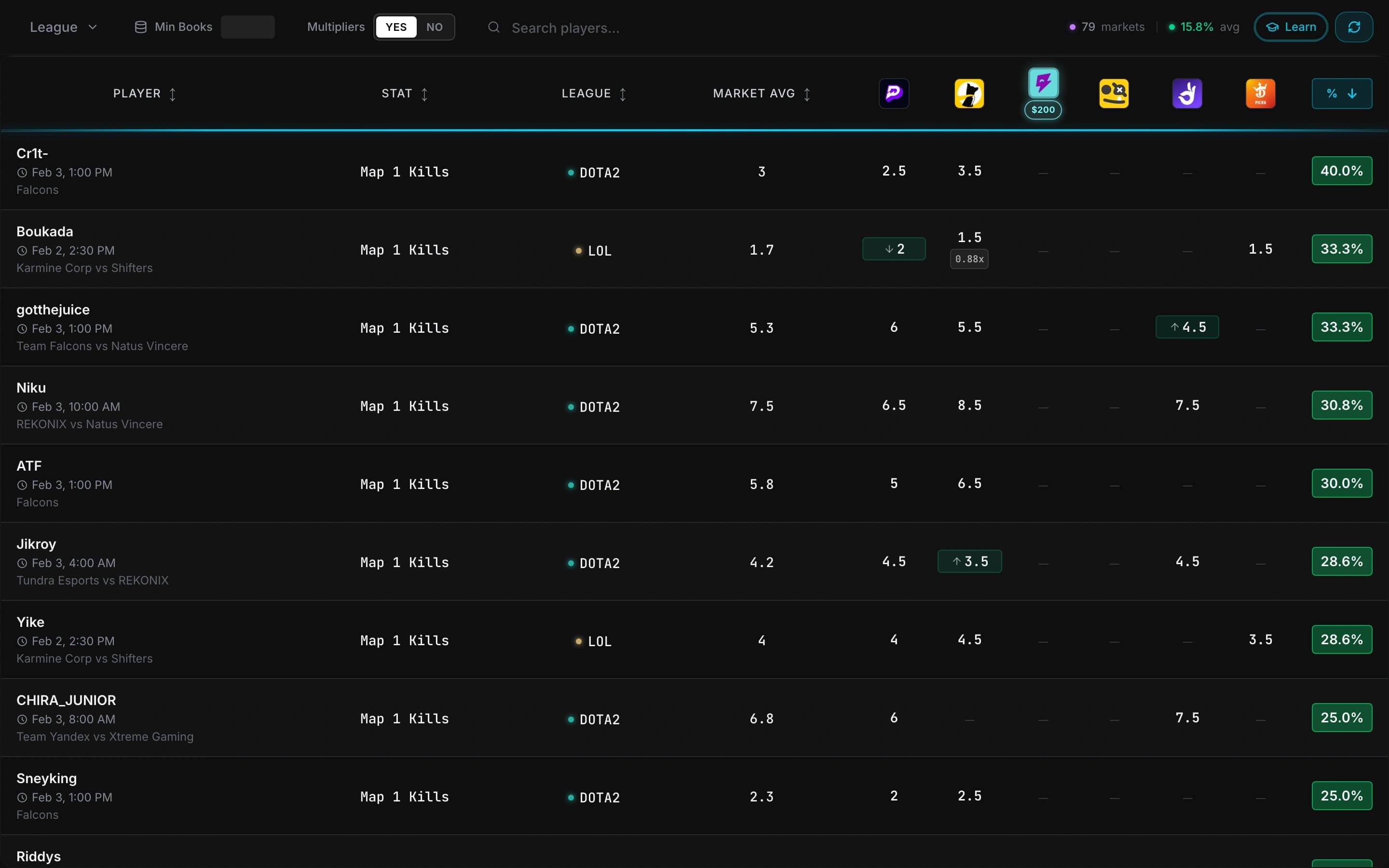
The table gathers esports projections across supported books and platforms, then compares the highest and lowest available lines on the same player or market. The biggest spread appears first.
That view is especially helpful for props where one platform lags after news or prices a niche market differently from the rest of the board.
Reading the table
Use player, team, game, market, low line, high line, and spread percentage together. A high spread with only two books can be noise. A high spread across several books is more trustworthy.
Open the row before acting. Make sure the market type matches across books and that one book is not using a different map, series, or scoring condition.
Use Discrepancy to find disagreement, then use Fantasy Props or EV Calculator to confirm the side and price are actually +EV.
Esports discrepancy workflow
Scan before match start
Lines are often softer before the final pre-match move.
Require multiple books
Three or more references make the discrepancy more reliable.
Confirm market rules
Check maps, series length, and player status before placing anything.
Filters that matter
Filter by esport, league, and books you can use. If you understand CS2 better than Dota, start there. Market knowledge helps you catch bad rows before they cost you.
When the board is empty
Do nothing. Esports edges come in waves around schedules and news. Forcing action when the discrepancy table is quiet defeats the purpose of the tool.
Which esports does the tool cover?
Coverage depends on what books are offering, but it is built around markets like CS2, League of Legends, Dota, and Valorant.
How big does a discrepancy need to be?
It depends on the market, but bigger spread percentage and more books quoting the same line make the signal stronger.
Why can a row be misleading?
One book may be stale or using different rules. Always expand the row and confirm the market before acting.
Open the Esports Discrepancy Tool
Scan esports markets for the biggest line disagreements across supported books.