Tool Tutorial
How to Use the Optimizer
Find sportsbook bets priced better than the fair market.
The Optimizer applies the +EV workflow to the book you choose. It compares every spread, total, moneyline, and player prop at that book to a no-vig market view and ranks the rows where the book is still hanging value.
Pick your book, sort by EV, and move quickly when stale or shaded lines rise to the top.
What the Optimizer does
Sportsbooks rarely agree perfectly. One book may be slow after injury news, another may shade toward public action, and another may simply have a different risk position. The Optimizer turns those differences into a ranked list of positive-EV bets at the book you choose.
It removes the hold from the market, estimates a fair price, and compares that fair price to the line you can actually bet. When your price is better, the row earns a positive EV percentage. Game lines and player props share one board, so a stale spread and a mispriced prop compete for the same spot at the top.
Set a useful default view
Start with the Book picker. The Optimizer ranks one book at a time, so choose one you have funded. A 4% edge at a book you do not have is just research. A 2% edge at your main book is actionable.
Then narrow League, Game day, and Markets to what you want to cover. Many users begin with spreads and totals, then add player props and moneylines once they are comfortable with thinner markets and larger price swings.
How to read a row
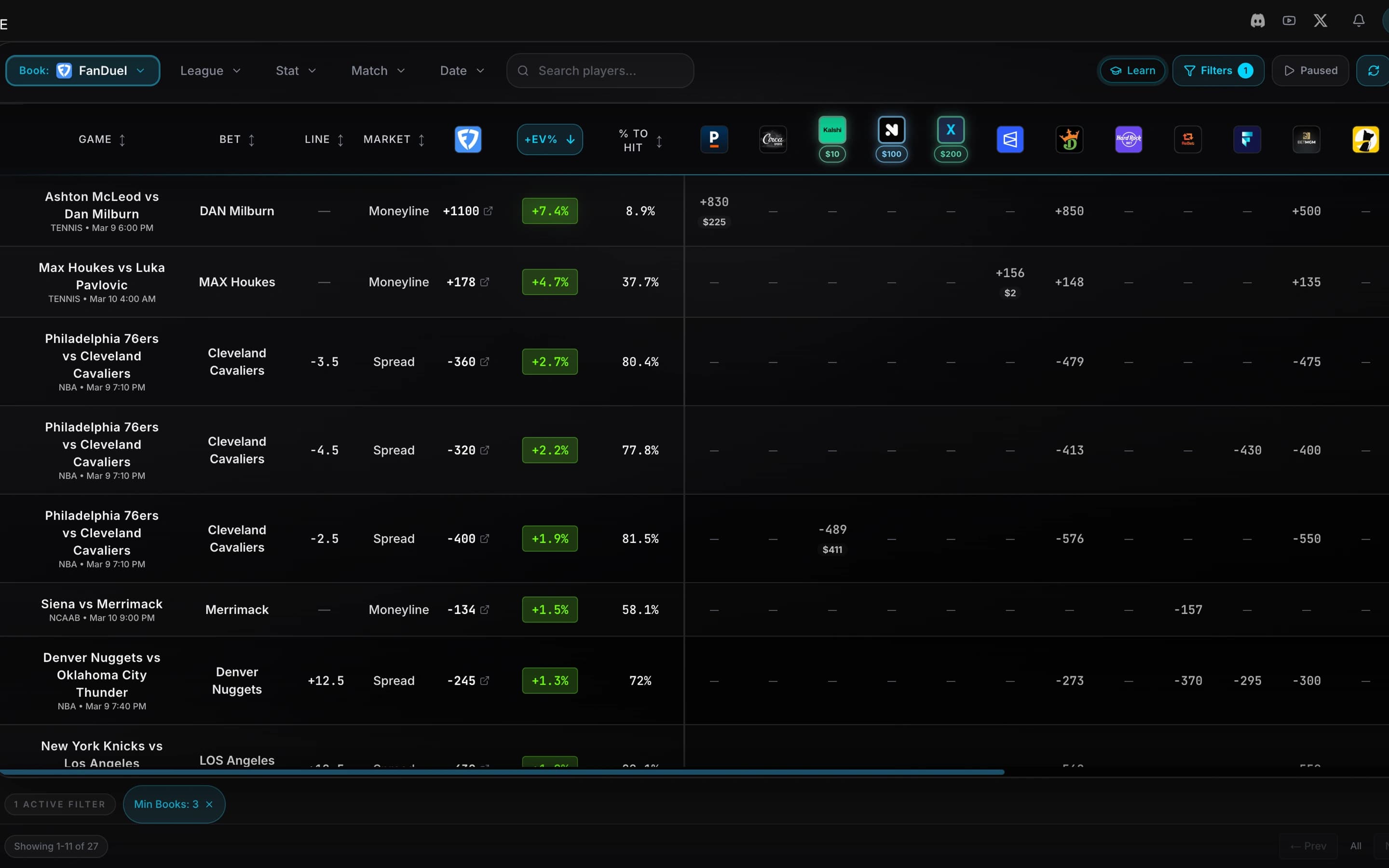
Each row shows the play, your book's price, the EV percentage, and the chance to hit with its fair odds. The fair price is the key number because it tells you what the bet should cost in a cleaner market.
The columns to the right show the same bet at other books, so you can see which book is out of line. Expand a row to check how the line has moved. If the price has moved, pass. If the price is still there, the edge is real enough to consider.
When a row looks surprising, plug the two-way market into the No-Vig Calculator. It shows the same fair-price concept the Optimizer uses at scale.
Daily Optimizer workflow
Filter
Pick your book, leagues, and markets.
Sort
Rank rows by EV percentage and scan the top of the board.
Size
Use flat units or fractional Kelly, then log the closing line.
Sizing with discipline
Game-line edges tend to be smaller than prop edges, and props usually carry lower limits, so sizing matters. Many bettors start with flat units and then graduate to fractional Kelly as their tracking improves.
Why stale lines matter
The best edges often come from temporary disagreement. Injury news, weather, or sharp movement can update one book before another. The edge is strongest before the lagging book catches up.
What markets does the Optimizer cover?
Spreads, totals, moneylines, and player props at supported sportsbooks, exchanges, and prediction markets, all on one board. Fantasy Props covers DFS pick'em slips.
What happened to Game Lines and Sportsbook Props?
They are now one page. The Optimizer shows game lines and sportsbook player props together, and old Game Lines links open it.
Is EV percentage the same as win probability?
No. The chance to hit estimates how often the bet should win. EV percentage estimates expected return based on the price and that probability.
Should I bet every positive row?
No. A positive row is a lead to check, not a pick. Confirm the price is still live at a book you can use, decide whether it fits your bankroll, and make your own call.
Open the Optimizer
Find player props, spreads, totals, and moneylines where your book's price beats the fair market number.