Original research · September 18, 2026
How a Bettor With a 24 Percent Win Rate Made $32,731 This Year
By Matt Downs
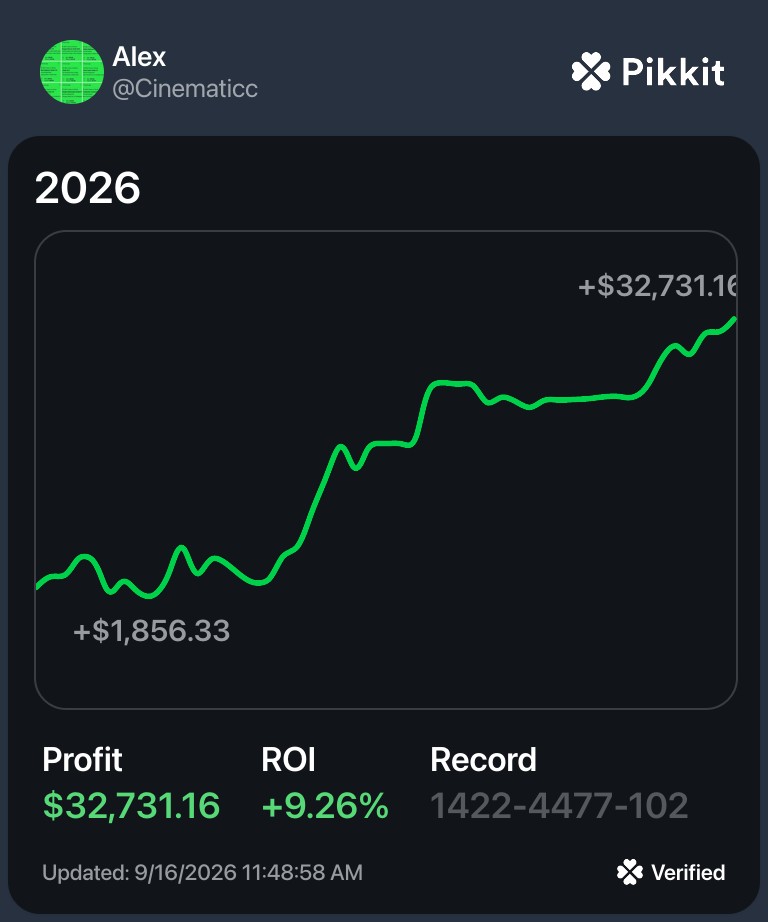
Most people assume a profitable sports bettor wins most of their bets. The record below belongs to a full-time bettor named Alex, and it is the opposite. Through September 16, 2026 he has won 1,422 bets and lost 4,477, a 24 percent win rate. He is up $32,731.16 for the year, a 9.26 percent return on every dollar wagered, and every bet is synced from the sportsbooks and graded by a third-party tracker. This article explains how a record that looks like a losing gambler's produces that profit, and what he actually does differently from the person who loses.
Why win rate does not decide profit
A bet has two parts: whether it wins, and what it pays when it does. Casual bettors judge themselves on the first. Profitable bettors are judged by the second, because payout is the only part they control before the game starts.
Alex loses three bets for every one he wins because most of what he takes pays more than even money. A bet at +300 only needs to win 25 percent of the time to break even. Win it 28 percent of the time and you are profitable while losing 72 percent of your bets. That is his whole year in one sentence.
The question he asks on every bet is not whether the team will win. It is whether the price he is being offered is better than what the bet is actually worth. If a bet needs a 52 percent chance to break even and the evidence says it is closer to 55, he has an edge. That bet still loses 45 times in 100. Taken once, it is a gamble. Taken 5,899 times, which is how many of his bets have settled this year, the three-point gap becomes $32,731.
How you know what a bet is worth
The sportsbook market itself tells you. Thirty or more books price the same player prop or game line every day, and the sharpest of them, Pinnacle and Circa for game lines, move their numbers on real money from bettors who win. Strip the book's built-in fee out of a two-sided price and the number left over is the market's best estimate of the true probability. The no-vig calculator does that arithmetic for free, no account required.
Once you have that fair number, the rest is comparison. Any book, app or exchange posting a price better than fair is offering an edge. Any price worse than fair is a slow leak, even on the nights it wins. Everything Alex does is a version of finding the first kind and refusing the second.
Method one: pick'em parlays built from the price, not the player
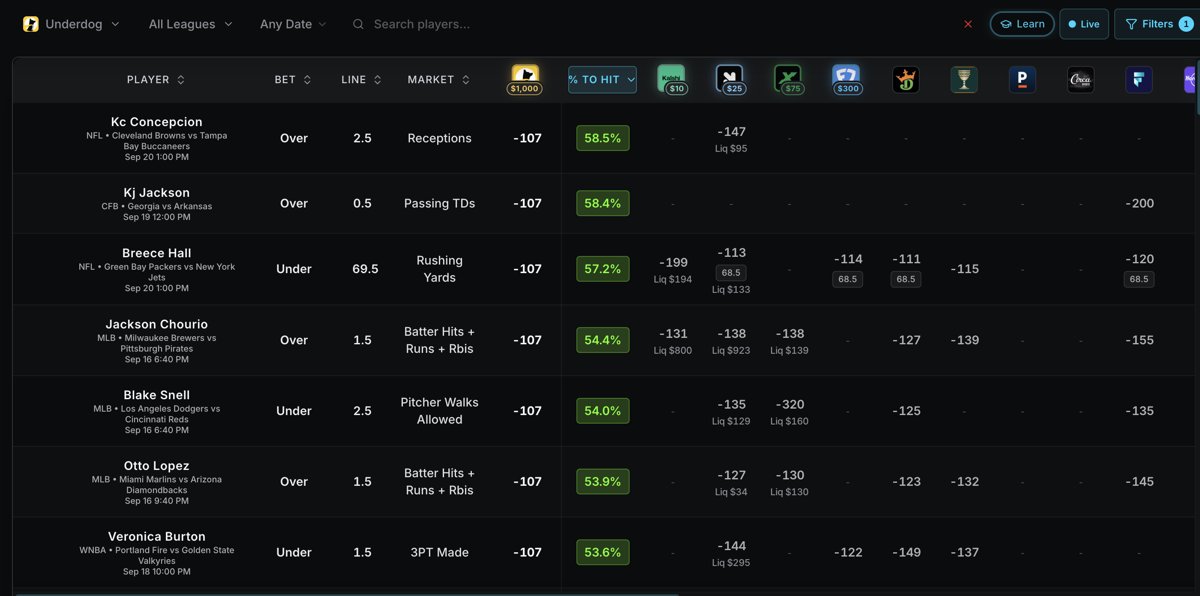
Apps like PrizePicks, Underdog and DraftKings Pick6 pay a fixed multiple on a parlay of player props. A three-pick entry on PrizePicks pays 6x whether you take the over or the under on each leg. That fixed payout is the opening, because the app is not pricing each side. The sportsbook market is.
So instead of looking at a player's last five games, which every book already has in its model, Alex looks at which side the whole market leans. His example is a receiver's over 3.5 receptions where nearly every sharp book has the over favored. On a fixed-payout app the over costs the same as the under, which makes it the best price on the board for that leg. He stacks three legs the market favors and evaluates each one on its fair probability, not on whether the player is having a good year. If the number says an under, he takes the under.
The payout gap is the proof. He built the same three legs on FanDuel as a standard parlay: $100 pays $392. On PrizePicks the identical entry pays $600. Same picks, same outcome, $108 more from choosing where to place it. At a 6x payout a three-pick entry needs each leg to hit 55 percent of the time to break even, and when the market has already told you a leg is above that, the entry is positive expected value before kickoff.
Method two: top-down price checks on prediction markets
Prediction markets and exchanges such as Novig, ProphetX, Kalshi and Polymarket have no house setting the price. You trade against other people, so a price can sit well away from the rest of the market when nobody has corrected it yet. Alex's rule is that the exchange he is on must beat every competing exchange and must beat Pinnacle. If one box is not checked, he passes.
His game-line example: a baseball run line at +147 on Novig while Pinnacle had the same side at -156 with $10,000 limits, Kalshi at -161, ProphetX at -148, Polymarket at -150, DraftKings at -162 and FanDuel at -164. Every serious price on the market said the bet was worth around -155, and one exchange was paying +147 for it. That is not a prediction about the game. It is a mispriced ticket.
The same rule works on props. A quarterback's anytime touchdown was even money on Novig while ProphetX had it -112, Pinnacle -116, Circa -110, and the major books -135 to -145. Hundreds of these gaps appear across a day's card, and none of them require an opinion about the player.
Same bet, seven prices
| Novig | +147 | The exchange price Alex took. Pays $147 on $100. |
|---|---|---|
| ProphetX | -148 | A competing exchange. Pays $68 on $100. |
| Polymarket | -150 | Pays $67 on $100. |
| Pinnacle | -156 | The sharpest game-line book, $10K limits. Pays $64 on $100. |
| Kalshi | -161 | Pays $62 on $100. |
| DraftKings | -162 | Pays $62 on $100. |
| FanDuel | -164 | Pays $61 on $100. |
The part that hurts: you will lose most of your bets
This approach does not feel like winning. It feels like losing three out of four, with the profit arriving as a slow tilt in the account balance rather than a big night. A bettor who needs to see a green day to stay motivated will quit before the sample is large enough to show anything, and most do. The math on exactly how many bets that takes is in how many bets variance really needs.
Three habits make it survivable. Bet the same size every time, so a normal losing run cannot compound. Judge every bet by the price you got against the fair price, not by whether it won. And log all of it, so the year can tell you the truth instead of the last three days.
Frequently asked questions
Can you be a profitable sports bettor with a losing record?
Yes. Profit depends on the payout of the bets you win, not on how many you win. A bettor who takes prices above the true odds can win 24 percent of bets and profit, which is exactly the 2026 record shown here: 1,422 wins, 4,477 losses, up $32,731.
What is positive expected value betting?
Betting only when the price offered is better than the bet's true probability implies. If the fair chance is 55 percent and the price only requires 52 percent to break even, the bet has positive expected value. It still loses often, but over a large number of bets the gap shows up as profit.
Why do PrizePicks parlays pay more than sportsbook parlays?
Pick'em apps pay a fixed multiple regardless of which side you take, while sportsbooks price each leg individually. When the market favors one side of a prop, the fixed-payout app is paying the same for the favored side as the unfavored one. In the example here the same three legs paid $600 on PrizePicks and $392 on FanDuel.
How do you find mispriced bets on prediction markets?
Compare the exchange price against every competing exchange and against the sharpest sportsbooks, especially Pinnacle. When the exchange is paying more than all of them for the same outcome, the price is out of line with the market. A run line at +147 on one exchange while the market sat around -155 is a typical example.
How do you know the true odds of a bet?
Remove the sportsbook's fee from a two-sided price to get the no-vig probability, then compare across many books. The consensus of sharp books is the best available estimate of the true chance. A free no-vig calculator does the arithmetic.
How many bets does it take for this to work?
Thousands, not dozens. Small edges need large samples before profit separates from noise. The record here reflects 5,899 settled bets in under nine months, and the profit was not visible in the first few hundred.