Original research · September 17, 2026
I Lost 1,852 Bets in My Best Month Ever. Here Is How Many Bets Variance Really Needs.
By Matt Downs
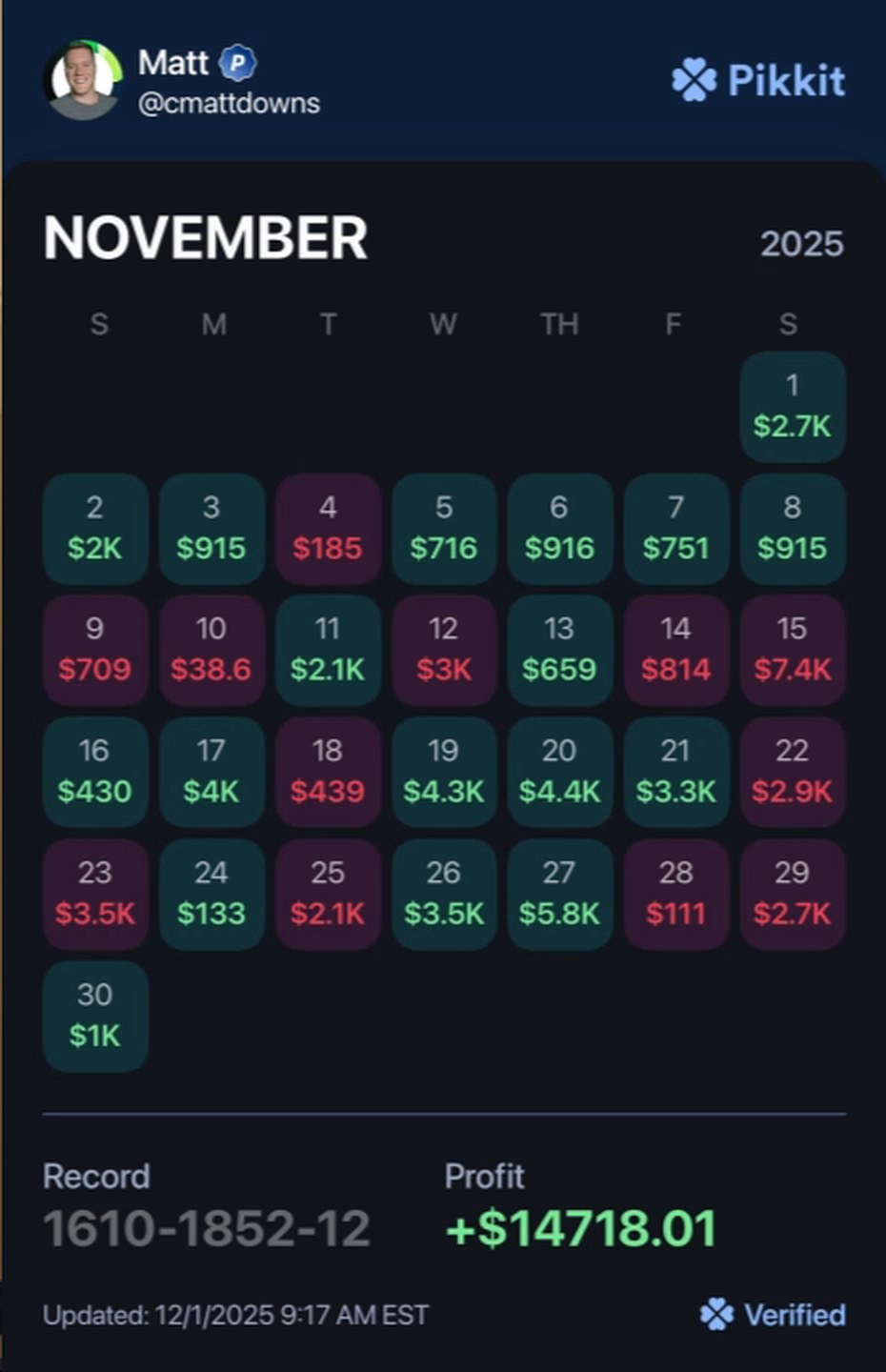
November 2025 was the best month of betting I have ever had. It is also the month with the single worst day of my career, a $7,400 loss on the 15th, and a month where I lost far more bets than I won. All three of those are on the same Pikkit card, verified straight off the sportsbooks: 1,610 wins, 1,852 losses, 12 pushes, up $14,718.01. This article is about why those numbers belong together, and about the question every bettor who quits early gets wrong: how many bets do you actually need before the results mean anything?
How a 46 percent win rate finishes a month up $14,718
Of the 3,462 bets that got decided, I won 1,610. That is 46.5 percent. At flat stakes the average price I took works out a little better than +120, and the break even win rate at +120 is 45.5 percent. One point of win rate above break even, multiplied across 3,462 bets, is the whole month.
That is what a real edge looks like in practice. It is not a 70 percent hit rate and it is not a green calendar. It is a small gap between the price you paid and the price the bet was worth, repeated enough times that the gap shows up as money instead of noise.
The word for the noise is variance, and November is the cleanest example I have of how big it is. Eighteen green days and twelve red ones. A best day of $5,800 and a worst day of $7,400, three days apart. If you only saw the second week, you would have watched the 12th through the 15th lose roughly $10,500 in four days and concluded the process was broken.
The 15 day problem, and the 20 bet problem
Here is the stat that made me write this. 67 percent of the people who cancel Upside do it before they have entered 20 bets. Twenty. They sign up, take a handful of plays, hit a red night like my 15th, and decide the tool does not work.
Twenty bets cannot tell you anything. With an edge of about 5 percent per bet at -110, which is a very good edge, the expected profit over 20 bets is one unit and the standard deviation is more than four units. The signal is a quarter the size of the noise. You are not testing the tool at that point. You are flipping a coin and grading the tool on which side landed.
If I had judged November on its first 15 days I would have quit thousands of dollars in the hole. The process that produced the second half of the month was the same process that produced the first half. The only thing that changed was the sample.
How many bets you really need
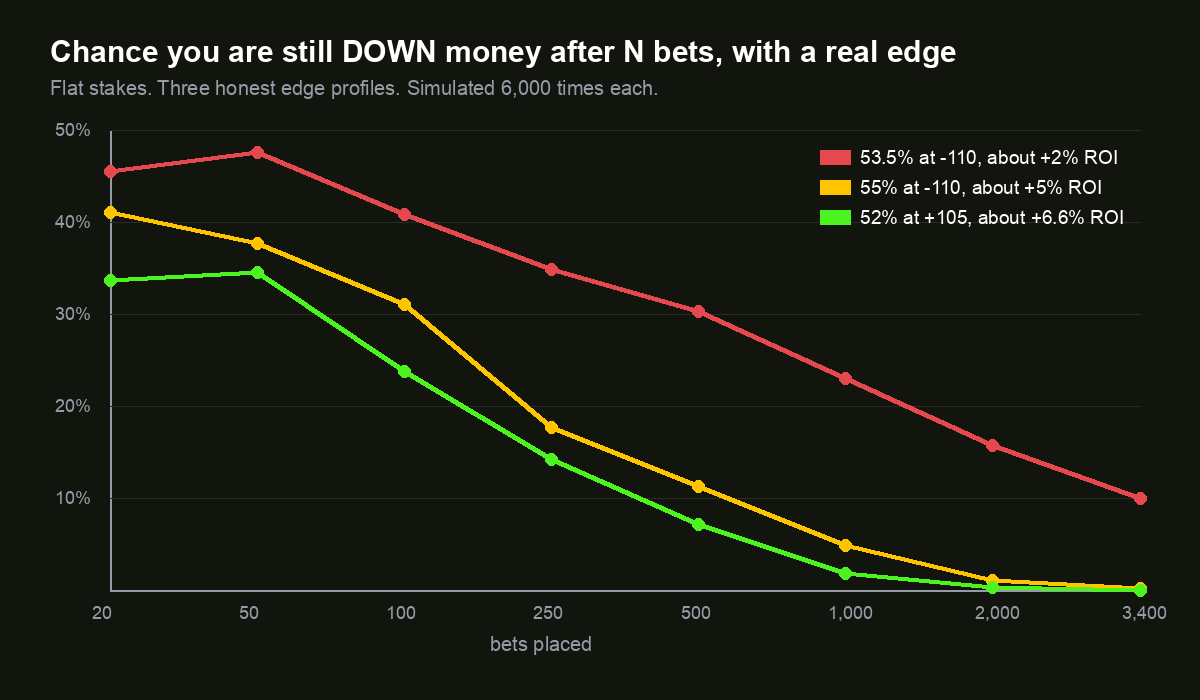
The chart above is the honest answer, and it depends on one thing: the size of your edge. I simulated three bettors, each with a genuine edge, each betting flat stakes, and asked how often they were still below zero after a given number of bets.
A 2 percent edge (winning 53.5 percent at -110) is roughly what a careful line shopper earns on mainstream markets. That bettor is still down money 41 percent of the time after 100 bets, 30 percent after 500, and 23 percent after 1,000. It takes about 3,300 bets before there is a 90 percent chance the results are positive. That number is not a coincidence. It took me about 3,400 bets before variance smoothed out and this turned into real side income.
A 5 percent edge (55 percent at -110) is what the +EV Sniper finds when it is fed enough books. That bettor is down 31 percent of the time after 100 bets and 11 percent after 500, and needs roughly 600 bets to reach the same 90 percent confidence.
A 6.6 percent edge (52 percent at +105, the profile of a props bettor who only takes plus money above fair) gets there in about 400 bets.
The rule of thumb behind all three: the number of bets you need grows with the square of the noise-to-edge ratio. Halve your edge and you need four times as many bets. That is why a 2 percent edge needs thousands and a 6 percent edge needs hundreds, and why nobody with any edge at all can learn anything from twenty.
Bets needed for a 90 percent chance of being in profit
| 2% edge (53.5% at -110) | about 3,300 bets | Still down 23% of the time after 1,000 bets. This is my November profile. |
|---|---|---|
| 5% edge (55% at -110) | about 600 bets | Down 11% of the time after 500. What a well-fed +EV Sniper produces. |
| 6.6% edge (52% at +105) | about 400 bets | Plus-money props above fair. Fastest to separate from noise. |
| Any edge, 20 bets | a coin flip | Expected profit one unit, standard deviation four. Nothing is learnable here. |
What to do with this
1. Bet the same size every time. Every number above assumes flat stakes. The $7,400 day happened at the same stake as the $5,800 day. If your size grows on a heater and shrinks after a red night, the math stops applying to you and the sample you are building is worthless. The Kelly sizing article covers how to pick the size.
2. Judge the price, not the result. A bet you took at +120 that the market closed at +105 was a good bet whether it won or lost. Run the two-sided line through the no-vig calculator before you fire, and log the fair price next to the price you got. That log tells you whether you have an edge long before the profit column does.
3. Log every bet. Pikkit, a spreadsheet, a notebook. November is only useful because all 3,474 bets are on one card with a timestamp. Memory keeps the winners and forgets the rest.
4. Set the sample before you start. Decide now that you will not evaluate the process before 100 bets, and that you will not trust the profit column before 500. Then a $7,400 day is a data point instead of a verdict.
The honest part
Twelve of the thirty days in November were red. Four days in the middle of the month lost around $10,500 combined. I lost 242 more bets than I won. That is what positive expected value looks like while it is working, and if a week like that would make you shrink your bets or chase, the math quits on you before it has a chance to pay. Better to know that from the calendar than to find out in the second week.
Frequently asked questions
How many bets do you need to know if you are a profitable sports bettor?
It depends on the size of your edge. With a 2 percent edge at -110 odds it takes roughly 3,300 bets to be 90 percent confident the results are positive. With a 5 percent edge it takes about 600, and with a 6.6 percent plus-money edge about 400. Twenty bets tell you nothing at any edge.
Can you lose more bets than you win and still be profitable?
Yes, if the average price you take is above the break even for your win rate. November 2025 was 1,610 wins against 1,852 losses at an average price a little better than +120, where break even is 45.5 percent, and it finished up $14,718.
What is variance in sports betting?
Variance is the gap between what an edge should produce on average and what it actually produces over any short stretch. A 5 percent edge over 20 bets has an expected profit of one unit and a standard deviation of more than four, so short-run results are mostly noise. The noise shrinks relative to the edge as the number of bets grows.
Why does flat bet sizing matter for variance?
Because every sample-size calculation assumes the same stake on every bet. If bets get bigger during hot streaks and smaller after losses, a normal losing run compounds into a hole the edge cannot recover from, and the record stops measuring the process.
How long does a losing streak last with a real edge?
Longer than most people expect. A bettor with a 2 percent edge is still down money 30 percent of the time after 500 bets and 23 percent of the time after 1,000. Inside November 2025 there was a four-day stretch that lost roughly $10,500 in a month that finished up $14,718.