Original research · September 22, 2026
Kalshi College Football Betting Strategy: The 3 Steps Behind 150 Profitable Bets in a Minute
By Matt Downs
On Friday, September 19, 2026, the Upside sniper surfaced over 150 college football bets on Kalshi with a positive expected value against the rest of the market, in under a minute. This is the three-step process that produced them, walked on the actual screens from that board: compare the same bet across every book, target the markets nobody is watching, then read where the sharp money has already been placed.
Every price, probability and dollar figure below was read off those captures. The games are played now, and no result is claimed for any of them. The point is the method, which carries over to every Saturday board.
Step one: a Kalshi percentage is a price, so compare it like one
Every contract on Kalshi is quoted in cents, and cents are a probability. A contract at 55.7 cents pays one dollar if it wins, so the market is saying that outcome happens about 55.7% of the time. That converts straight to American odds, and the implied odds calculator does it in one step: 55.7% is -126. Whether you read cents, a percentage or American odds, you are reading the same price tag, which is how much money comes back if you are right.
At -126 you risk 126 dollars to win 100. On a 100 dollar bet the profit is 10,000 divided by 126, which is 79.37 dollars, for a total return of 179.37 dollars. Once every book is in the same language, the comparison is trivial.
The Tarleton State example: same spread, 19 dollars more, and a crossed market
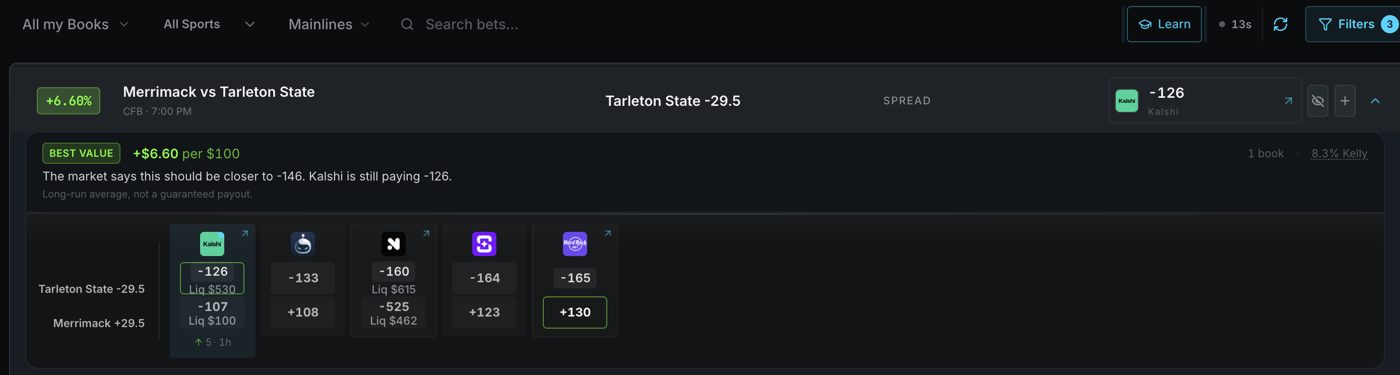
Tarleton State -29.5 against Merrimack was priced at -126 on Kalshi and -165 at Hard Rock. Same spread, same result required. On a 100 dollar bet Hard Rock pays about 61 dollars in profit and Kalshi pays 79.37 dollars, roughly 19 dollars more for an identical outcome. The tool's market read put fair value near -146, which means Kalshi was the side that was off, not Hard Rock.
Then look at the other side of Hard Rock's line. They were offering Merrimack +29.5 at +130. Convert both: -126 implies 55.75%, and +130 implies 43.48%. Together that is 99.23%, which is below 100. A pair of opposing prices that adds to less than 100 is a crossed market, and it is the strongest evidence you can get that one price is stale. The sniper labelled the Kalshi side +6.60 dollars per 100, and it says on the same line that the figure is a long-run average, never a guaranteed payout.
Tarleton State -29.5, September 19, 2026
| Kalshi | -126 (55.75% implied), 530 dollars of liquidity | |
|---|---|---|
| Novig | -160 | |
| Hard Rock | -165, with Merrimack +29.5 at +130 (43.48% implied) | |
| Market fair price | about -146 | |
| Kalshi side plus Hard Rock other side | 99.23%, a crossed market | |
| Profit on 100 dollars, Kalshi vs Hard Rock | 79.37 dollars vs about 61 dollars | |
| Sniper expected value | +6.60 dollars per 100, long-run average |
Step two: target the markets and teams nobody is watching
Most people have never heard of Tarleton State, and that is why the price was wrong. On the day of that capture there were 197 college football games with lines available, against 16 games on a normal NFL Sunday. That is surface area, and every sportsbook and every prediction market has to cover all of it. A Notre Dame moneyline has thousands of eyes on it. A Merrimack spread has almost none.
Sportsbooks make it worse for themselves. Their model depends on beating their own customers, so when a bettor starts winning on small-school college football they limit that account, often down to pennies, within days. Sharp bettors who cannot get money down at a book take it to the exchanges instead, which is why Kalshi and Novig carry so much of the sharp college football action. Look beyond the main game total and the main spread: alternate spreads, alternate totals and player props multiply that surface area again.
Thin liquidity is the signal, not the problem
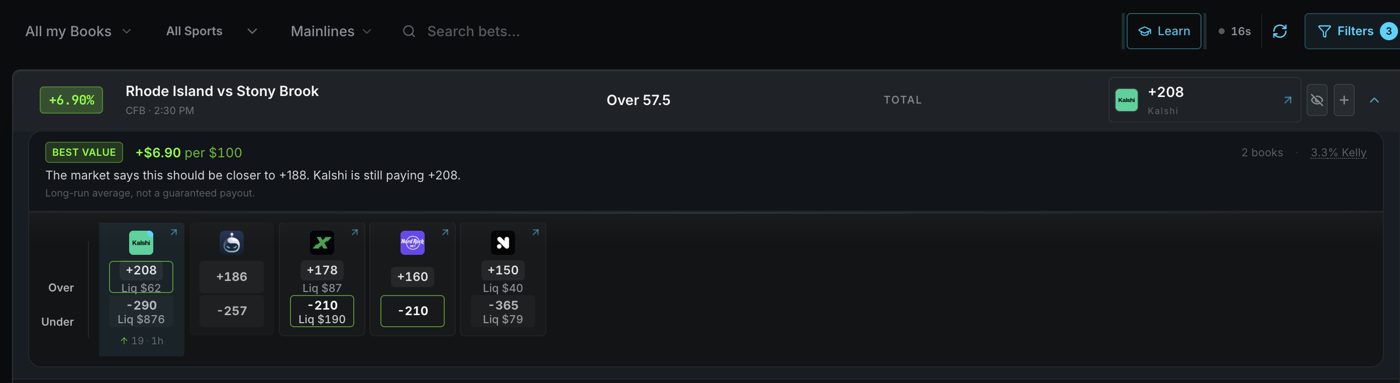
Rhode Island against Stony Brook, over 57.5. Kalshi was paying +208 with 62 dollars of liquidity while the rest of the market sat between +150 and +186, and the fair price read +188. Sixty-two dollars sounds like a reason to skip it. It is actually the explanation for why the price was still there: nobody had traded it, so nobody had corrected it.
That is the pattern on almost every top row of the sniper for college football. Heavily juiced numbers like -430 or +280 tell you the line is an alternate, main lines are rarely priced that far from even, and alternates on small schools are the least-watched prices on the board. Keep the outcome and the price together when you compare them, because an alt line at +208 and a main line at +208 are not the same bet.
Step three: follow the whale action
A prediction market is an open order book. Anyone can see the resting orders, which means sharp money leaves a footprint that a sportsbook never shows you. The Whale Watch tool collects those orders across Kalshi, ProphetX and Novig and shows them next to the price you can actually get.
Florida International +4.5 against Florida Atlantic is the clean example. Kalshi had it at +114. On ProphetX one whale had laid 800 dollars at +111 and another 1,436 dollars at +112. On Novig a sharp had 1,500 dollars resting at +113, and ProphetX showed another 1,442 dollars at +113. Four different sharps offering real money on the same side at prices worse than +114, and nobody taking the opposite side at minus money. If they are willing to front that much at +111 to +113, and Kalshi is handing out +114, the Kalshi side is the better version of a bet the sharp money already likes.
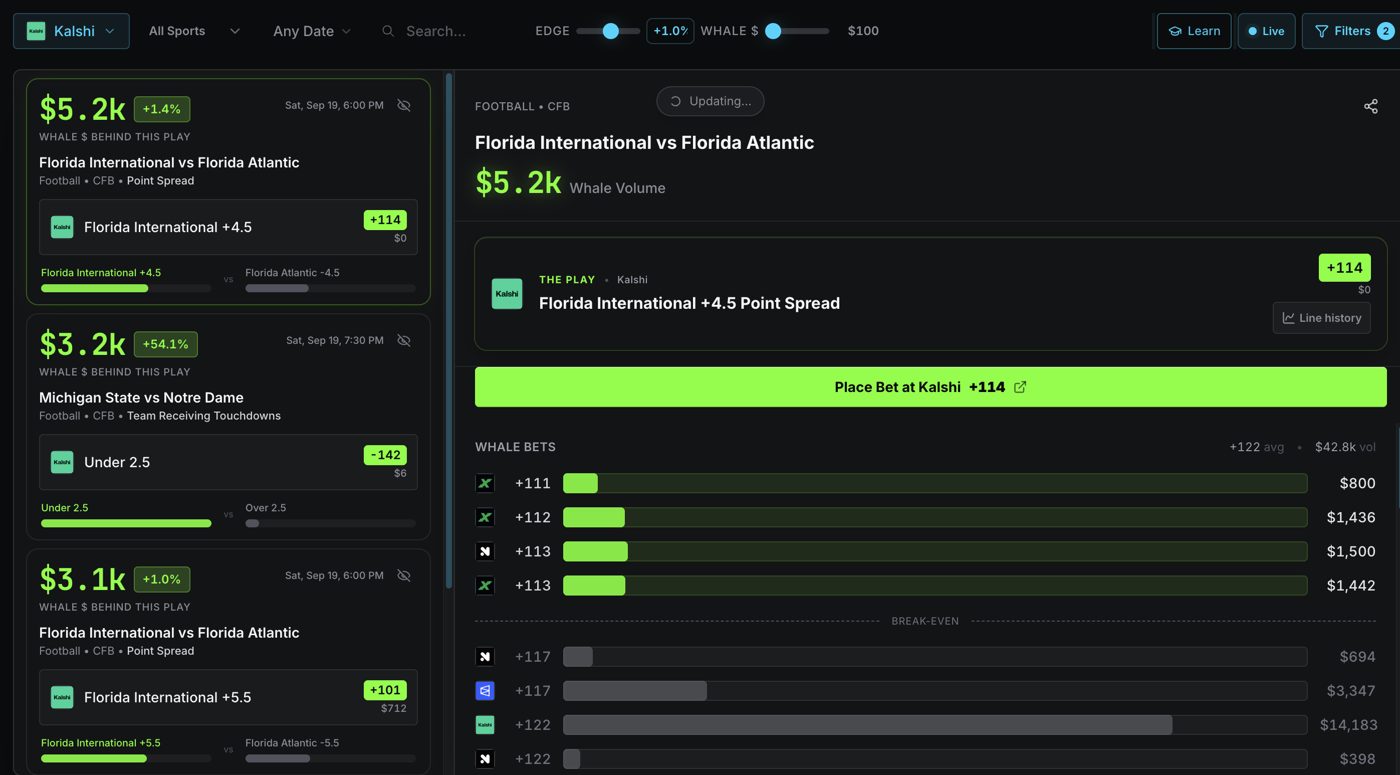
Florida International +4.5, September 19, 2026
| Kalshi price available | +114 | |
|---|---|---|
| ProphetX whale orders | 800 dollars at +111, 1,436 dollars at +112, 1,442 dollars at +113 | |
| Novig whale order | 1,500 dollars at +113 | |
| Whale volume on the play | about 5,200 dollars | |
| Break-even at +114 | 46.73% |
Weighting the sharp books
The sniper's expected value figure comes from devigging every book on the market and comparing the Kalshi price to that fair number. Which books count most is a setting. For game lines it makes sense to weight Pinnacle and Circa heavily, since both are sharp on US game lines, with a little extra on DraftKings and FanDuel for volume. There is no single correct weighting, but a fair price that leans on the sharpest books is harder to fool than a plain market average.
Once the weights are set, the tool re-scans every second, so a line that was there when you read this article may already be gone. That was true during the capture session too: one play left the board while it was being explained, because someone else took it.
The three steps together
Compare the exact same bet, at current prices, across the entire market, with every book converted to the same odds format. Open the alternate lines and repeat that comparison, keeping the outcome and the price attached to each other. Inspect the whale action, understand what those resting orders represent, and check how much you can actually buy at the price before you count on it.
By hand, across 197 games and every alternate line, that process is the reason most people quit doing it. The +EV Sniper runs steps one and two continuously and the Whale Watch runs step three, and both are included in the five-day free trial. None of this makes any single bet a winner. Done over hundreds of bets at prices the market says are wrong, it is how a bettor ends up ahead.
Frequently asked questions
Can you bet college football on Kalshi?
Yes. Kalshi lists college football spreads, totals and moneylines as event contracts priced in cents. A contract at 55.7 cents pays one dollar if the outcome happens, which is the same as a -126 American price.
How do you convert a Kalshi price to American odds?
Treat the cents as a probability. For a price above 50 cents, odds equal negative 100 times the probability divided by one minus the probability, so 55.75 cents is -126. For a price below 50 cents, odds equal positive 100 times one minus the probability divided by the probability. The free implied odds calculator at upside.tools does this for any price.
What is a crossed market?
A crossed market is when the implied probabilities of the two opposing sides, taken from different books, add up to less than 100 percent. Tarleton State -29.5 at -126 on Kalshi (55.75 percent) and Merrimack +29.5 at +130 on Hard Rock (43.48 percent) total 99.23 percent. It is the clearest sign that one of the two prices is stale.
Why is college football better than the NFL for finding mispriced bets?
Surface area. On the capture day there were 197 college games with lines against 16 NFL games, and every book has to price all of them. Small schools and alternate lines get the least attention, and sportsbooks limit winning college football bettors quickly, which pushes the sharp money onto exchanges where it is visible.
Is a positive expected value bet guaranteed to win?
No. The +6.60 dollars per 100 figure on the Tarleton State line is a long-run average across many bets at that kind of price. Any single bet can lose. The edge shows up over hundreds of bets, which is why the method matters more than any one play.
What does whale volume on a prediction market tell you?
It shows resting orders from large bettors, including the price they are willing to accept. When several sharps offer money on one side at +111 to +113 and nobody takes the other side, a book still paying +114 on that side is offering a better price than the sharp money asked for.