Original research · August 5, 2026
The Cash Out Button Is a Hedge You Never Got to Price
By Matt Downs
You have a ticket alive with one leg left. $50 on a +900 parlay, $500 coming back if it lands. The other side of that final leg is sitting at -140, and the app is offering to cash you out.
Both of those are the same decision wearing different clothes. One of them shows you the price.
The hedge, done by hand
Put $291.67 on the other side at -140 and you lock $158.33 whichever way the leg goes. That is the equal-profit hedge, and the hedge calculator returns it in about ten seconds.
Nothing mysterious is happening. You are buying the outcome you do not already own, in the amount that flattens the two possible results into one.
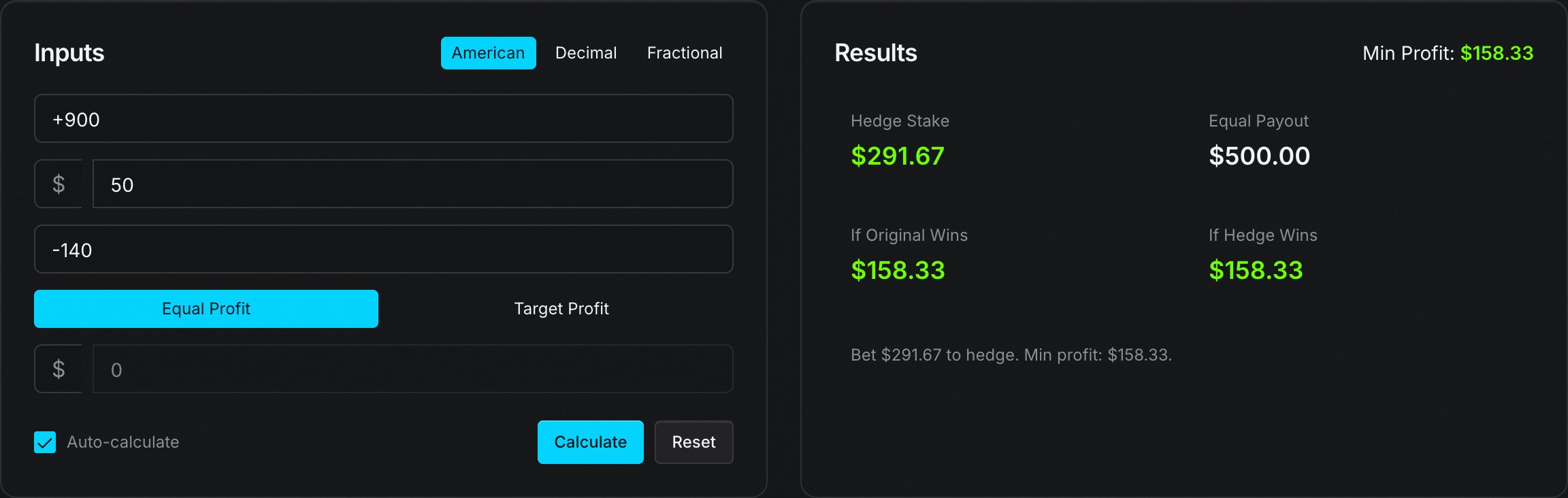
Cash out is that hedge, placed for you, at a price you cannot see
When a book offers to cash you out, it is running exactly this calculation internally and handing you a single number. The difference is that you did the hedge at a price you could inspect and compare, and the cash out arrives with the price already folded in.
That is the whole objection to the button. Not that it is a scam, but that it removes the one thing you need in order to judge it.
The check almost nobody runs on the hedge itself
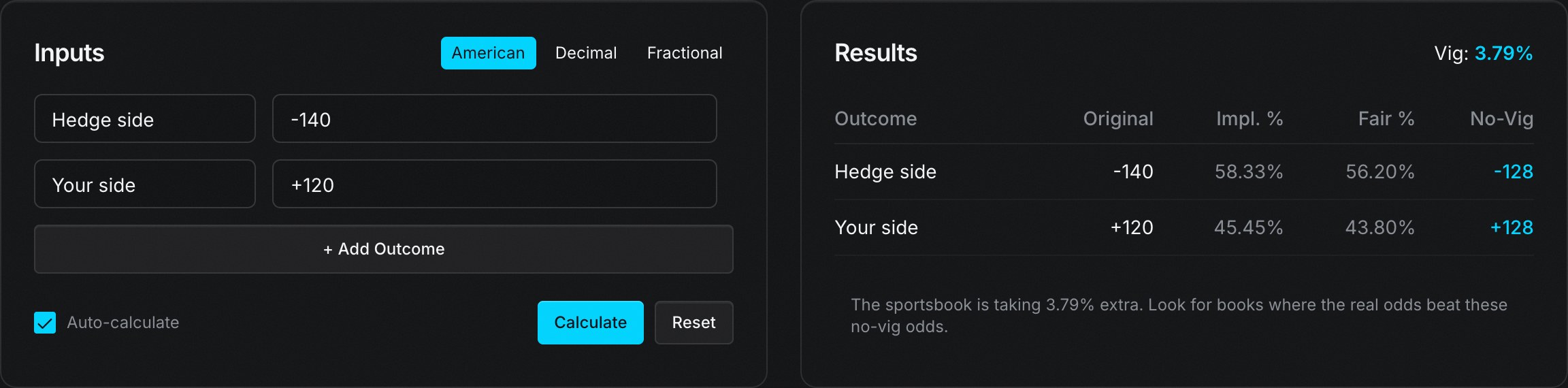
-140 implies 58.33 percent. The other side at +120 implies 45.45 percent. Add them together and you get 103.79 percent.
A real probability distribution adds to 100. The extra 3.79 is the book's cut on that market. Strip it out and the fair price on the side you would be hedging is about -128, not -140. Run any two-sided market through the free no-vig calculator and you get this in one step.
So what does hedging actually cost?
About two points of probability, in this example. You are paying -140 for something worth -128. That is the toll for converting an uncertain $500 into a certain $158.33.
Whether that toll is worth paying is a bankroll question and not a feelings question. If losing the ticket outright would genuinely hurt, paying two points to remove the variance can be entirely rational. If the stake is small relative to your roll, you are paying a premium to avoid a swing you can comfortably absorb.
Some context on the ticket itself
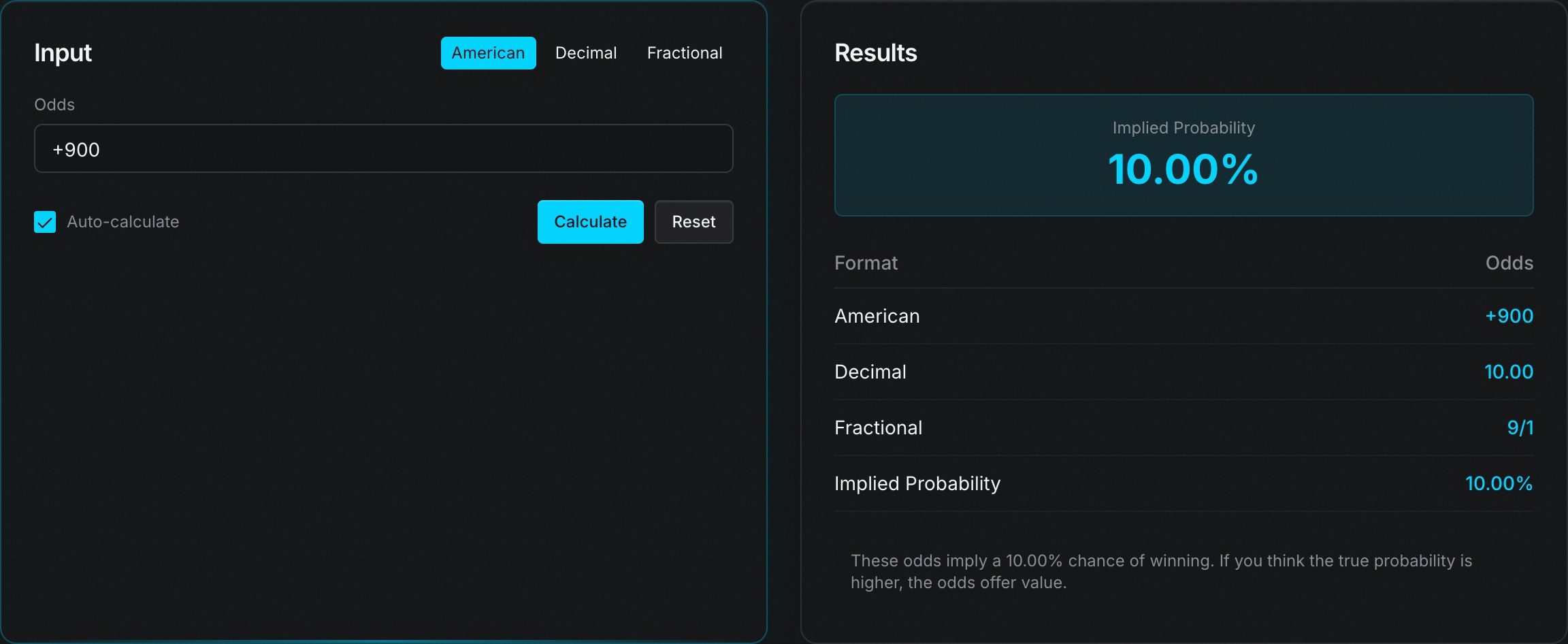
+900 is a 10.00 percent implied shot, so the break even percentage on that parlay was 10 percent when you placed it. Four legs at -110 price out at +1228 and a 7.53 percent chance of all four landing, which is worth knowing before you build one rather than after.
The same arithmetic run deliberately across two books, +120 at one and -105 at another on a $500 split, returns $517.20 either way. That is $17.20 locked at a 3.44 percent return, and it is the same mechanic as hedging, just set up on purpose instead of in a panic at 9pm.
Frequently asked questions
Should I ever cash out a bet?
Sometimes, but the decision should be made on the price rather than on nerves. Cashing out is a hedge the book places on your behalf at a number it does not show you. Calculate the equal-profit hedge yourself first, compare it to what the cash out offers, and decide whether the difference is worth paying.
How is a cash out amount calculated?
The book works out the stake required on the opposite side to flatten your two possible outcomes into one, then applies its own margin and quotes you a single figure. It is the same arithmetic as a manual hedge, with the price folded in rather than displayed.
How do I calculate a hedge myself?
Take the payout your live ticket returns if it wins, and the current price on the opposite side, and solve for the stake that makes both outcomes pay the same. On a $50 ticket at +900 returning $500, with the other side at -140, that stake is $291.67 and it locks $158.33 either way.
What does it cost to hedge a bet?
The cost is the sportsbook's margin on the side you buy. In this example -140 and +120 imply probabilities summing to 103.79 percent, so the cut is 3.79 percent and the fair price on the hedge side is about -128 rather than -140. Hedging there costs roughly two points of probability.