Original research · August 8, 2026
Kalshi Was Paying -142 While Five Sportsbooks Said -292
By Matt Downs
On the evening of August 7 I bet on a tennis match between two players I had never heard of, and I still could not tell you anything about either of them. The reason the bet was worth making had nothing to do with tennis.
One venue was pricing the favorite at -142 while everybody else had him between -340 and -425. This is what that gap looks like when you take it apart, including the two parts most people leave out: what the price had moved to by the time the order filled, and what the fees took.
Five books said one thing and Kalshi said another
The match was Alejo Sanchez Quilez against Aryan Shah, a 7:00 PM start. Five sportsbooks had Sanchez Quilez as a heavy favorite, somewhere between -340 and -425. Kalshi still had him at -142.
Nothing about the tennis is different across those six screens. Same match, same player, same outcome. The only thing that changed is what each venue was charging for it, and one of them had not moved.
The same player, priced six ways
| Kalshi | -142 | 58.68% break-even |
|---|---|---|
| Book 2 | -340 | 77.27% break-even |
| Book 3 | -351 | 77.83% break-even |
| Book 4 | -351 | 77.83% break-even |
| Hard Rock | -425 | 80.95% break-even |
| Market consensus | -292 | 74.49% break-even |
Convert the prices to percent odds and the gap stops being abstract
American odds hide the number you actually care about, which is how often you have to be right for the bet to break even. Run them through the free implied odds calculator and it takes a few seconds.
-142 means you break even by winning 58.68 percent of the time. The market consensus of about -292 means 74.49 percent. That is roughly 16 points of disagreement about how likely one player was to win one tennis match.
Five venues clustering between 77 and 81 percent, against one sitting at 59 percent, is not a difference of opinion about tennis. It is one order book that had not caught up.
What a 16-point gap is actually worth
If the fair probability is 74.49 percent and you are being paid as though it were 58.68 percent, every $100 through that price returns about $26.95 in expectation. You can reproduce that in the free EV calculator by entering the price you are offered and the probability you believe.
That is a long-run average across many bets at that kind of edge, and it is never a prediction about any single one. A +26.90 percent bet loses all the time. It is still the bet you want.
The price moved and the fees are real
Two things happen between seeing a price and owning it, and neither of them shows up in a screenshot of the odds.
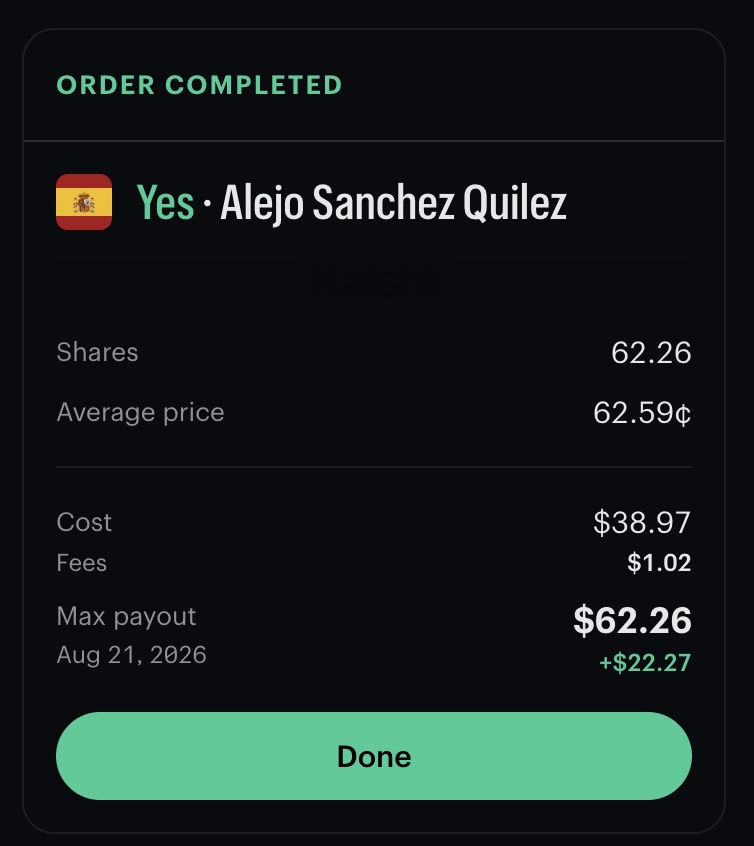
First the price moved. The order filled at an average of 62.59 cents a share, which is about -167, rather than the -142 that was on screen. Second, Kalshi charged $1.02 in fees on a $38.97 position, which is 2.62 percent of the cost.
Put both in and the honest number is this. The total outlay was $39.99 to receive $62.26 if it settled yes, so the real break-even was 39.99 divided by 62.26, or 64.23 percent. Against a fair value of 74.49 percent, roughly 10 points of edge survived the move and the fee, which is about 16 percent return on the money actually at risk.
That is a smaller number than the headline. It is also the only number that was ever true.
It won, and that is not why it was a good bet
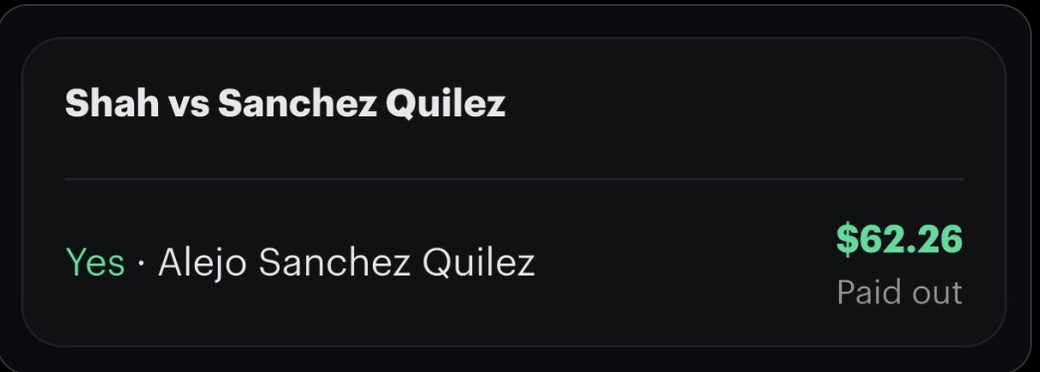
The position settled and paid out $62.26 for a profit of $22.27.
The result is the least informative part of this. The bet was good at the moment the order filled, because of the gap between 64.23 and 74.49, and it would have been exactly as good if he had lost in straight sets. Judging a bet by whether it won is how people talk themselves into bad prices that happened to come in.
Liquidity is what stops this being free money
The Kalshi tile showed Liq $51, meaning roughly fifty dollars was available at that price. That is why the position is $38.97 and not $500.
This is the part that gets left out of most posts about mispriced markets. Gaps this wide exist precisely because they are small and short-lived. A price that is 16 points off with $50 behind it is common. A price that is 16 points off with $5,000 behind it mostly does not exist, and if it does, it usually means you are the one who is wrong.
The practical version is to treat these as a volume game. Small edges, taken often, on prices you can verify in twenty seconds.
Frequently asked questions
Are Kalshi odds better than sportsbook odds?
Sometimes, and not reliably. Kalshi is an order book rather than a book setting a line, so its price reflects whoever is currently willing to trade. That means it can lag a market that has moved, which is what happened here, and it can also be worse than the books when nobody is quoting. The only way to know is to compare the specific price you are offered against several other venues at that moment.
How much does Kalshi charge in fees?
Kalshi charges a trading fee per contract that is largest for contracts priced near 50 cents and shrinks toward the extremes. On the position described here it came to $1.02 on a $38.97 order, about 2.62 percent of cost. Always read the fee line on the order ticket rather than estimating, because it changes your break-even and the exchange calculates it per fill.
What does break-even percentage mean?
It is how often a bet has to win for you to finish level. A price of -142 has a break-even of 58.68 percent, so winning less often than that loses money over time no matter how good any single result looks. Comparing the break-even of the price you are offered against your honest estimate of the true probability is the whole of finding value.
Does a winning bet mean it was a good bet?
No. A bet is good or bad at the moment you place it, based on the price you paid against the probability of the outcome. Results are one sample from a distribution. The bet described here was good because 64.23 percent was cheaper than 74.49 percent, and that would have been true whether it settled yes or no.