Original research · August 7, 2026
The Same NFL Preseason Total Was Priced +127 and -110 on the Same Night
By Matt Downs
Preseason football is back on the board, and the first NFL bet I placed this season is a clean example of the only edge that survives contact with a sportsbook. It has nothing to do with the teams.
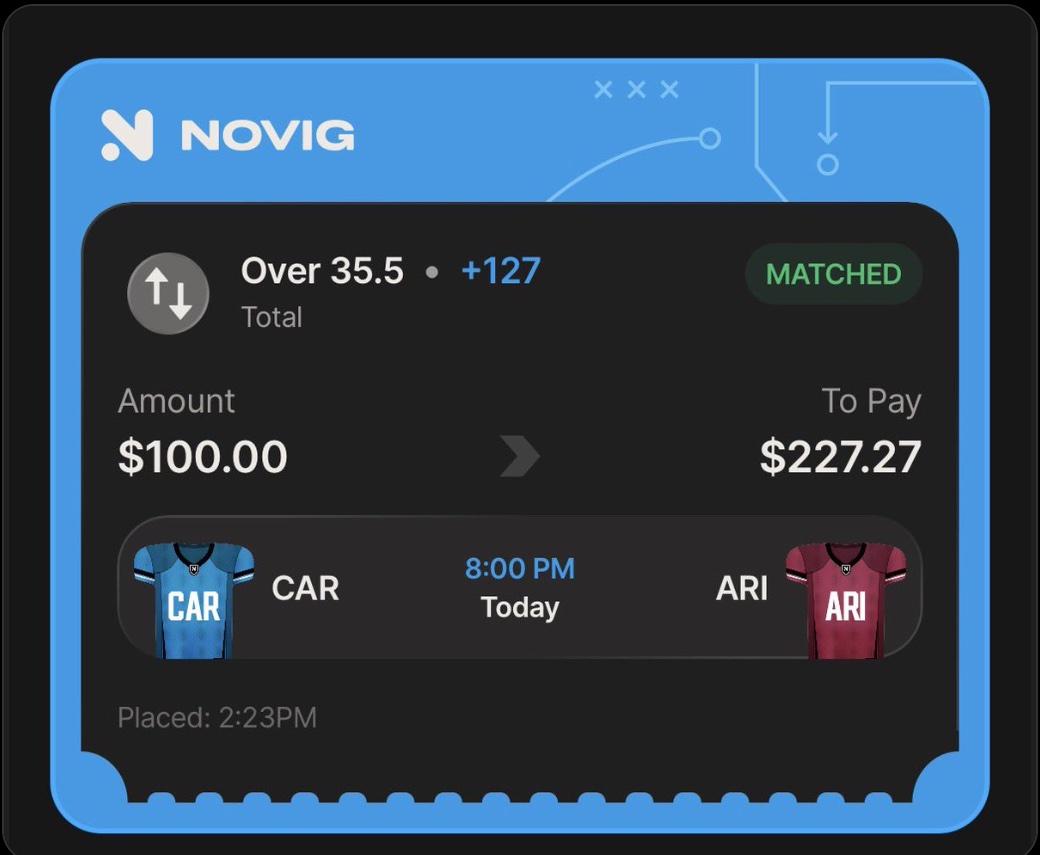
I took Over 35.5 in the Carolina and Arizona game at +127. Then I went and looked at what everyone else was charging for the identical bet.
Five venues, five prices, one outcome
Kalshi had it at +119. ProphetX at +120. Polymarket at +122. I got +127. And DraftKings was posting the same side at -110.
Nothing about the football is different across those five screens. Same game, same total, same side. The only thing that changed is what each venue wanted to charge for it.
The same Over 35.5, priced five ways
| Novig | +127 | 44.05% break-even |
|---|---|---|
| Polymarket | +122 | 45.05% break-even |
| ProphetX | +120 | 45.45% break-even |
| Kalshi | +119 | 45.66% break-even |
| DraftKings | -110 | 52.38% break-even |
Turn the prices into percent odds and the gap stops being abstract
American odds hide the thing you actually care about, which is how often you have to be right. Convert them and it gets obvious. You can run any of these through the free implied odds calculator in a few seconds.
+127 means you break even hitting 44.05 percent of the time. +120 means 45.45 percent. Those three exchange prices cluster within about a point and a half of each other, which is the market broadly agreeing on what this total is worth.
DraftKings at -110 needs 52.38 percent. That is not a rounding difference from the other four. It is more than seven points of break-even percentage on an outcome everyone else agrees is close to a coin flip.
What the gap is worth in dollars
A hundred dollars at +127 returns $227.27. A hundred dollars at -110 returns $190.91. That is $36.36 of difference on one bet, decided entirely by which screen you happened to have open.
Run it as expected value and it flips the sign of the bet. If the fair price really is +120, meaning a 45.45 percent true chance, then taking +127 is worth about +3.17 percent ROI, roughly $3.17 per $100. Taking -110 on that same 45.45 percent is worth about -13.2 percent. Same read on the game, opposite outcomes, because of the price. The EV calculator does that arithmetic for you.
Why preseason is when these gaps are widest
Books price what they know. In preseason they know the least they will know all year: rotations are unannounced, starters play a series or two, and there is no current-season form to model. So the books disagree with each other more than they will in November, and disagreement between books is exactly what a price gap is.
That is also why preseason rewards shopping over handicapping. You are not trying to out-read anybody on which backup quarterback looks sharp. You are looking for the venue that has the number wrong relative to everyone else.
The bet won, and that is not why it was a good bet
Carolina and Arizona went over with room to spare, sitting on 50 points with six and a half minutes left in the fourth. Up $127 to start the season.
That result is not the argument. The bet was correct at 2:23 in the afternoon, before a snap was played, because the price was better than the market's own consensus. Had it lost, it would still have been the right bet at that number. Grading a bet by whether it won is how people talk themselves into paying -110 for a +120 outcome for years at a time. Grade it by the price you paid against what the market says it was worth.
Frequently asked questions
Why do NFL preseason odds vary so much between sportsbooks?
Because books have the least information they will have all season. Rotations are unannounced, starters may play only a series, and there is no current-season form to model. With less to price on, books disagree with each other more, and that disagreement shows up as wider gaps between the numbers on offer for the identical bet.
What does +127 mean compared to -110?
+127 means a $100 bet returns $227.27 and you break even by winning 44.05 percent of the time. -110 means a $100 bet returns $190.91 and you break even at 52.38 percent. On the same outcome that is a gap of more than seven percentage points in the win rate you need, and $36.36 in return per $100 staked.
Is line shopping actually worth the effort on a single bet?
On one bet it is worth $36.36 in the example above. Compounded across a season it is the difference between a positive and a negative expected value strategy, because the price you pay is the only variable you fully control. Your read on the game is uncertain; the number on the screen is not.
How do I know which price is the fair one?
Compare several venues and strip out the margin. When three or four independent markets cluster within about a point of each other, that consensus is a reasonable estimate of fair value. A price meaningfully better than that cluster is where the expected value is, and a price meaningfully worse is what you should decline.