Original research · August 10, 2026
Same Bet, Different Odds: Why Sportsbooks Disagree
By Matt Downs
Two people can back the same team, in the same game, on the same afternoon, and get paid completely different amounts. Nothing about the bet changed. Only the logo at the top of the screen did.
This is the single cheapest edge available to a recreational bettor, and it requires no opinion about the sport at all. Here is a live example, priced out to the dollar.
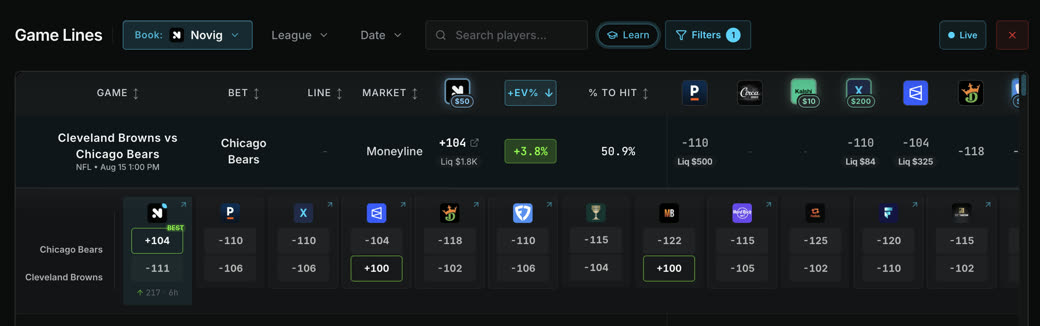
One game, twelve prices
This is a Chicago Bears moneyline for a preseason game that has not been played. One exchange has the Bears at +104. Open the row and eleven other books have that identical side priced at -110, -115, -118, -122 and -125.
The difference in plain terms: at +104 you win $104 for every $100 you put up. At -125 you have to risk $125 to win that same $100. Same team, same game, same result. The bet either lands or it does not, and it lands or fails identically at every one of those twelve books.
What that spread is actually worth
Odds are a break-even percentage wearing a disguise. +104 needs the bet to land 49.02% of the time to break even. -110 needs 52.38%. -125 needs 55.56%. That is a swing of six and a half percentage points in what the same wager has to achieve, purely on where it was placed.
Put a probability against it and the spread turns into money. The board reads this game at 50.9% to hit. At +104 that is worth about +3.8% of your stake. At -125 the same side is worth about -8.4%. Twelve points separate the best available price from the worst, and nobody handicapped their way to a single one of them.
The same bet at four different prices
| +104 (best price) | break-even 49.02% · EV +3.8% | |
|---|---|---|
| -110 (typical) | break-even 52.38% · EV -2.8% | |
| -118 | break-even 54.13% · EV -6.0% | |
| -125 (worst price) | break-even 55.56% · EV -8.4% |
Why books disagree in the first place
A sportsbook price is that book's opinion plus the margin it wants to charge, adjusted for the money it has already taken. Those three inputs differ everywhere. A book holding heavy action on one side shades its number to attract the other. An exchange with no house position quotes closer to what its users will actually trade at.
Disagreement is widest when information is thinnest. Preseason football is the clearest case of the year: lineups are unannounced, playing time is guesswork, and the books have less to go on than at any other point on the calendar. Less information produces more disagreement, and disagreement is where the gaps live.
How to read a row before you bet
Strip the margin out first. Take the two sides of a market, convert both to percentages, and notice they add up to more than 100. That excess is the vig, and the amount over 100 is what the book is charging you. The free no-vig calculator does that conversion in a few seconds.
Then compare the number in front of you to what the rest of the field says. If several books cluster around one price and a single venue is well off it, that outlier is either an error in your favour or information you do not have yet. Checking the expected value of the price you are being offered is what separates the two.
What this does and does not do
A twelve point gap on one preseason moneyline is about as wide as these get. Most rows are worth two or three percent, and two or three percent only turns into money across hundreds of bets. Anyone presenting line shopping as a way to win this weekend is selling something.
What it does do is remove a cost you were paying without noticing. If you habitually take -115 on bets available at -105 elsewhere, you are handing over several points of margin on every wager you make, regardless of how good your picks are. Fixing that is arithmetic, and the arithmetic works whether or not your read on the game is any good.
Frequently asked questions
Why do sportsbooks have different odds on the same game?
Each book sets a price from its own opinion of the outcome, the margin it wants to charge, and the money it has already taken on each side. A book carrying heavy action on one team will shade its number to attract bets on the other. Exchanges, which hold no position of their own, tend to quote closer to what users will actually trade at. Those inputs differ everywhere, so the prices do too.
How much money does line shopping actually save?
It depends on the spread available. In the example above, the same moneyline ranged from +104 to -125, a difference of about twelve percentage points of expected value. More typically the gap between the best and worst widely available price is two to four points. That compounds across every bet you place rather than showing up in any single one.
Is the best price always the right bet?
No. The best available price tells you where to place a bet you already want, not whether to want it. If one venue is far off a price that every other book agrees on, that is sometimes an error in your favour and sometimes a sign of information that has not reached the rest of the market, such as a late scratch. Comparing the outlier to the consensus is how you tell the difference.
What does a break-even percentage mean in odds?
It is the win rate a bet needs just to avoid losing money at that price. -110 requires 52.38%, -125 requires 55.56%, and +104 requires 49.02%. Converting odds to a break-even percentage is the fastest way to see what a price is really asking of you, because the percentages are directly comparable across books in a way the odds themselves are not.
Why are preseason odds more spread out than regular season odds?
Books have the least information about preseason games all year. Lineups are unannounced and playing time is unpredictable, so each book is working from thinner data and their estimates drift further apart. Wider disagreement between books means wider gaps between the best and worst available price.