Original research · September 28, 2026
Sports Betting for Beginners: The 3 Steps That Decide Whether You Profit
By Matt Downs
Somewhere between 95% and 99% of sports bettors lose money over their lifetime. Knowing a sport better does not change that, because the thing that decides profit is not who you pick. It is the price you pay, how much you put on it, and whether you took the free money on the table first.
This guide is the three step process from Matt Downs' video "Give me 15 minutes, I will make you a profitable sports bettor". Every number below is from that video, including a real college football bet that lost and was still the right bet to make.
Step 1: Take every welcome bonus your state allows
The most underrated starting strategy needs no skill at all. Every sportsbook, DFS app and prediction market legal in your state runs a new-customer offer, and for a bettor with a small bankroll those offers are the most profitable thing available.
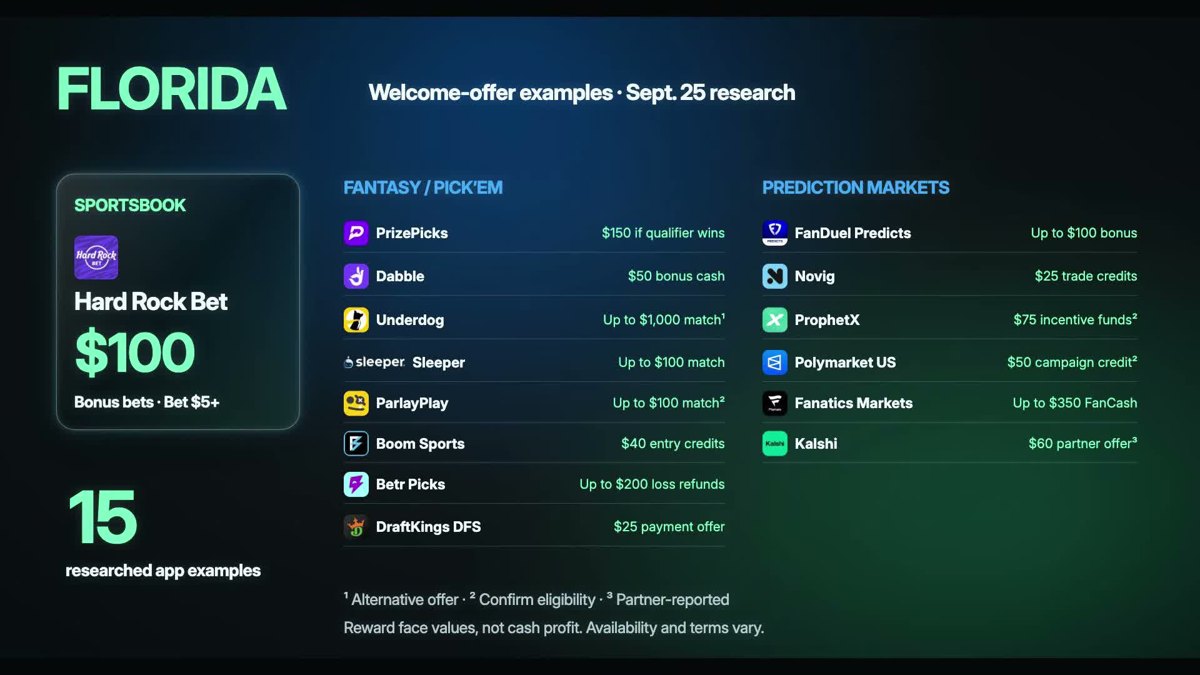
Florida is one of the thinnest states for this, with a single legal sportsbook, and a September 2026 check still found 15 apps with a welcome offer. Sleeper matched deposits up to $100. Novig paid $25 in trade credits on a $10 deposit. Kalshi paid $60 on $25 of trades. States with full sportsbook markets, like New Jersey and Virginia, carry far more. Offers change often and each has its own terms, so check the current version before depositing.
Step 2: Check whether you are getting a good price
Pricing is everything. It does not matter whether you like overs on star players or unders on bad teams. If the payout does not match the chance of the outcome, the bet is not worth the price.
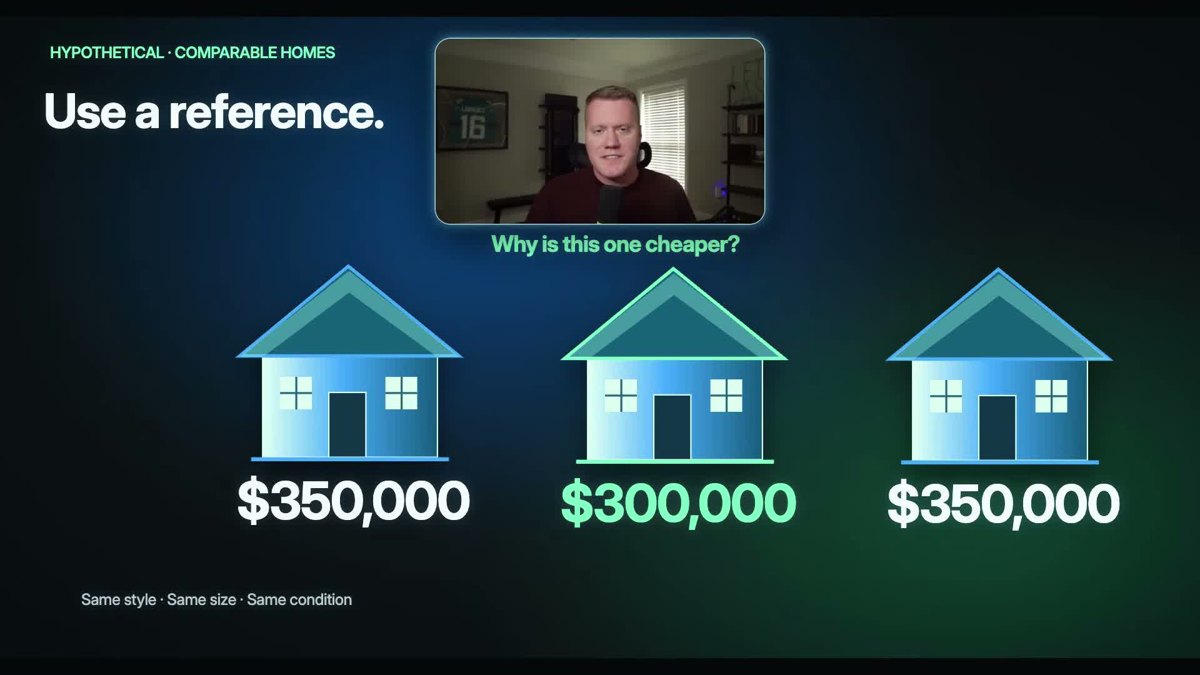
Think about buying a house. Every comparable home nearby sells for about $350,000, same style, size and condition, and one is listed at $300,000. You have a reference point, so you have a reason to believe it is mispriced. You did not decide it was a good price because you liked the kitchen. Liking a player and getting a good price on that player's over are two separate questions in the same way.
If a hurricane took that house two years later, buying it would still have been a good decision. Nobody can predict the future. A $50,000 discount against the market is worth taking every time, and a bet priced better than the rest of the market is the same thing. The comparison only works on identical bets: same player, same line, same game, same market. An over 20.5 and an over 22.5 are different bets.
How to read American odds and prediction market prices
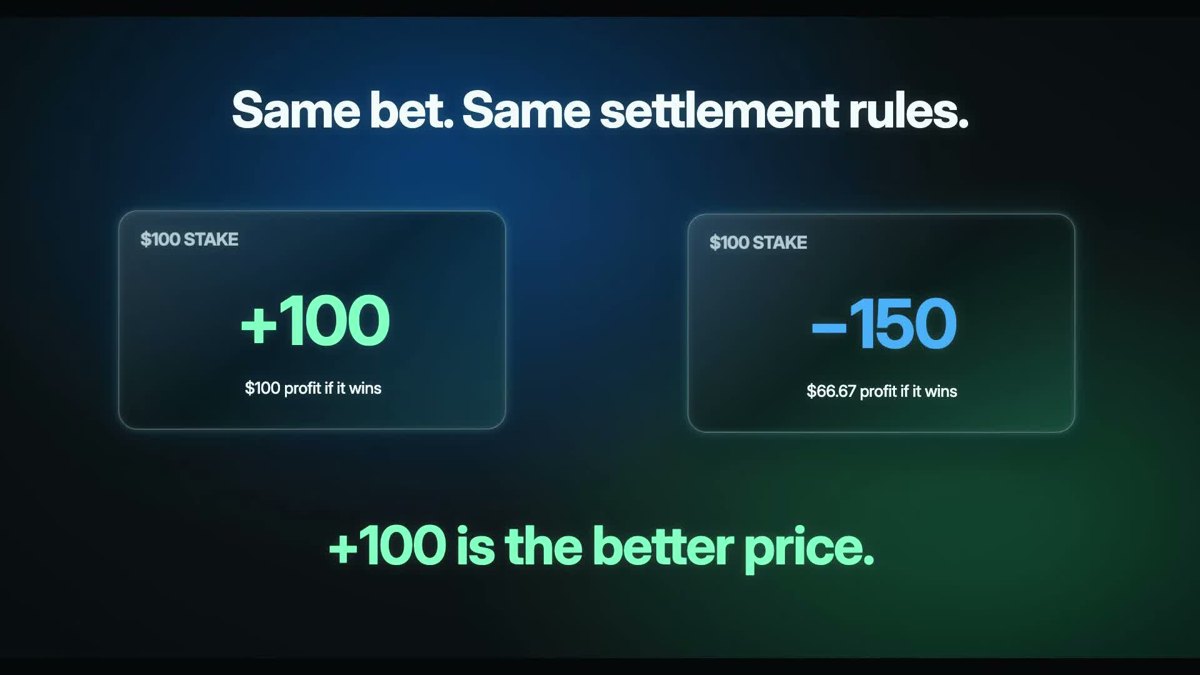
Sportsbooks like FanDuel and DraftKings quote American odds. At +100, a $100 bet wins $100 and returns $200 in total. At -150, you risk $150 to win $100, so a $100 bet wins only $66.67. For the same outcome under the same settlement rules, +100 is the better price.
Prediction markets price in cents per contract, and a winning contract pays $1. Buying at 50 cents risks 50 to win 50, the same as +100. Buying at 60 cents risks 60 to win 40, the same as -150, and that 60 cents is also your break-even percentage: the outcome has to happen more than 60% of the time. The implied odds calculator converts any price to that percentage.
How to remove the vig and find the fair price
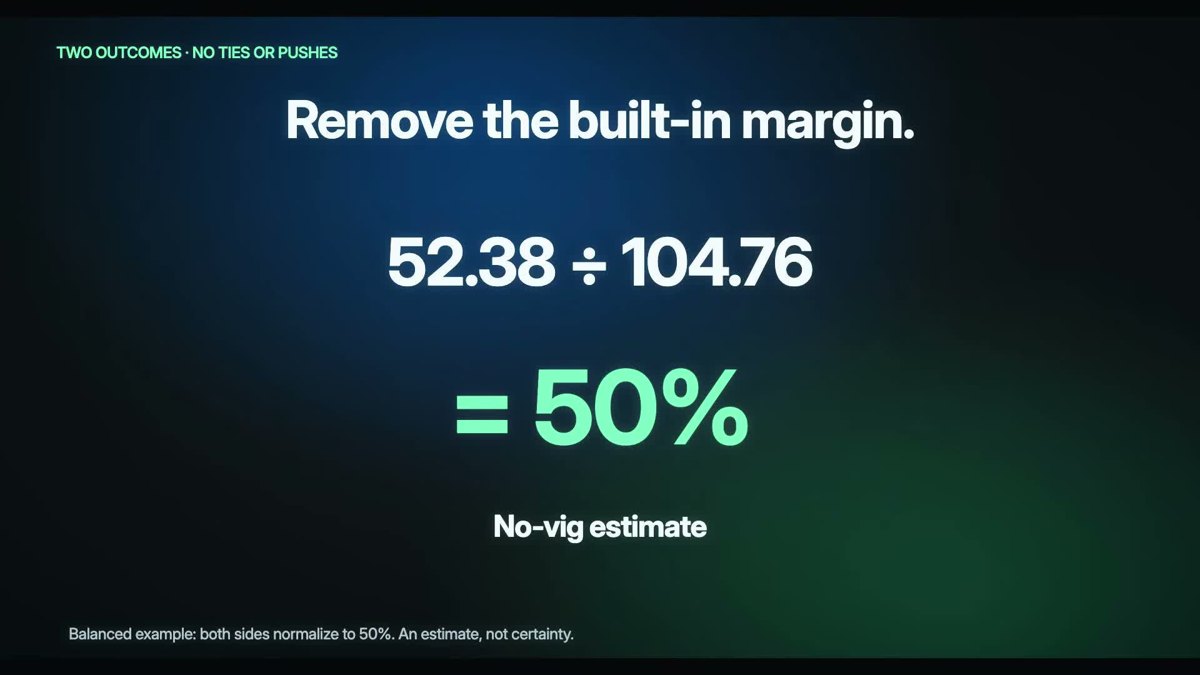
Every price includes a margin, the vig. In a two-way market with both sides at -110, each side needs 52.38% to break even. Added together that is 104.76%, which cannot be a real probability. Divide each side by the total and you get 50% each. That is the no vig estimate, and the no-vig calculator does the division for any pair of prices.
One book is weak evidence. Several credible markets agreeing on the same number is a much better reference, and a book still hanging an old number after the rest have moved is what a stale line looks like.
A worked positive EV example
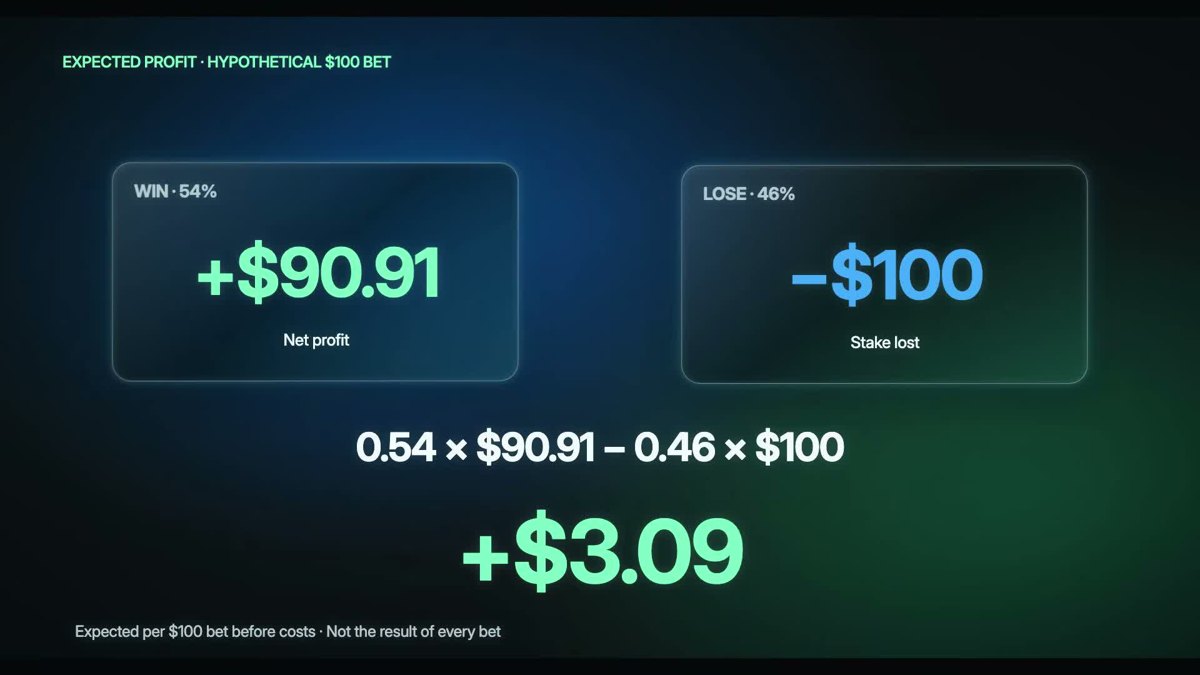
Say the no vig estimate across the market gives a team a 54% chance, and one book still has them at -110, which needs 52.38%. On $100 you win $90.91 or lose $100. Weighted by 54% and 46%, the expected profit is +$3.09 per $100. That is what positive expected value means: the price is favourable if the estimate is accurate. The EV calculator runs the same weighting.
The real bet: Oregon at USC, under 58.5
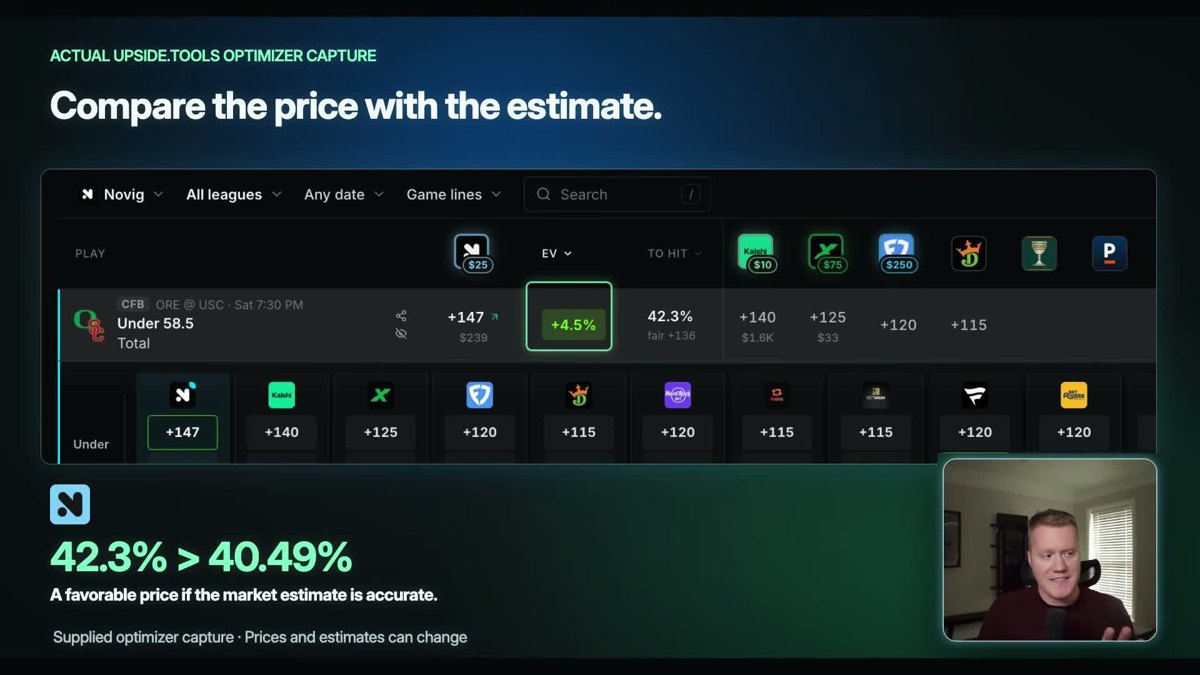
On the Upside optimizer, the under 58.5 in Oregon at USC was +147 on Novig, which implies 40.49%. The same under was +140 on Kalshi, +125 on ProphetX, +120 on FanDuel and +115 on DraftKings. With the vig removed across the market, the under was 42.3% to hit. Getting paid as if it were 40.49% when the market says 42.3% is positive EV.
It lost. Oregon won 41 to 27, 68 points. That does not make it a bad bet. Even if 42.3% is exactly right, the under loses 57.7% of the time. A good price can lose and an overpriced bet can win, and one result proves neither. For how a losing record can still be profitable at scale, see how a bettor with a 24 percent win rate made money this year.
Oregon at USC, under 58.5
| Novig price | +147 | |
|---|---|---|
| Novig break-even | 40.49% | |
| Market no vig estimate | 42.3% | |
| Other books | +115 to +140 | |
| Result | Lost (68 total points) |
Step 3: Size every bet at about 1% of your bankroll
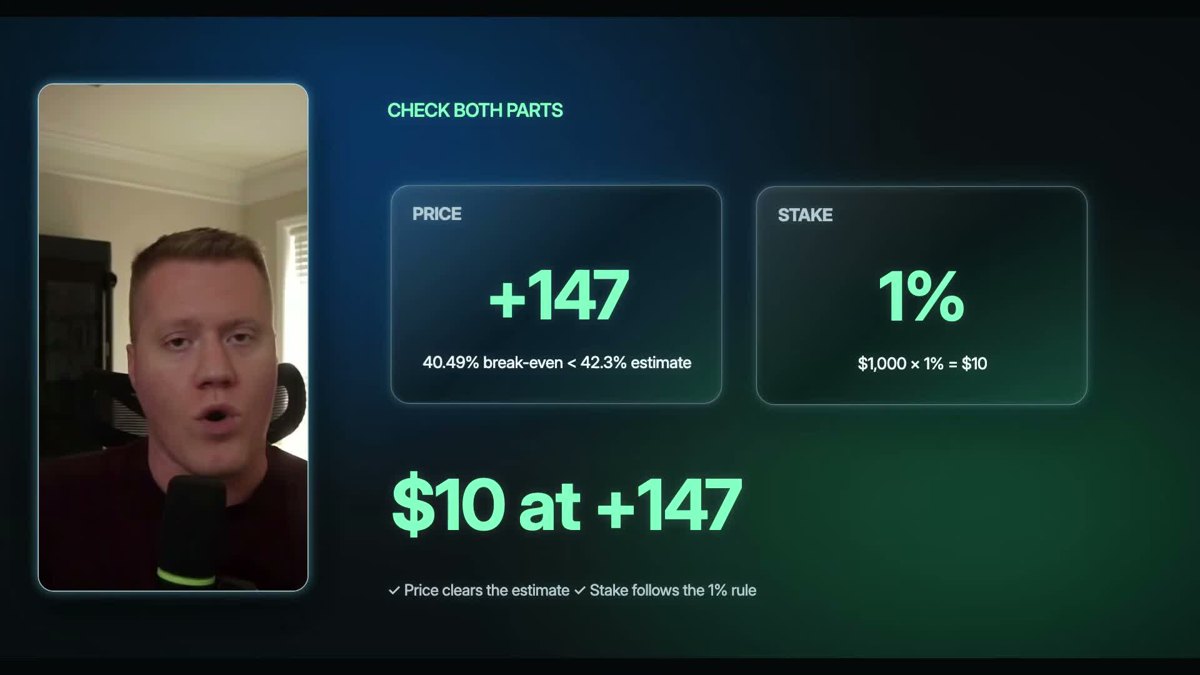
Because a good process still loses often, how much you stake matters as much as what you bet. Keep betting money separate from money for bills, and never bet more than you can afford. Then risk roughly 1% per bet: $10 on a $1,000 bankroll, $5 on $500. Do not jump from $10 to $100 because you lost the last one or because a bet feels strong. Recalculate from your current bankroll, and size down when several bets depend on the same game, because they are not independent. The Kelly calculator is the step up once you trust your estimates.
The test that ends the video: same Oregon under, $1,000 bankroll, +147 at one place and +120 at another. $100 at +147, or $10 at +120? Neither. +120 does not clear 42.3%, so a smaller stake does not fix it. +147 clears it, but $100 is 10% of the bankroll. The answer is $10 at +147. If +147 is gone by the time you get there, you pass, move on, and record the price you actually got.
Frequently asked questions
What is the best sports betting strategy for beginners?
Take every welcome bonus legal in your state, only bet prices that beat the no vig estimate from the wider market, and risk about 1% of your bankroll per bet. The price and the stake decide profit more than the pick does.
What does -110 mean in sports betting?
You risk $110 to win $100. It needs a 52.38% win rate to break even. With both sides at -110 the market adds to 104.76%, and removing that margin gives a fair price of 50% each.
How do prediction market prices compare to sportsbook odds?
A prediction market contract pays $1 if it wins, so its price in cents is the break-even percentage. 50 cents equals +100 and 60 cents equals -150.
Can a positive EV bet lose?
Yes, often. The Oregon at USC under at +147 was priced at 40.49% against a 42.3% market estimate and still lost. A 42.3% outcome fails 57.7% of the time. Profit comes from taking good prices repeatedly.
How much should a beginner bet per game?
About 1% of the current bankroll per bet, so $10 on a $1,000 bankroll. Size down when several bets depend on the same game, and never raise stakes to chase a loss.