Original research · August 13, 2026
One Book's Price Is Not the Fair Price
By Matt Downs
I write these off my own screens, and on one of them I nearly published a number that was five times too big.
The row looked spectacular. A DFS app had a prop at -119. ProphetX had the same side at -260. Run those two prices into percentages and you get 54.34% against 72.22%, so the gap reads as almost 18 points of break even. That is an enormous claim, and every number in it is true.
It is also wrong, and the reason it is wrong is the single most useful thing I know about reading odds.
The 18 point edge that was actually 3
Here is the arithmetic that made it look so good. A price of -119 means you risk $119 to win $100, so it demands 54.34% to break even. A price of -260 demands 72.22%. Subtract one from the other and you get 17.88 points, which would be the largest edge I have ever seen on a prop.
The problem is that -260 was one book. When I priced that same row against every book posting it, the fair number came back at -135, which is 57.45%.
So the honest gap is 57.45% against the 54.34% the DFS app charges. That is 3.11 points, not 17.88. Real, worth taking, and 5.8 times smaller than the number I could have put in front of you with a straight face.
Same prop, same moment, two ways of reporting it
| Quote the priciest book alone | 17.88 points of edge | ProphetX at -260 (72.22%) against the DFS app at -119 (54.34%) |
|---|---|---|
| Devig across every book posting it | 3.11 points of edge | fair price -135 (57.45%) against the same -119 |
| How much the single quote inflates it | 5.8x | both figures are arithmetically correct, only one is honest |
What devigging is, and why one price can never be fair
Every price a book posts has its cut built in. Go ahead and add up what it costs to buy both sides of any market and you will see it. Two sides at -110 each are 52.38% apiece, and 52.38 plus 52.38 is 104.76. That market is 104.76% likely to happen, which is impossible. The 4.76 is the house.
Devigging is stripping that back out. You take both sides, work out how much over 100 they add to, and scale them down until they total 100. What comes out is the price with no vig in it, and that is the only number worth comparing anything to.
This is why quoting one book is a trick even when nobody means it as one. That book's price contains its own cut and its own opinion, and an outlier is usually an outlier because it is protecting itself, not because it has found something. The market is what a lot of books agree on after you take the vig out. The no vig calculator does this in one box, and it is free.

What a real edge looks like on the screen
Once you price a row properly, the honest edges are small and they are still worth having. Will Warren over 4.5 strikeouts had 18 books on it and the DFS app was the cheapest price of the lot, at 55.1% to hit against the 54.2% a six leg card needs. That is under a point, and it is the good kind of row.
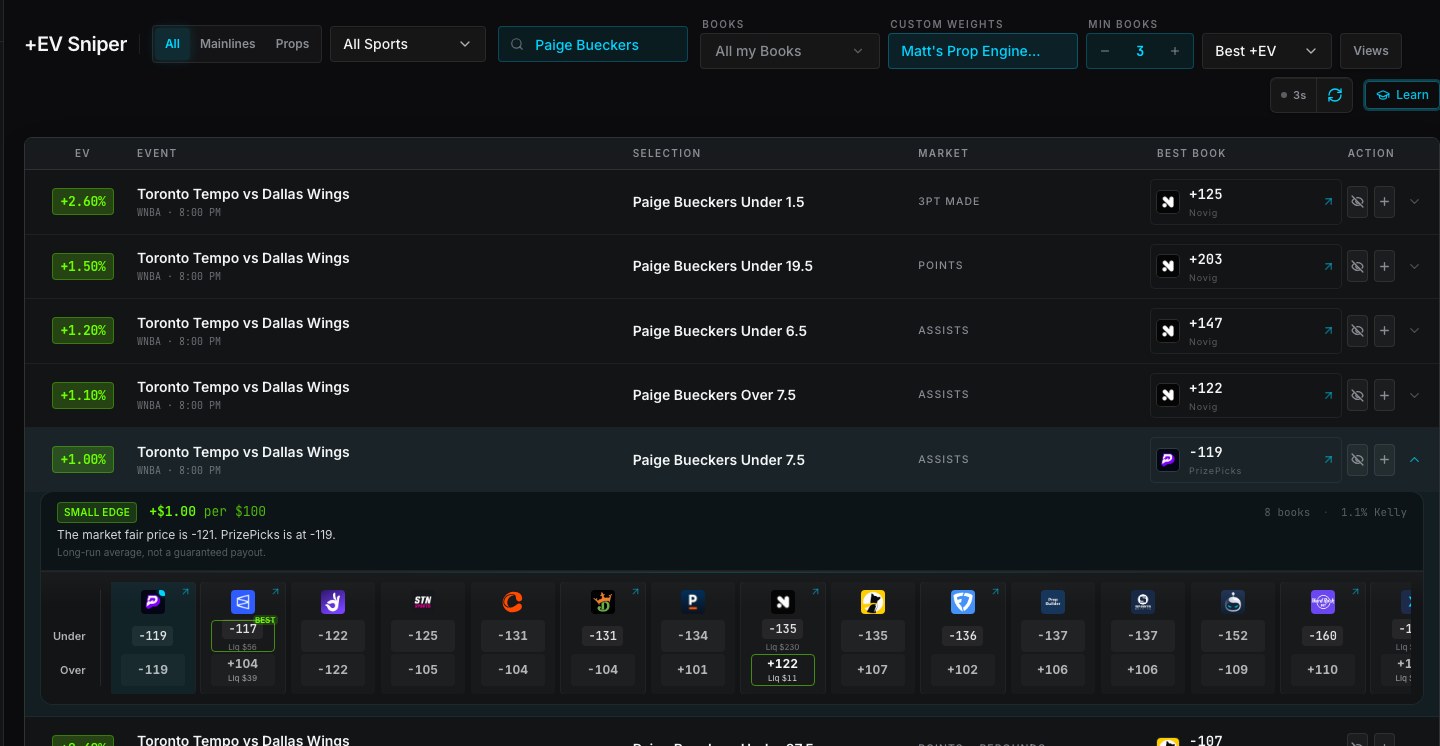
Paige Bueckers under 7.5 assists priced out at a fair -121 across eight books, against -119 on the DFS side. Our own tool labelled that one SMALL EDGE and put it at a dollar of expected profit per $100 staked. It would have been very easy to dress that up. A dollar is what it is.
Viktor Hovland over 68.5 strokes went the other way and is worth showing for it. The DFS app had the best price available at -119, 56.5% to hit, while Kalshi was at -142. About two points of edge against what a six leg flex demands, on a golfer, from a market most people never open.
A different line is not the same thing as a different price
There is a second gap people mix up with this one, and it is worth separating because the arithmetic above does not apply to it.
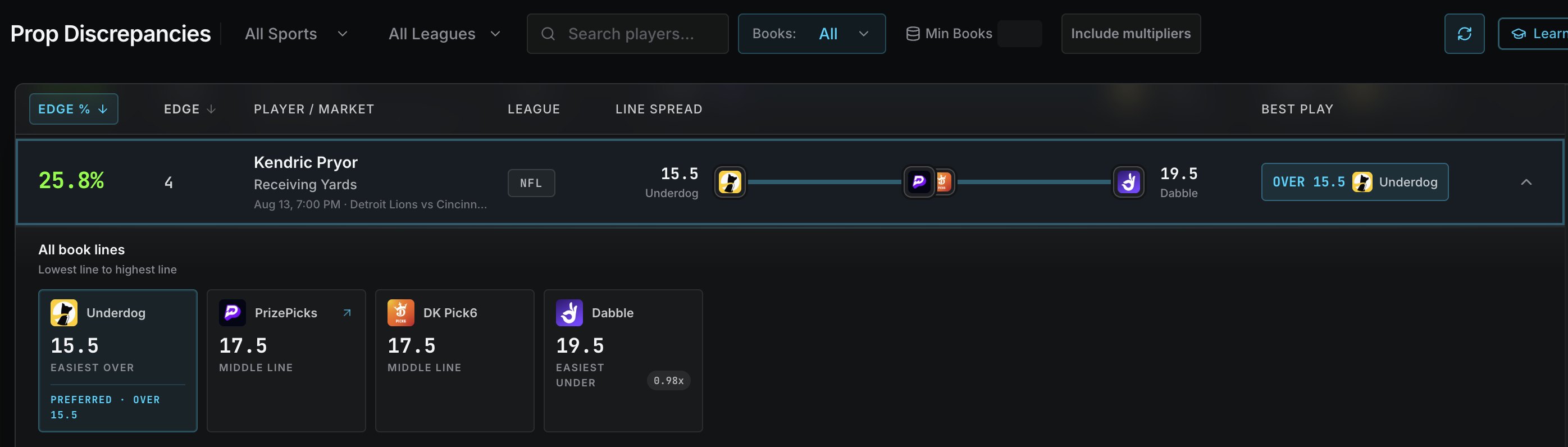
Kendric Pryor receiving yards, on a Lions at Cincinnati game that had not been played yet: Underdog had the line at 15.5, PrizePicks and Pick6 both had 17.5, and Dabble had 19.5. Those apps are not disagreeing about a price. They are disagreeing about the number itself, and four yards of line is a far bigger disagreement than a few cents of vig.
A price gap asks whether you are being charged too much for the same bet. A line gap asks whether you are being offered a different bet entirely. Both are worth finding. Only the price gap is what devigging measures.
How to run this on one prop tonight
None of this needs a subscription and I would rather you check me than take my word for it.
Take the price your app is charging and turn it into the percentage it demands. That is the implied odds calculator, and -119 comes out at 54.34%. Then open the odds screen, find every book posting that same side, and devig them with the no vig calculator to get the fair number.
If the fair number is higher than what your price demands, the row qualifies. If it is not, it is a pass, and most of them are.
The only rule that matters here is the one that cost me a headline: never quote the friendliest book on the board as though it were the market. Doing it by hand for one prop takes a few minutes, and it is the difference between a 3 point edge and a story about an 18 point one.
Frequently asked questions
What does devigging odds mean?
It means removing the sportsbook's built-in margin from a price. Both sides of a market always add up to more than 100%, and the excess is the book's cut. Devigging scales both sides back down to 100% so you are left with the price implied by the odds alone. That devigged number is the only one worth comparing another price against.
Why can't I just compare against the best odds I can find?
Because an outlier price is usually an outlier for a reason that has nothing to do with value. I nearly published a prop as an 18 point edge on the strength of a single book at -260. Devigged across every book posting the row, the fair price was -135 and the real edge was 3.11 points, which is 5.8 times smaller.
How do you calculate implied probability without the vig?
Convert both sides to implied probability first. Two sides at -110 are 52.38% each and add to 104.76%, so there is 4.76% of vig in that market. Divide each side by 1.0476 and they total 100%. Our free no vig calculator does it for you, including for markets where the two sides are priced differently.
Is a small edge on a prop actually worth taking?
Yes, and small is what real ones look like. A row we flagged at a fair -121 against -119 is a dollar of expected profit per $100 staked. It is not exciting, and it is the honest size of most genuine edges. Anything advertised as enormous on a liquid market is usually a single-book quote that has not been devigged.
What is the difference between a line gap and a price gap?
A price gap means two places charge different amounts for the identical bet. A line gap means they are offering different bets. We found Kendric Pryor receiving yards posted at 15.5, 17.5, 17.5 and 19.5 across four DFS apps on the same night. Devigging measures price gaps. A four yard line gap is a separate question and often a larger one.