Original research · August 14, 2026
I Tried Arbitrage Betting for One Hour and Made $0.00
By Matt Downs
Arbitrage betting is the one strategy that sounds like it cannot lose. Two books disagree about the same game, you take both sides, and you collect no matter who wins. The math is real. I want to be clear about that before anything else, because the math is not the problem.
So I tested it. One hour, live, every pre-game arb my scanner could find across Kalshi, Polymarket, Novig, ProphetX and the books. Located, sized, and ready to bet in one click. The hour ended at zero dollars and zero cents.
What the math actually promises
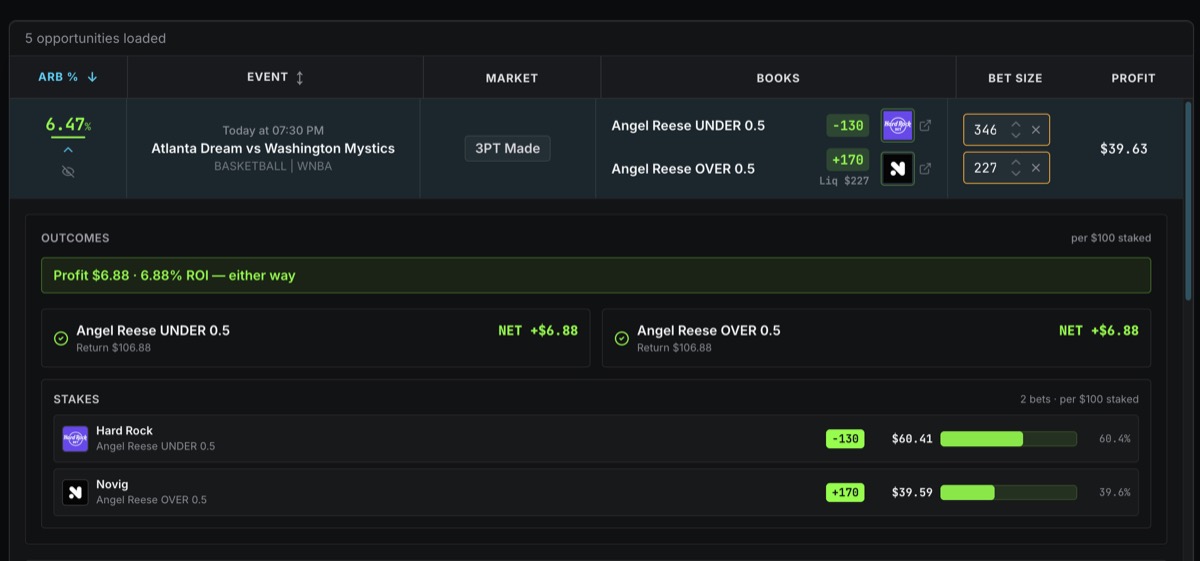
Here is a real row off my scanner. Hard Rock had Angel Reese under 0.5 threes at -130. Novig had the over at +170. Those two prices disagree enough that you can back both sides and win either way.
Split $100 sixty-forty, $60.41 on the under and $39.59 on the over, and both outcomes pay back $106.88. That is $6.88 of profit with no opinion about whether she hits a three. You can run those two prices through the arbitrage calculator and get the same stake split and the same return.
6.88% in one night. The S&P 500 does about 10% in a year. On paper this is the closest thing to free money that betting has ever offered, and five years ago people genuinely built bankrolls doing exactly this. So with a screen full of these, how does an hour end at zero?
Every one was gone before my click landed
The arbs were real. I watched them appear, checked the math, and reached for the click. Every single one had gone by the time the click arrived.
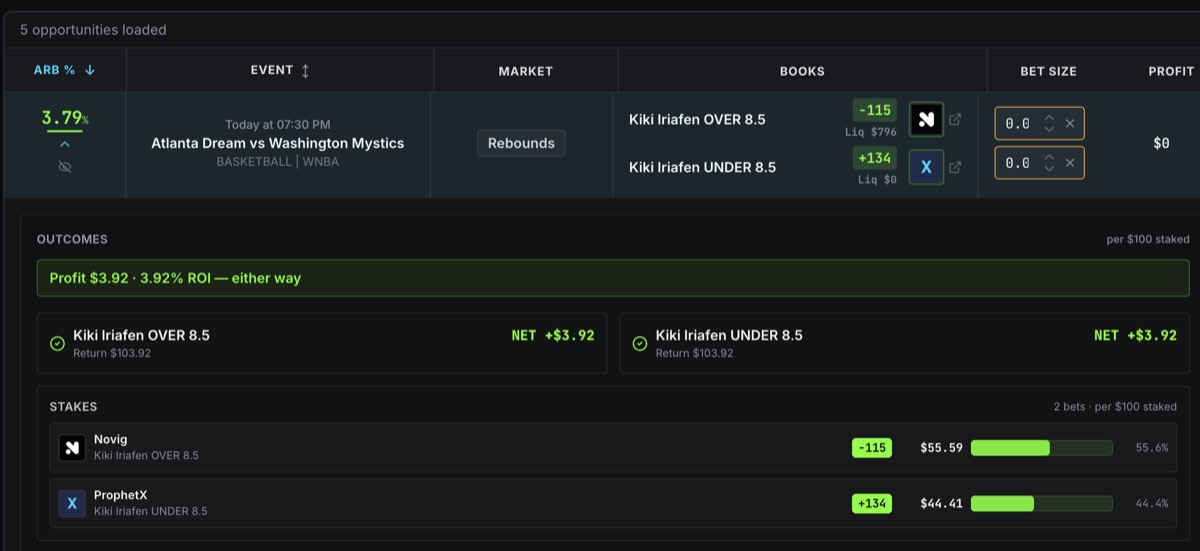
This is what they looked like when my cursor got there. A 3.79% arb on Kiki Iriafen rebounds, Atlanta at Washington. Novig has the over at -115 and ProphetX has the under at +134, and the board says $3.92 profit per $100 either way.
Now read the liquidity under each price. Novig has $796 sitting behind the over. ProphetX has $0 behind the under. An arb is one bet made of two legs, so a dry leg is not half an opportunity, it is no opportunity. That is why the bet size boxes both say 0.0 and the profit column says $0.
That is the plate after dinner, and I got served it for an hour straight.
Who is eating them, measured off the public tape
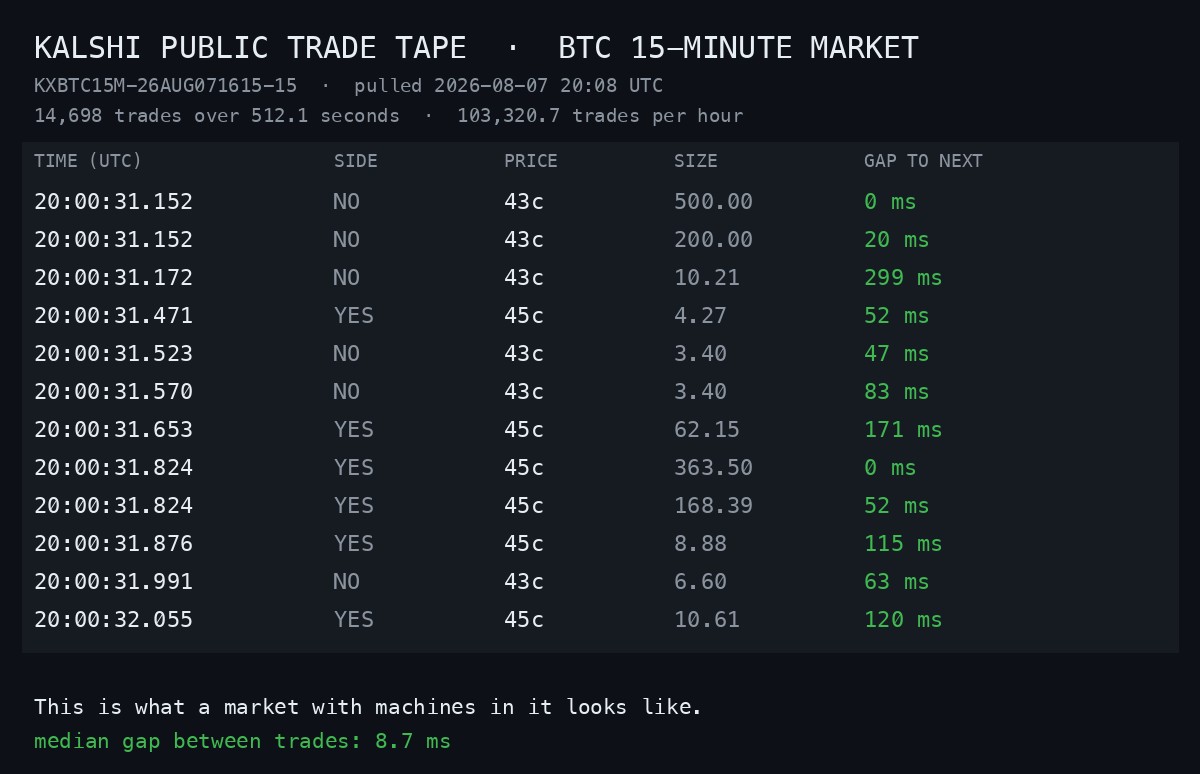
Somebody is taking these trades, and on Kalshi you can prove who, because the trade tape is public. Anybody can pull it. I pulled one Bitcoin 15-minute market for one afternoon: 14,698 trades in eight and a half minutes.
That is 8.7 milliseconds between trades
28.7 trades per second, and a median gap of 8.7 milliseconds. Go ahead and try to click twice in nine milliseconds. That is not people. That is machines trading with machines, and when a gap opens in a market that bots patrol, an order is already waiting for it.
The obvious response is that you need faster tools. You do not. You cannot out-click a machine that lives in the building, and speed was never going to be the thing you win on.
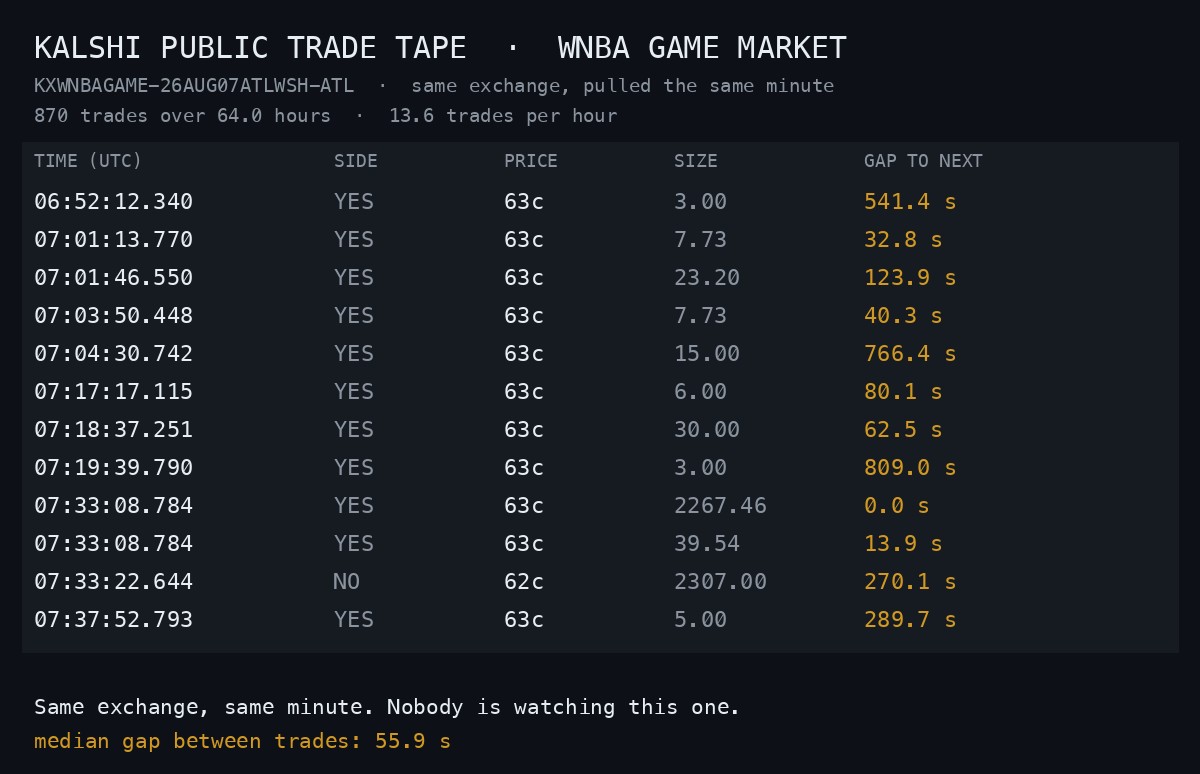
Now the same tape pulled at the same minute off the same exchange, for a WNBA game.
Two markets on one exchange, both tapes pulled the same minute
| Bitcoin 15-minute market | 14,698 trades in 8.5 minutes | 103,321 trades per hour, median gap 8.7 milliseconds |
|---|---|---|
| WNBA game market, Atlanta at Washington | 870 trades in 64 hours | 13.6 trades per hour, median gap 55.9 seconds |
| Difference in how often a trade happens | about 7,600x | same exchange, both tapes pulled at 20:08 UTC on 2026-08-07 |
The second wall is your own account
Say one had stuck around long enough for a human to bet it. About half of these arbs price against regular sportsbooks, and the books already know what arbing looks like.
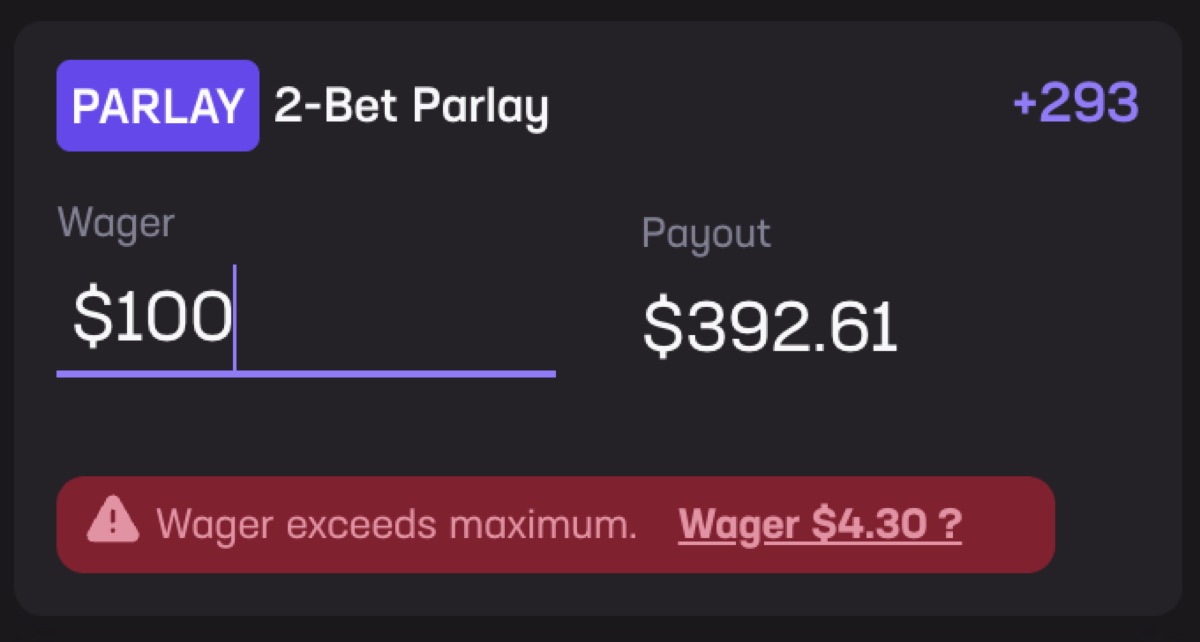
This is my Hard Rock account. I typed a $100 wager and got told the wager exceeds my maximum. My max bet is $4.30, because they limited me long ago for winning, which is what happens to winners and it usually happens within days. I taught a friend to arb and he lasted a weekend.
Run that beautiful 6.88% arb at a $4.30 ceiling and you make twenty-nine cents. That is the real ceiling on the free money even when the bots leave you a scrap.
Gone in nine milliseconds, or capped to pocket change. Those are the two options, and together they are how an hour of guaranteed profit comes to zero dollars and zero cents.
Where the edge actually moved
The interesting part is in that comparison table. A bot has to pay for itself. In a market that took 870 trades across 64 hours, there is not enough volume to cover the cost of pointing a machine at it, so nobody does.
That is where the mispriced numbers now sit. Not in the arb, which needs two venues to disagree and needs both sides still available when you arrive, but in a single price that is simply wrong on a market too small for anyone to bother policing. You take one side, you do not race anybody, and there is no pairing to fall apart.
The way to tell whether a price is wrong is to strip the house cut out of the market's own consensus and compare. That is what the no-vig calculator does, and it is the same arithmetic whether you are checking one book or twenty.
Being honest about the tradeoff: this version loses. An arb pays every time it fills, and a good price does not. You will take correctly-priced bets that lose several nights in a row, and the only thing you control is whether the number was right when you took it.
What to do tonight
Pick one market that nobody is watching. Smaller leagues, women's sport, the second half of a slate, anything with a thin tape.
Name the fair price before you bet, or you are guessing. Strip the vig out of what the market as a whole is saying, then look at what your app is offering for the same outcome.
Size small on purpose, because you are going to be wrong plenty of individual times while the price is still in your favour.
The bots did not kill the edge. They just told you where it is not.
Frequently asked questions
Is arbitrage betting still profitable in 2026?
In practice, not for a person clicking by hand. In a live hour across five venues, every pre-game arb my scanner surfaced was taken before my click landed, and the hour returned $0.00. The arithmetic still works. The fills are what stopped existing.
Why does an arbitrage opportunity disappear before I can bet it?
Automated traders are sitting on those markets. On one Kalshi market I measured 14,698 trades in eight and a half minutes, a median of 8.7 milliseconds between trades. A human cursor cannot arrive inside that window.
Will sportsbooks limit me for arbitrage betting?
Yes, and quickly. My own Hard Rock account rejects a $100 wager and allows $4.30. At that cap a 6.88% arb pays twenty-nine cents. Limits usually land within days of a pattern the book recognises.
Is arbitrage betting risk free?
The pair is risk free only if both sides fill at the prices you saw. If one leg fills and the other has moved, you are left holding a one-sided bet you never intended, which is the ordinary risk you were trying to avoid.