Why Thin Kalshi Markets Carry Bigger NFL Betting Edges
By Matt Downs · August 24, 2026
Most bettors chase the biggest number on the board. The better question is which market nobody else is watching, because that is where a wrong price survives long enough to matter.
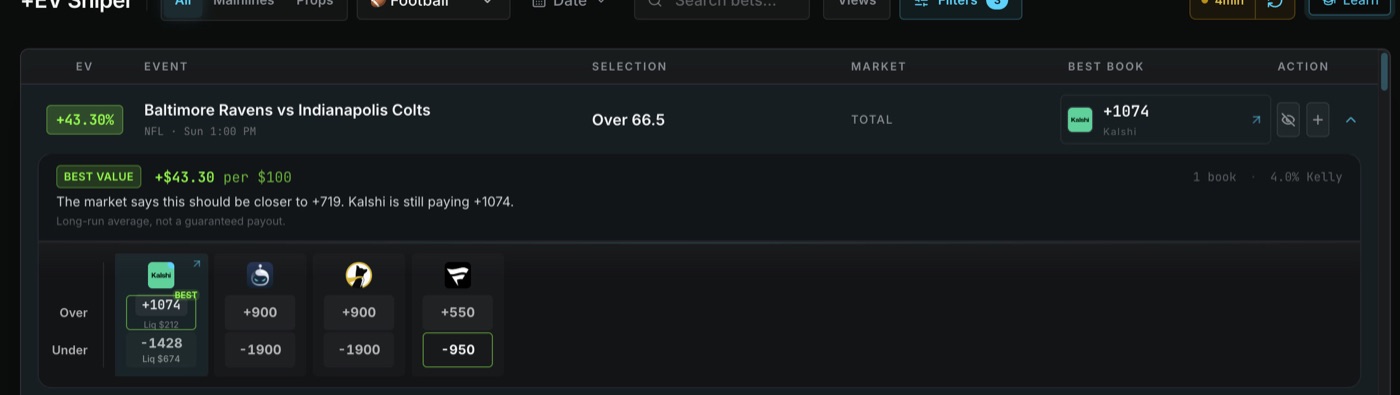
This is a real market, captured live off Upside's own +EV Sniper: Baltimore Ravens at Indianapolis Colts, the Over 66.5 total. Kalshi was paying +1074. The tool's own consensus read said fair was closer to +719. The gap between them is the entire trade, and the reason it existed is sitting right there on the same screen.
The price, read as a probability
Every price on Kalshi is a probability wearing a costume. +1074 converts to an implied 8.52% chance, the same conversion the implied odds calculator does automatically. The tool's own fair line, +719, converts to 12.21%. That 3.69 point gap is where the +43.30% EV comes from. Run the numbers independently (0.1221 x 11.74 - 1 = 43.35%) and it reproduces the tool's own figure to within rounding.
Three other books were quoting the same bet at the time: +900, +900, and +550. Every one of them paid less than Kalshi's +1074 for the identical outcome.
The number that explains why the gap exists
The probability math says the bet was underpriced. It does not say why the mispricing was still there to find. That answer is the liquidity figure sitting next to the Kalshi quote: $212.
A total on a 1pm NFL game is not the market getting watched. The books and models that keep marquee lines tight, the moneyline, the main spread on the primetime game, are not spending attention on a market this small. Fewer people trading a line means fewer data points setting its price, which means more room for the price to be wrong and a slower correction once it is.
That is the mechanism, not a coincidence: thin markets carry bigger edges because the systems that correct prices don't bother sizing into them. The edge and the liquidity number are the same fact, read two ways.
The same bet, four books
| Kalshi (best) | +1074 | Liq $212 |
|---|---|---|
| Book 2 | +900 | |
| Book 3 | +900 | |
| Book 4 | +550 |
It was not a one-off
The same afternoon carried four more live rows on the Sniper: a Saints-Lions total at +43.30% EV, a 49ers-Rams spread at +28.80% through a different book entirely, Seattle's game that night at +21.50% through Kalshi, and a second Ravens-Colts total at +20.60%. None of these were the marquee bet of the day. That is the pattern, not an accident.
The check that finds it
The strategy is not favorite versus underdog, and it is not picking a side because the number looks scary or safe. It is finding the market that is thin enough that nobody has bothered to correct it today, then confirming the gap by converting every price to a probability and comparing it to what the rest of the market says.
Doing that by hand across four books on one game is slow. Doing it across every game, every book, all day is not something a person can keep up with alone, and that is the actual argument for a tool that checks continuously rather than a pick.
What this does not say
This is one captured market, not a backtest. It shows that a real mispricing existed and why, not that this specific bet will win. At 37.6% to hit, it loses more often than it wins, and the case for taking it rests entirely on the price paid relative to the true probability, not on a prediction about the game.
The comparison books shown are the ones visible on that capture, not a full market census, and their names were not confidently identifiable from the screenshot icons alone, so only the numbers are cited here.
Frequently asked questions
Why do thin or low-liquidity markets on Kalshi have bigger edges?
Books and pricing models spend their attention on the markets everyone bets, main spreads and totals on marquee games. A niche total on an early game does not get that attention, so fewer people trade it, fewer data points set its price, and the price corrects more slowly once it drifts from fair value. The edge and the low liquidity are the same underlying fact.
How do you tell if a Kalshi price is a good bet?
Convert the price to an implied probability, then compare it against what the rest of the market says that probability should be. A price of +1074 implies an 8.52% chance; if sharp consensus puts the true chance closer to 12%, the price is underpriced regardless of whether it looks like a favorite or a longshot.
Does a big EV percentage mean a bet is likely to win?
No. A bet with 43.30% EV can still have a low chance of winning, in this example 37.6%, meaning it loses more often than it hits. EV measures the size of the pricing edge, not the probability of winning any single bet.
Is a low liquidity number on Kalshi a red flag?
It is a size limit, not a warning about the price. A thin market can carry a real, mispriced number. The liquidity figure just caps how much can be traded at that price before it moves.