Original research · August 21, 2026
Why Every PrizePicks Pick Is Priced at -119
By Matt Downs
Open PrizePicks and check ten different picks across ten different sports. The price on every single one will be -119. Not close to it. Exactly -119, every leg, every sport, every day.
That is PrizePicks' standing price for a two way prop, and it means something specific: whatever you pick has to clear 54.34% to be worth taking. Here is the math behind that number, and then a real leg from August 21, 2026 run against thirteen sportsbooks to show what checking one actually looks like.
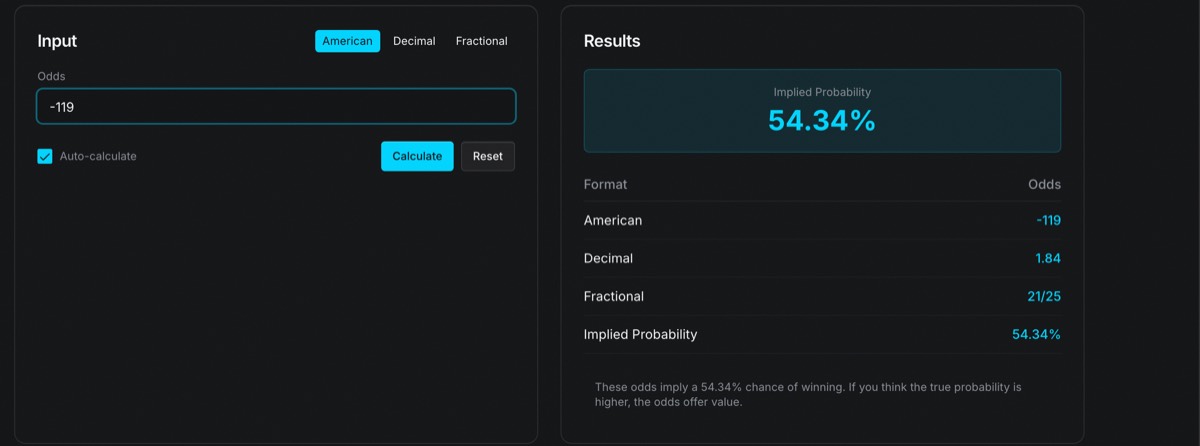
The math behind -119
American odds of -119 mean you risk 119 to win 100. Break-even is the risk divided by the total return, so 119 / (119 + 100) = 119/219 = 54.34%. You can reproduce it in a few seconds on the free implied odds calculator.
So a PrizePicks leg is worth taking when the real chance of it landing is better than 54.34%. Below that line the price is against you no matter how good the player looks, and the flat pricing means this is true of every leg on the board at once.
The payout structure moves the bar slightly. A six pick flex needs roughly 54.2% per leg because the consolation tiers cushion a miss, while a three pick play is priced nearer -122 and needs about 54.95%, a higher bar with no cushion under it. The smaller, safer feeling card is the harder one to fill honestly.
Break-even by price
| -107 (Underdog four pick flex, folded) | 51.69% | |
|---|---|---|
| -119 (PrizePicks, every leg) | 54.34% | |
| -122 (PrizePicks three pick) | 54.95% | |
| -137 | 57.81% | |
| -146 | 59.35% | |
| -178 | 64.03% |
A real leg, checked against thirteen books
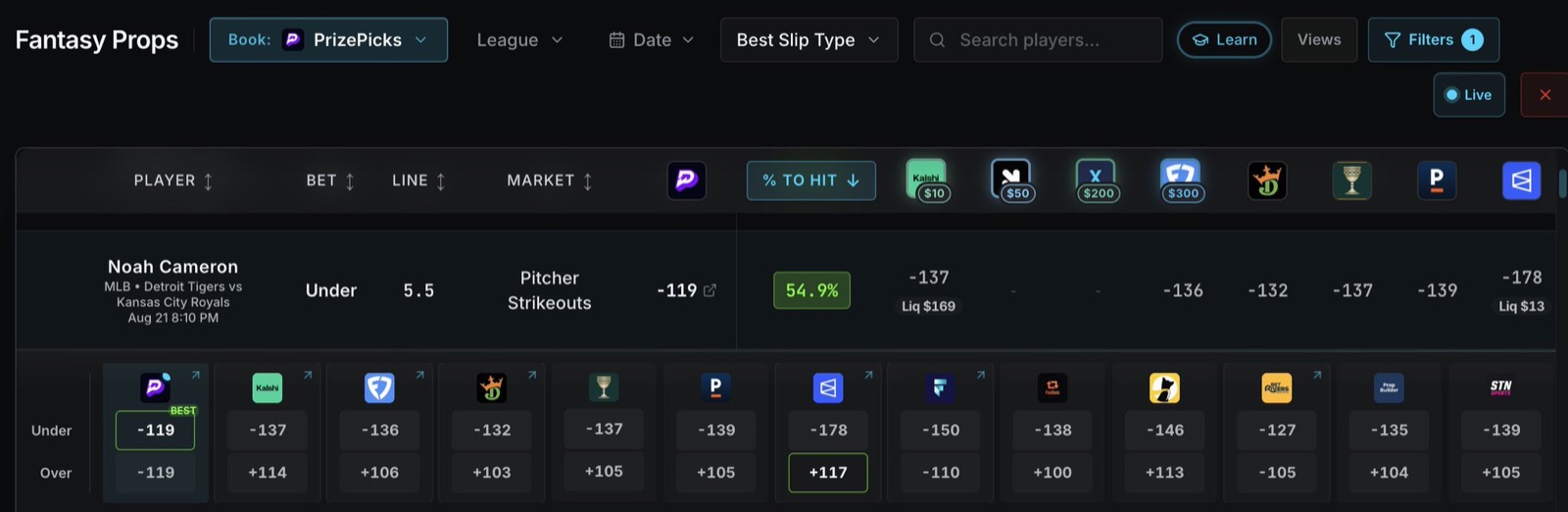
On August 21, 2026, Noah Cameron under 5.5 pitcher strikeouts was on the PrizePicks board at the usual -119. The same prop was posted by thirteen sportsbooks and exchanges that morning, and every one of them was charging more for that under than PrizePicks was.
Kalshi had it at -137. FanDuel -136. DraftKings -132. Underdog -146. Fliff -150. Novig, an exchange, was up at -178 on thin liquidity. PrizePicks was the cheapest price on the board for the identical side of the identical prop.
That gap is the entire signal. It does not require an opinion about Noah Cameron. It says the rest of the market had repriced this under and PrizePicks, whose price never moves off -119, had not caught up.
What the market actually thought
A listed price is not a probability, because it has the house margin baked into it. To get the market's real opinion you have to strip that out, which is what devigging means.
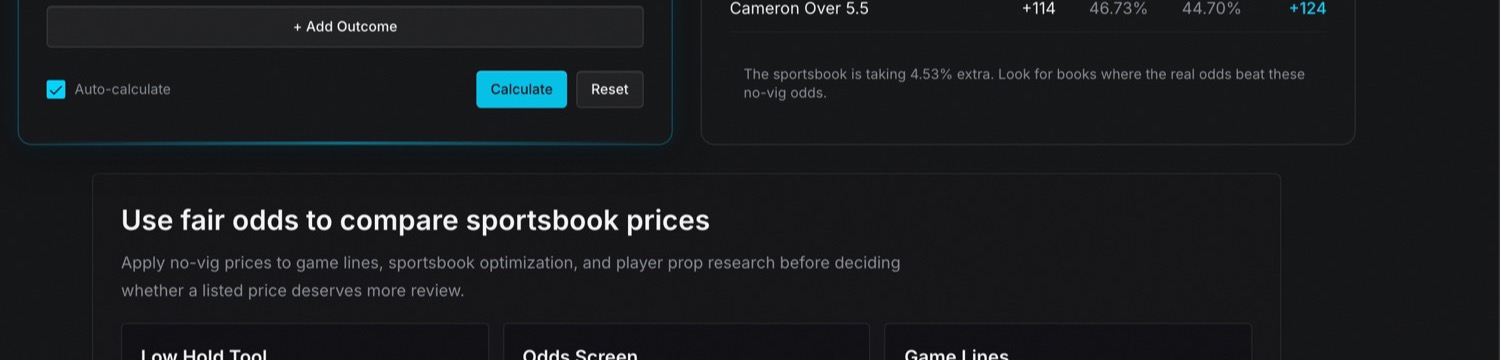
Take Kalshi's two sided quote on this prop: under at -137, over at +114. Those convert to 57.81% and 46.73%, which add to 104.54% rather than 100%. The extra 4.53% is the house. Normalise the two and the fair probability on the under comes back at 55.30%. The no-vig calculator does this in one step.
Run the same exercise across all thirteen books instead of one and the consensus fair price lands at 54.9%. That is the number worth using. A single book is one opinion, and picking the friendliest one is how people talk themselves into legs that were never there.
So: the market said 54.9%, PrizePicks demanded 54.34%, and a six pick flex needed about 54.2%. The leg cleared, by roughly 0.7 percentage points.
How to check a leg yourself
Find the same prop at a sportsbook that posts both sides. Put the two prices into the no-vig calculator to get a fair probability with the margin removed. Compare that number to 54.34%, or to 54.2% if you are building a six pick flex.
If the fair probability is above the line, the price is in your favour. If it is below, the leg is a pass however the player looks. Doing this across more than one book matters more than doing it precisely at one, because the consensus is harder to fool than any single number.
The implied odds calculator handles the conversion in the other direction when you just want to know what a price is asking of you.
What this does not tell you
An edge of 0.7 percentage points is real and it is small. It does not make a slip likely to win, and a six leg card needs all six to land. The leg above could lose and the price paid would still have been the right price.
Devigged consensus is an estimate, not truth. It is better than one book's number and better than a hunch, and it is still an estimate that moves as the market moves. Prices also drift through the day, so a number checked at noon is not the number at first pitch.
What the flat -119 does give you is a fixed line to measure against. The price is the part of this you control before anything is settled.
Frequently asked questions
Why is every PrizePicks pick -119?
It is PrizePicks' standing price for a two way player prop. Rather than repricing each player the way a sportsbook does, PrizePicks holds every leg at -119 and lets the payout structure of the entry do the rest. That flat price is where its margin comes from.
What break-even percentage does -119 represent?
54.34%. American odds of -119 mean risking 119 to win 100, so break-even is 119 divided by 219, which is 54.34%.
Does a six pick flex need the same 54.34% per leg?
Slightly less, about 54.2% per leg, because the flex consolation tiers pay something when one leg misses. A three pick play is priced closer to -122 and needs about 54.95% per leg, which is a higher bar than the six pick flex.
How do I know if a PrizePicks price is good value?
Find the same prop at a sportsbook posting both sides, remove the margin from those two prices to get a fair probability, and compare it to 54.34%. If the fair probability is higher, the PrizePicks price is in your favour. Checking several books instead of one gives a more reliable consensus.
Is PrizePicks ever cheaper than a sportsbook?
Yes. Because the price is frozen at -119 while sportsbooks move theirs, PrizePicks is sometimes the most expensive price on a prop and sometimes the cheapest. On Noah Cameron under 5.5 strikeouts on August 21, 2026, thirteen books all charged more than PrizePicks for the same side.