Original research · July 29, 2026
The PrizePicks Correlation Map: What 1,589 MLB Games Say About Which Pairs Are Free
By Matt Downs
Does PrizePicks actually hand you correlated picks for free? I pulled 1,589 MLB games and built about 50 real slips on the board by hand to answer it. They do — but only in one exact spot, and they've never published it.
Why correlated picks are worth real money
PrizePicks pays your slip as if every pick is independent of the others. They usually aren't. A pitcher going deep into the game and the opposing lineup piling up plate appearances tend to happen together. When two picks move together like that, a slip holding both is worth more than the payout is paying you. That's positive correlation, and it's real money.
So they block it. Build the obvious correlated pairs and the payout gets repriced on the spot — same-team hitter stacks, mirrored pitcher-hitter stats, scoring-stat combinations, all of it.
The one place PrizePicks lets correlation through
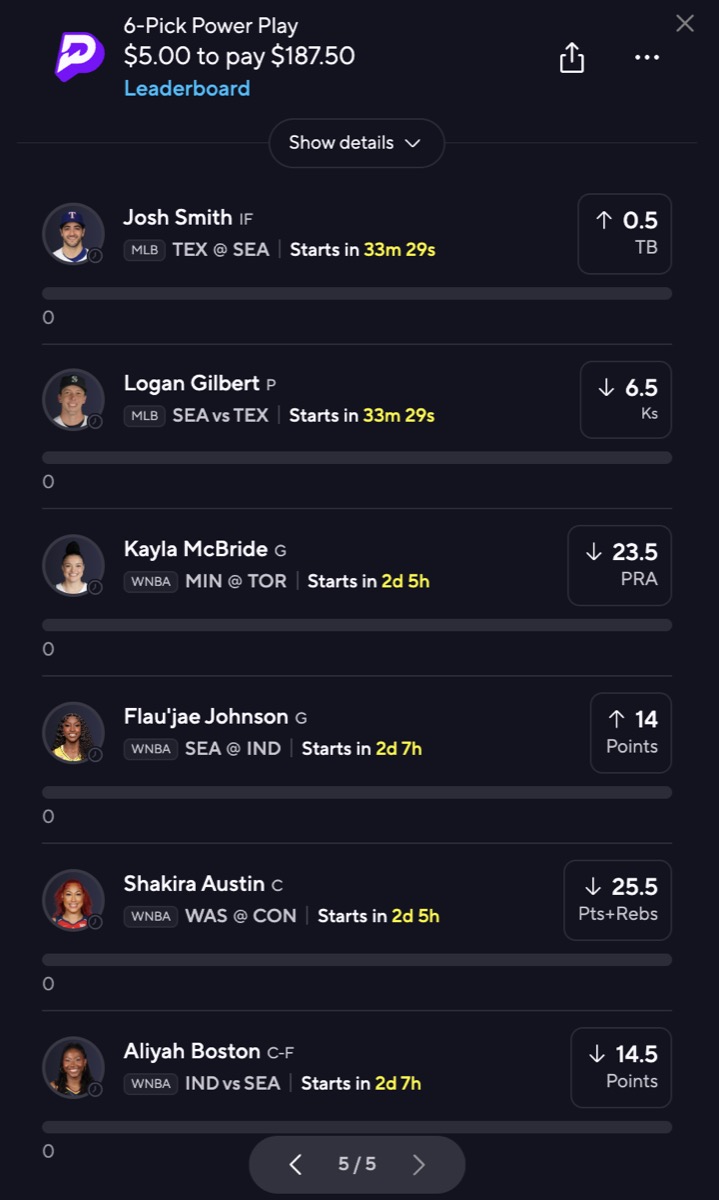
One correlated pair, on a 6-man Power, from a specific list of stat pairs — the payout doesn't move at all.
Put that exact same pair on a 2-man, a 3-man, a 4-man or a 5-man and the payout drops. It's a cliff at six legs, not a gradient. And add a second pair to that 6-man — it reprices too. Exactly one, maximum. I assumed I could stack three of them and that assumption cost me a week of testing.
What the free pair is worth
| Break even per pick, no correlation (6-man Power, 37.5X) | 54.7% | |
|---|---|---|
| Break even per pick, best pair PrizePicks allows | 52.7% | They sell you 1.9 points of pick accuracy and keep the other 3.4. |
The honest part: 52.7% is still a real bar
52.7% per pick is a bar most players never clear. This is not found money. Correlation multiplies an edge you already have — it doesn't create one. At 52% picks, none of the eligible pairs break even at all.
Two anomalies the data can't explain
Singles runs free but Doubles is blocked 3 for 3 — same at-bat family, opposite treatment. And Hits is blocked against every pitcher stat except Pitcher Fantasy Score, where it runs clean. I had four theories for why and the data killed all four. Treat the eligible list as a map, not a theory.
Never anchor the pair on Fantasy Score
No sportsbook prices Fantasy Score, so there's no vig to strip out and no way to price it — every +EV tool falls back to a placeholder 50% on those props. I built two slips that way and I couldn't tell you if those legs were any good. Pair on a book-priced stat instead; Pitching Outs UNDER is usually the answer.
How to build the slip tonight
Six-man Power, one correlated pair: Pitching Outs UNDER plus Walks, Singles or Total Bases from the opposing lineup. If the payout shifts at all when you add the pair, don't play it — not because it's necessarily bad, but because you can't compute whether it is.
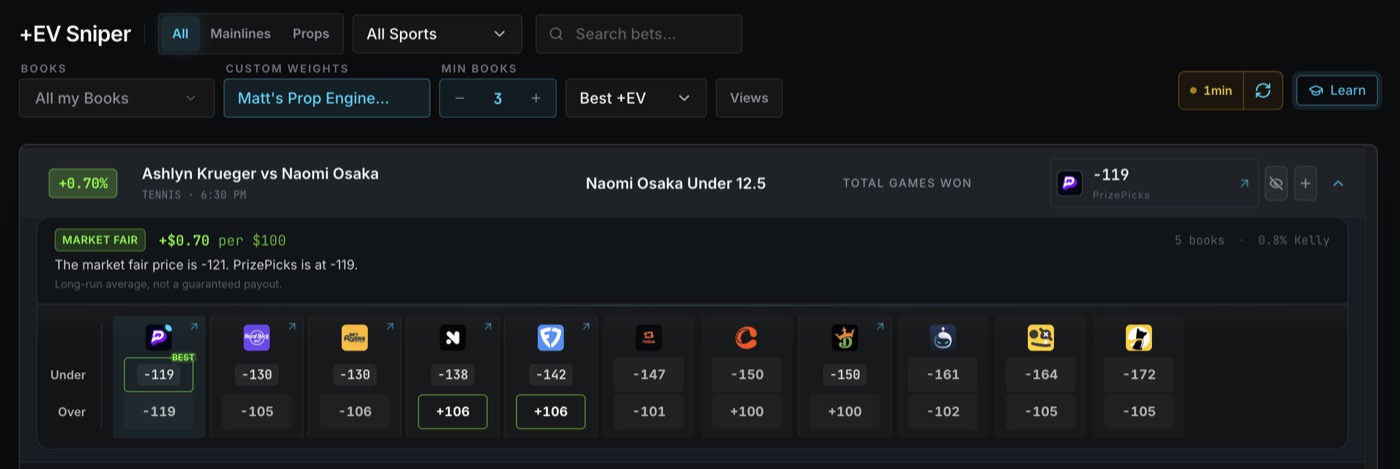
Which leaves the hard part: knowing whether your six picks actually clear 52.7% in the first place. That's what the +EV Sniper does — it reads 30+ sportsbooks, strips out the vig, and shows the real percent odds next to every pick.
Frequently asked questions
Does PrizePicks allow correlated picks?
Mostly no — same-team hitter pairs, mirrored stats, and scoring-stat combinations all reprice the payout. In 1,589 games of MLB data and ~50 live slip tests, exactly one exception held: a single eligible correlated pair on a 6-man Power plays at the full payout.
Why did my PrizePicks payout drop when I added a pick?
PrizePicks reprices slips it detects as correlated. The repricing is computed per slip against the specific players and lines, so the same structure with different players returns a different number. If the payout moves at all when you add a pair, the edge is no longer computable in advance.
What win rate do you need to break even on a PrizePicks 6-man Power?
At the standard 37.5X payout you need 54.7% per pick with six independent picks. With the best correlated pair PrizePicks allows, the bar drops to 52.7% — still a bar most players do not clear without pricing picks against the no-vig market.