How to Grow a $500 Sports Betting Bankroll: Promos, Boosts and 1% Sizing
By Matt Downs · October 15, 2026
If you only had $500 to bet on sports, the fastest honest way to grow it is three steps: claim every welcome offer you qualify for, play only the daily promos that clear their break even, and keep every entry at 1 percent of your bankroll. Matt Downs walks through the full plan in his video, and this page shows each step with screenshots taken from the tools on October 15, 2026.
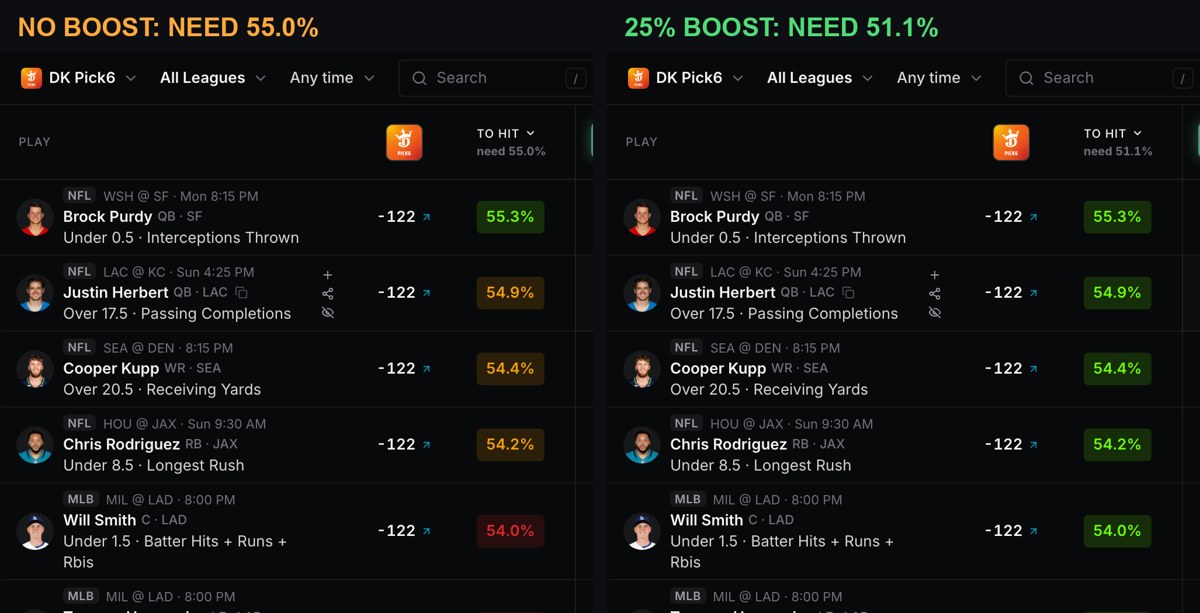
The step that does most of the work for a small bankroll is the second one. A profit boost lowers the break even percentage on a fixed payout entry, and on the board below a 25 percent boost dropped the per leg break even on a DK Pick6 3 pick from 55.0 percent to 51.1 percent. That is the difference between a slip that loses money and one that has a real edge. For the general version of this framework, see sports betting for beginners in 3 steps.
Step 1: Claim every welcome offer before you deposit anywhere
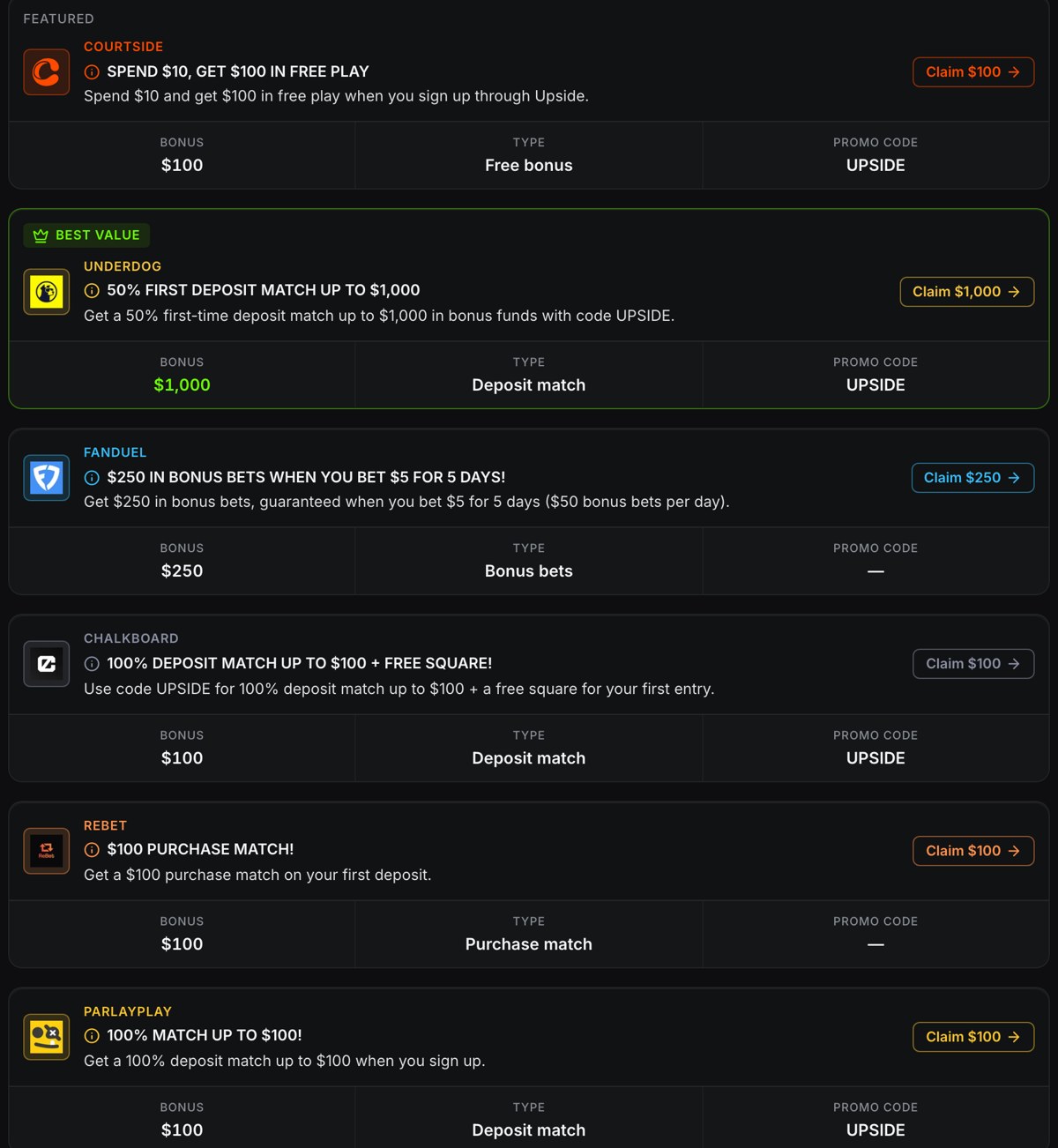
Welcome offers are the easiest money in sports betting and the step people skip the most. When Matt went through every sportsbook, DFS app and prediction market available in Florida, the welcome offers added up to $755 in bonus credit on top of the original $500. Offers change by state and by week, and Upside keeps a verified list of them on its promos page.
The detail that matters is the match type. A 100 percent match up to $100 pays the full $100 when you deposit exactly $100, and depositing $500 does not get you a dollar more. A 50 percent match needs $200 deposited to earn the same $100. Work out what each offer actually needs and spread the $500 across apps instead of putting it all in one place. Bonus bets and free play are not cash, so the bonus conversion calculator is the way to estimate what a credit is really worth before you count it.
Step 2: Know your break even, then let the boost do the work
Every DFS entry has a fixed payout, so the first number to know is the break even percentage. A 3 pick on DK Pick6 pays 6x, which means the whole slip has to hit 1 in 6 times, or 16.7 percent, to break even. Spread across three independent legs, each one has to hit about 55 percent of the time, because 0.55 multiplied by itself three times is about one sixth. The parlay calculator shows the same relationship for any set of odds.
A 25 percent boost changes the price, not the picks. Upside's optimizer prices that boosted 3 pick at 7.5x, so the slip only has to hit 13.3 percent of the time and each leg only needs 51.1 percent. The picks did not get more likely to hit. You get paid more when they do, which is why daily promos are where a small bankroll grows fastest.
Where the percent odds to hit come from
The percentage next to each play is the no vig chance it hits. The optimizer takes every sportsbook and exchange pricing the same line, removes the vig from each one, and blends them into one fair number. You can do the same thing for a single market with the no vig calculator. Without the boost, most of the plays on that board sat under 55 percent. With it, every one cleared 51.1 percent.
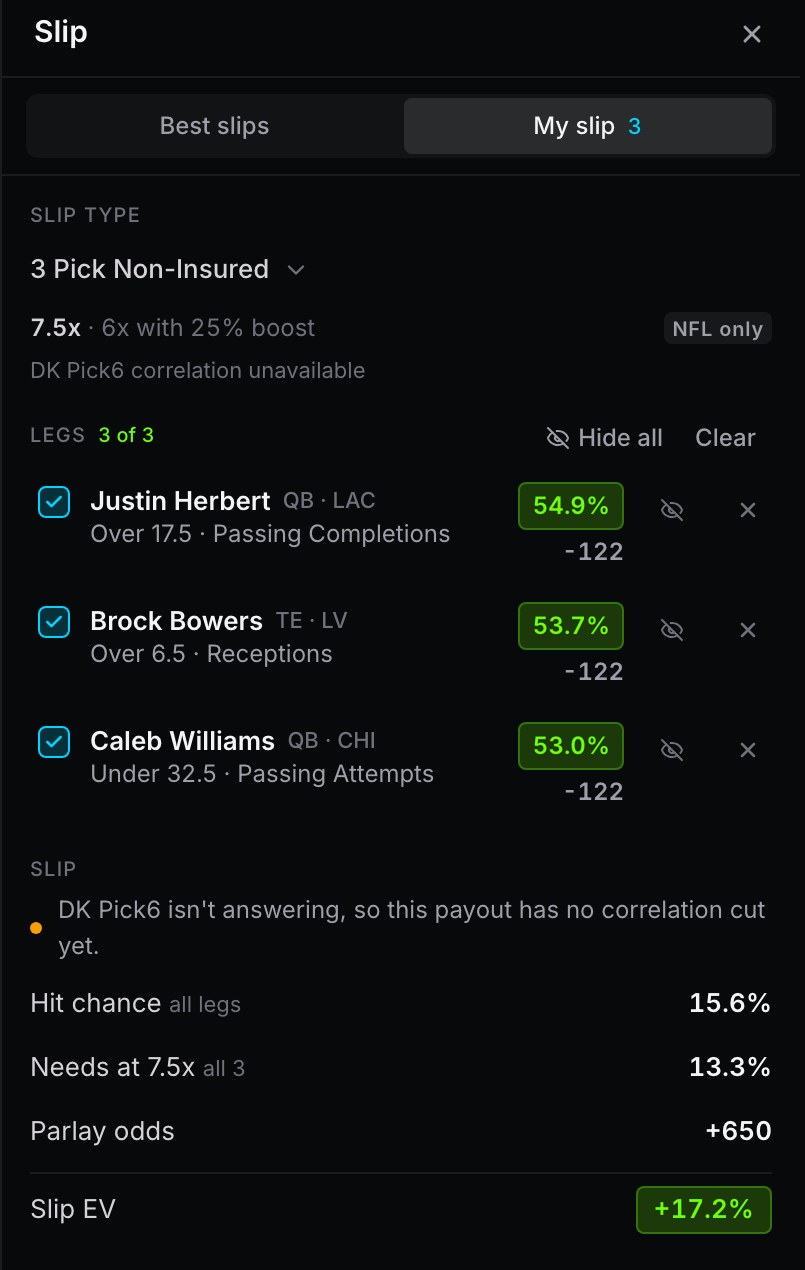
Here is a slip built from that board, one leg from each of three Sunday NFL games: Justin Herbert over 17.5 passing completions at 54.9 percent, Brock Bowers over 6.5 receptions at 53.7 percent, and Caleb Williams under 32.5 passing attempts at 53.0 percent. Multiplied together, all three hit 15.6 percent of the time. At 7.5x the slip needs 13.3 percent, so it comes out at +17.2 percent expected value. Without the boost the same slip pays 6x, needs 16.7 percent and loses money. Prices move all week, so treat this as an example of the process and check the live board before you play anything.
The same 3 pick, with and without the boost
| Payout | 6x / 7.5x | No boost / 25 percent boost |
|---|---|---|
| Slip break even | 16.7% / 13.3% | 1 divided by the payout |
| Per leg break even | 55.0% / 51.1% | Cube root of the slip break even |
| This slip's hit chance | 15.6% | 54.9% x 53.7% x 53.0% |
| Expected value | About -6% / +17.2% | The boost is what made it a bet |
Step 3: Keep every entry at 1 percent of your bankroll
With $500, 1 percent is a $5 max on every entry, parlays and straight bets alike. If the bankroll drops to $400 the max drops to $4, and if it grows to $750 it rises to $7.50. It sounds small on purpose. A slip that hits 15.6 percent of the time still loses more than five times out of six, even when it is a good bet.
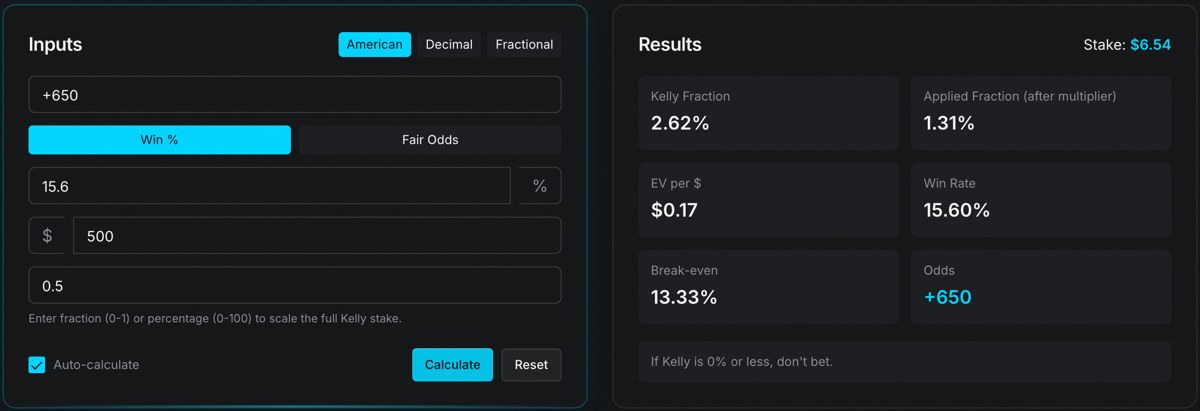
Running that same slip through the Kelly criterion calculator with a $500 bankroll shows where 1 percent comes from. Full Kelly says to bet 2.62 percent, about $13.10, and half Kelly says $6.54. Most sharp bettors bet a fraction of Kelly because full Kelly swings hard when the estimated hit rate is even a little off, and a $5 entry lands between a quarter and a half Kelly on a slip this strong. On thinner edges Kelly says to bet even less, which is why a flat 1 percent is the simplest rule for a small bankroll. Bet sizing beats bet picking shows what happens to the same card when stakes are sized up.
What a month of this looks like
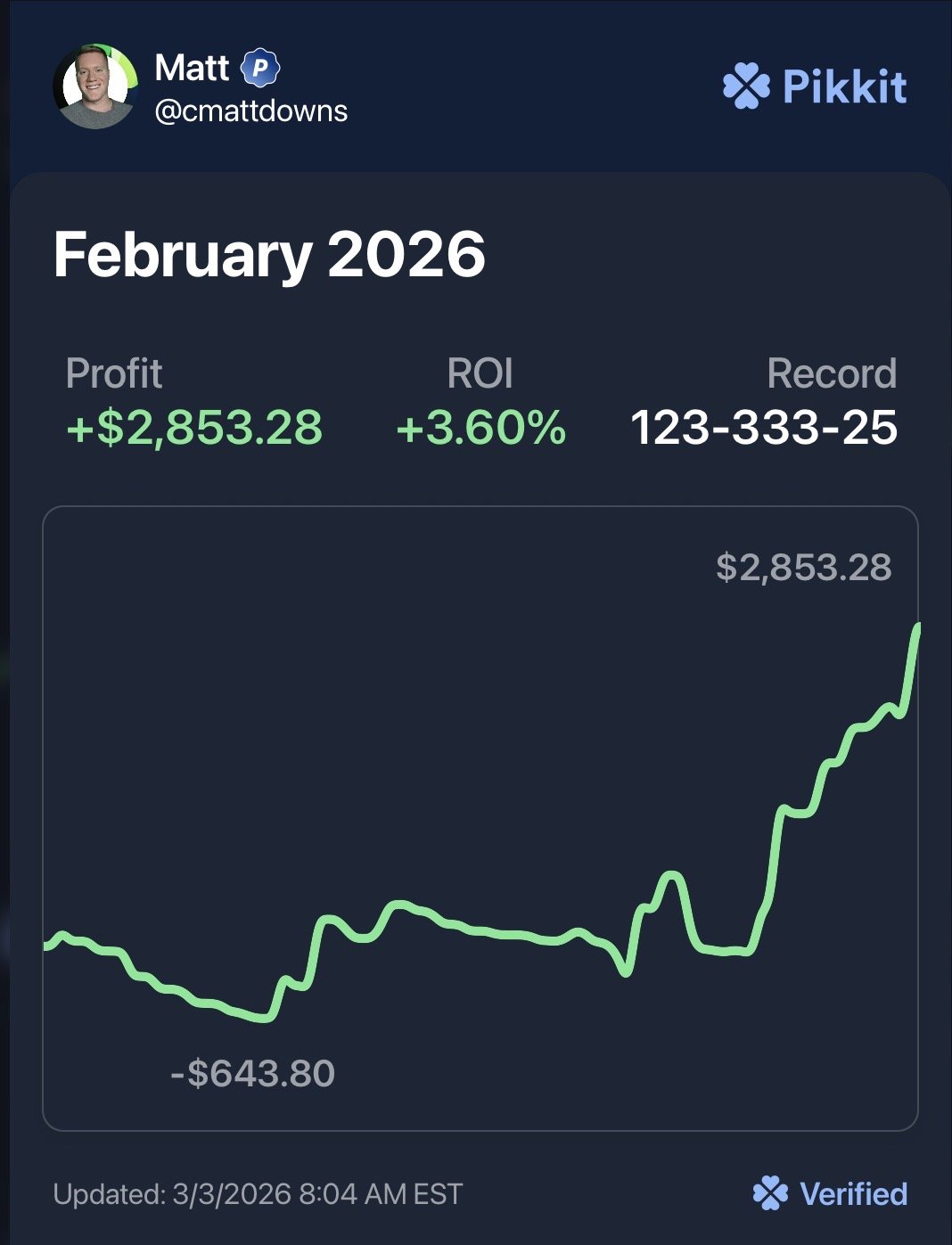
In February 2026 Matt ran a full month on DFS apps and daily promos only and finished up $2,853.28. The path was not a straight line: the month dipped to minus $643.80 before it climbed, and flat 1 percent sizing is what kept that drawdown survivable. Promos and line comparison created the edge, and the sizing rule kept the bankroll alive long enough for the edge to show up.
Frequently asked questions
How do you grow a small sports betting bankroll?
Claim every welcome offer you qualify for before depositing, play only the daily promos and boosts that clear their break even percentage, and keep every entry at 1 percent of your bankroll or less. With $500 that means a $5 maximum entry.
How much should I bet with a $500 bankroll?
No more than 1 percent per entry, which is $5. Adjust it as the bankroll changes: $4 at $400 and $7.50 at $750. On a strong boosted slip that lands between a quarter and a half Kelly stake.
How does a profit boost change the break even percentage?
A boost raises the payout without changing the odds of the picks. On a DK Pick6 3 pick, a 25 percent boost takes the payout from 6x to 7.5x as the optimizer prices it, which drops the slip break even from 16.7 percent to 13.3 percent and the per leg break even from 55.0 percent to 51.1 percent.
Is every sportsbook boost worth taking?
No. A boost only helps when the picks you would play clear the new break even. If a small boost barely moves the number and nothing on that app clears it, skip it for the day.
Are welcome bonuses worth it with a small bankroll?
Yes, they are the easiest added value available, but deposit only what each offer matches. A 100 percent match up to $100 pays the same $100 whether you deposit $100 or $500, and bonus bets are worth less than cash until you convert them.