What Is a Crossed Market in Sports Betting? Two Bets That Show It
By Matt Downs · October 19, 2026
A crossed market is when two books price the opposite sides of the same bet so differently that their implied probabilities add up to less than 100 percent. Normally the two sides of a market add up to more than 100 percent, and the extra is the vig. When they come in under 100, at least one of the two prices is wrong, and if one of them is a sharp exchange, the other book is usually the one that is off.
This page walks through a real one from October 12, 2026: the Chiefs moneyline at -350 on Courtside against +365 on the Chargers at Novig and +360 at FanDuel, six days before kickoff. It also covers a player prop from the next day where one app was cheaper than every sportsbook pricing it. Both bets were posted publicly by Matt Downs the day he placed them, and both cashed. The point of the page is why they were good bets, which the results do not tell you.
How to tell if a market is crossed
Convert each side to an implied probability and add them up. A favorite at -350 implies 77.8 percent, because 350 divided by 450 is 0.778. An underdog at +365 implies 21.5 percent, because 100 divided by 465 is 0.215. At the same book those two numbers would add up to something like 103 or 104 percent. Taken from two different books, these add up to 99.3 percent.
Under 100 percent means the two books cannot both be right about the game. The no vig calculator does the conversion for any pair of odds, and Upside's Game Line Optimizer does it across every book at once, then blends the sharper ones into a single fair price. For why the same bet carries different odds from book to book in the first place, see why sportsbooks have different odds on one bet.
The example: Chiefs -350 six days early
On Monday, October 12, the lines for the following Sunday's games had just gone up. Opening lines this early are about as soft as the market gets, because very little money has been bet into them yet. Courtside had the Chiefs moneyline against the Chargers at -350. Every other book on the board had the Chiefs at -360 or worse, all the way out to -480, and the no vig fair price came out to -368, a 78.6 percent chance.
The other side is what made it a crossed market. Novig, a sharp exchange, was paying +365 on the Chargers and FanDuel was paying +360. Either one adds up to less than 100 percent against the -350, so the Courtside price disagreed with both of them, and the sharp exchange was on the same side as the fair price.
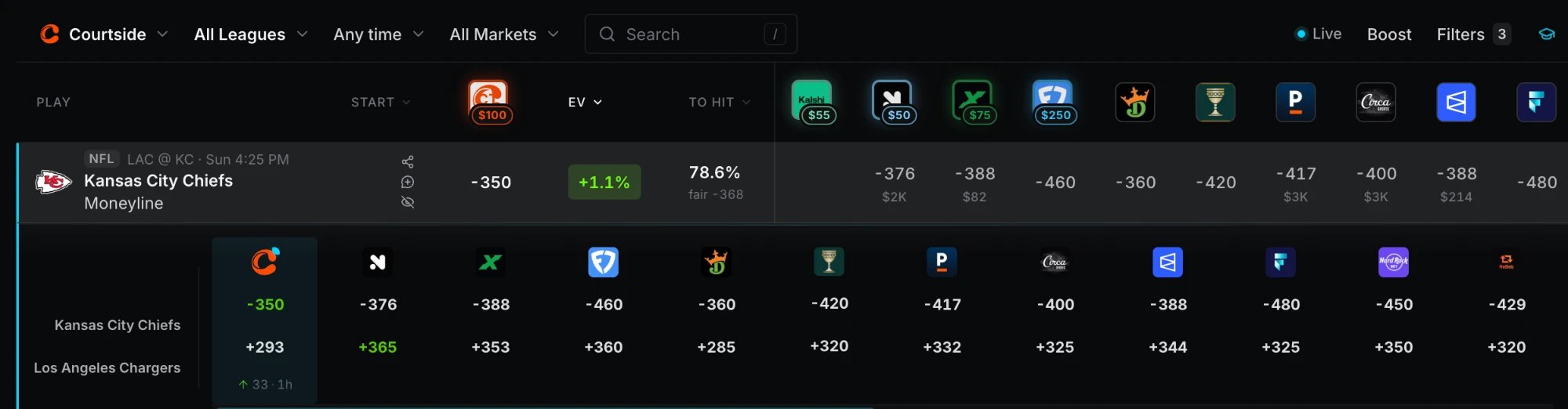
The Chiefs moneyline, by the numbers
| Courtside Chiefs -350 | 77.8% | Implied probability you pay for |
|---|---|---|
| Novig Chargers +365 | 21.5% | The sharp exchange on the other side |
| Combined | 99.3% | Under 100 percent means the market is crossed |
| FanDuel Chargers +360 | 21.7% | Also crossed: 99.5 percent combined |
| No vig fair price | -368 (78.6%) | Blended from the sharper books |
| Expected value at -350 | +1.1% | 78.6% x 1.2857 payout, minus the stake |
Why the result does not grade the bet
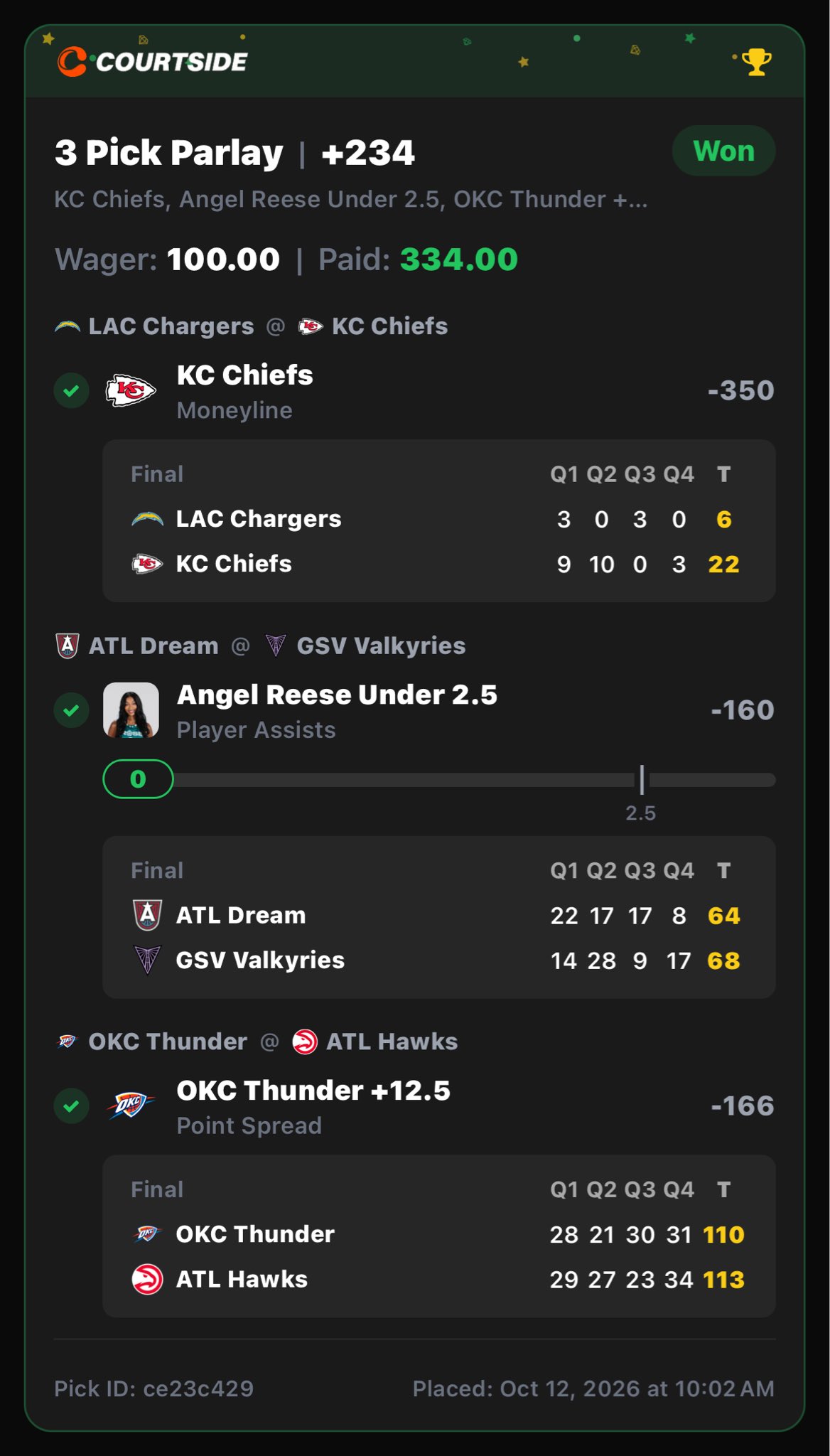
Matt used the Chiefs as one leg of a three pick parlay on Courtside, $100 to pay $334, and the Chiefs won 22 to 6. It is tempting to read that as proof, but a 1.1 percent edge on a big favorite still loses a little more than one time in five. If the Chargers had won, it would have been the same bet at the same price, and it would still have been the right one.
The way to judge a bet like this is the price you got against where the market settled, which is what positive closing line value measures. One winning slip is a sample of one.
The same idea on a player prop
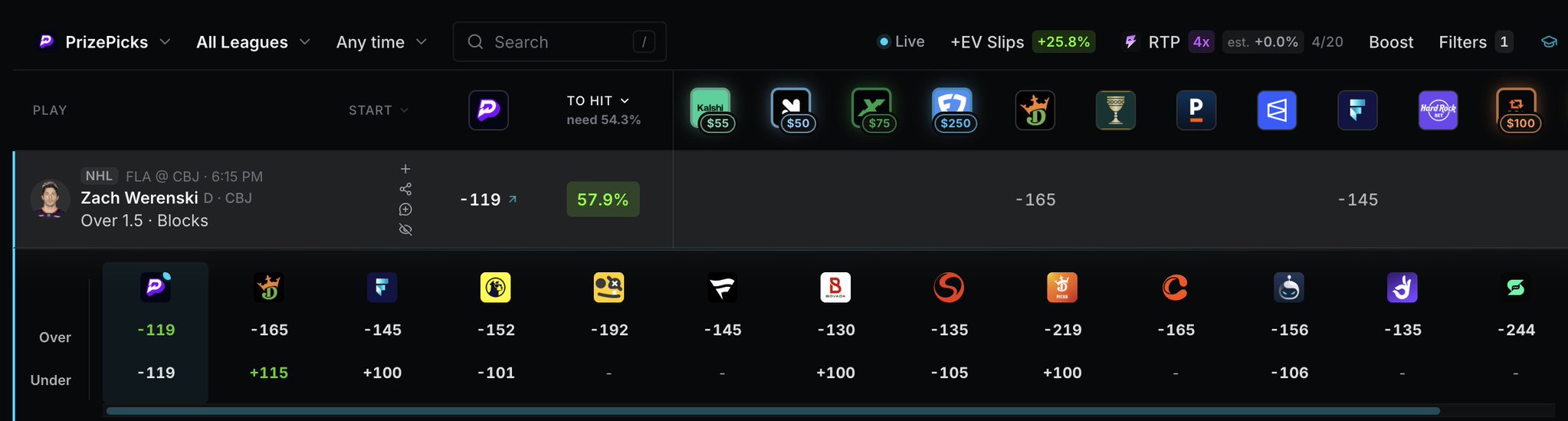
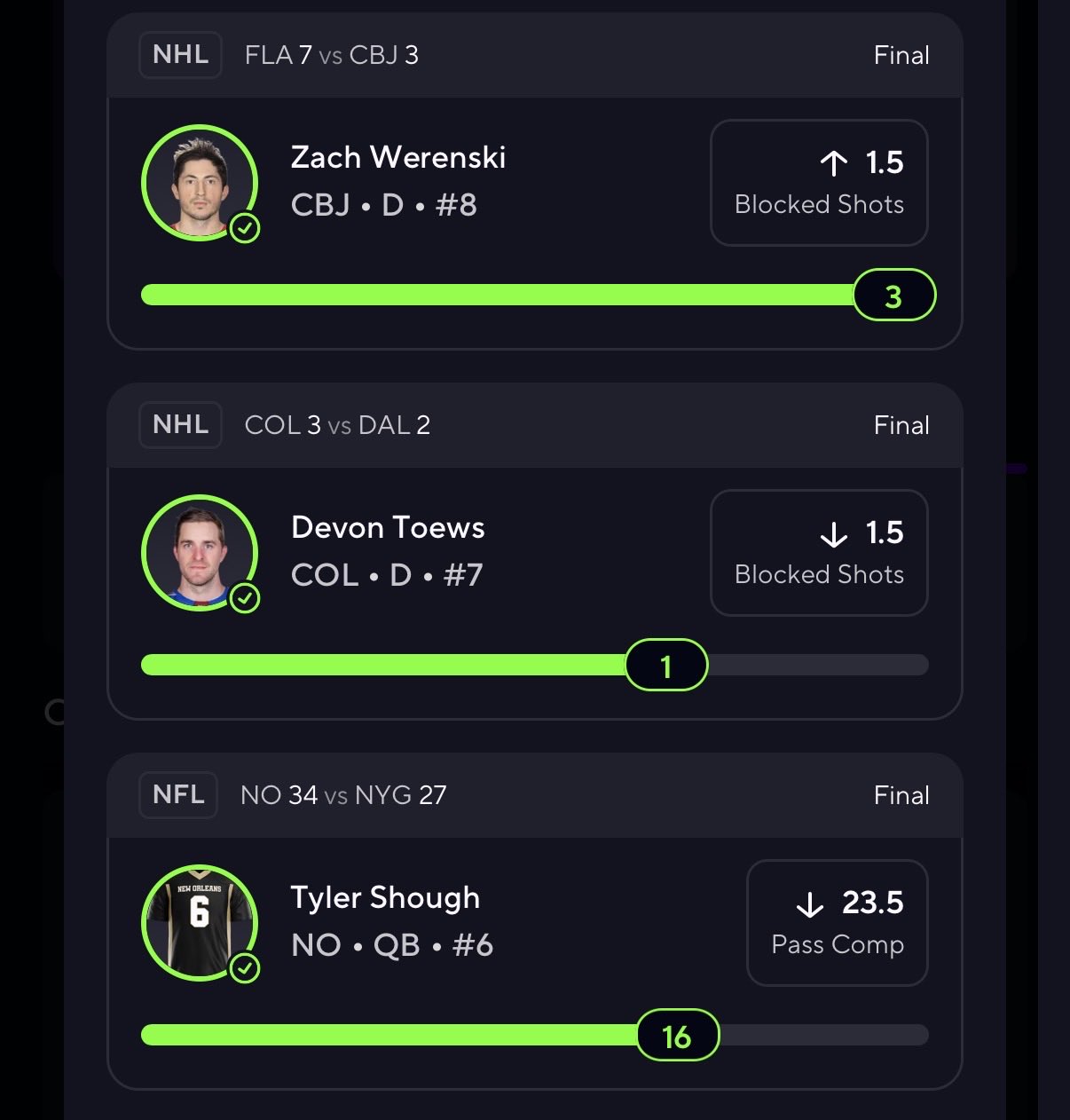
Not every good price is a crossed market. Sometimes one book or app is just cheaper than everyone else on one side. On October 13 Matt played Zach Werenski over 1.5 blocked shots in a PrizePicks 3 pick at 6x. Blocked shots is about as niche as hockey props get, and twelve books had the over priced anywhere from -130 to -244, with DraftKings at -165.
A 3 pick at 6x has to hit one time in six, so each leg needs about 55 percent, which works out to roughly -122 a leg. That was cheaper than every sportsbook on the board, and the Fantasy Props Optimizer had Werenski at 57.9 percent to go over. The -119 and 54.3 percent at the top of the screenshot below are the prices for a 6 pick Flex, which is a different entry type. For how PrizePicks entries map to odds, see PrizePicks -119 pricing explained.
When crossed markets and off market prices show up
They show up most where the least money has been bet: opening lines early in the week, and niche props like blocked shots, where books copy each other less and adjust more slowly. They close fast once sharp money finds them, so the habit that matters is checking the board when lines first go up, not the morning of the game.
Technically a market that adds up to under 100 percent could be bet on both sides for a small locked profit, but on the Chiefs that was 0.7 percent, and limits on the cheap side make it hard to size. The practical play is to bet the side the sharp exchange agrees with, at the book that is off. For more on why two sided arbitrage rarely pays, see is arbitrage betting still profitable.
Frequently asked questions
What is a crossed market in sports betting?
A crossed market is when two books price opposite sides of the same bet so differently that the implied probabilities add up to less than 100 percent. It means at least one of the two prices is wrong.
How do I check if a market is crossed?
Convert both sides to implied probability and add them. A favorite at -350 is 77.8 percent and an underdog at +365 is 21.5 percent, which adds up to 99.3 percent. Anything under 100 percent is crossed.
Is a crossed market the same as arbitrage?
In theory you can bet both sides of a crossed market for a small guaranteed profit, which is arbitrage. In practice the margin is usually under 1 percent and limits make it hard to size, so the better play is the side the sharp exchange agrees with.
When are crossed markets most common?
Early in the week when next weekend's lines first open, and on niche player props where books disagree the most. They tend to close quickly once sharp money finds them.
If a crossed market bet wins, does that prove it was a good bet?
No. A winning result is a sample of one. The bet was good because the price was better than the fair price when it was placed, and that would have been true even if it lost.