Why You Beat the Closing Line and Still Lose: The Over Tax on Player Props
By Matt Downs · October 27, 2026
Beating the closing line is supposed to be the scoreboard for a winning bettor, so why do so many bettors with positive CLV still lose money over a big sample? Matt Downs went back through more than 252,000 graded player props, 100,000+ bets that beat a sportsbook's closing number, every Novig and ProphetX trade since the summer, and 1,790 of his own prop bets to find out.
The short answer is that CLV is only as good as the closing number you grade it against. Sportsbooks overprice overs, so when you beat a sportsbook's close on an over, only about a third of that edge was real. Graded against an exchange's close instead, the problem disappears. This is Part 2 of the research; Part 1, whose odds the whole market follows, ranked the sharpest books.
Beating the close isn't the same as winning
The usual advice is that if you beat the closing line, the profit takes care of itself. That only holds when the closing number you beat was right in the first place. So instead of asking whether a bet beat the close, this test asks how much of that edge actually showed up in the results.
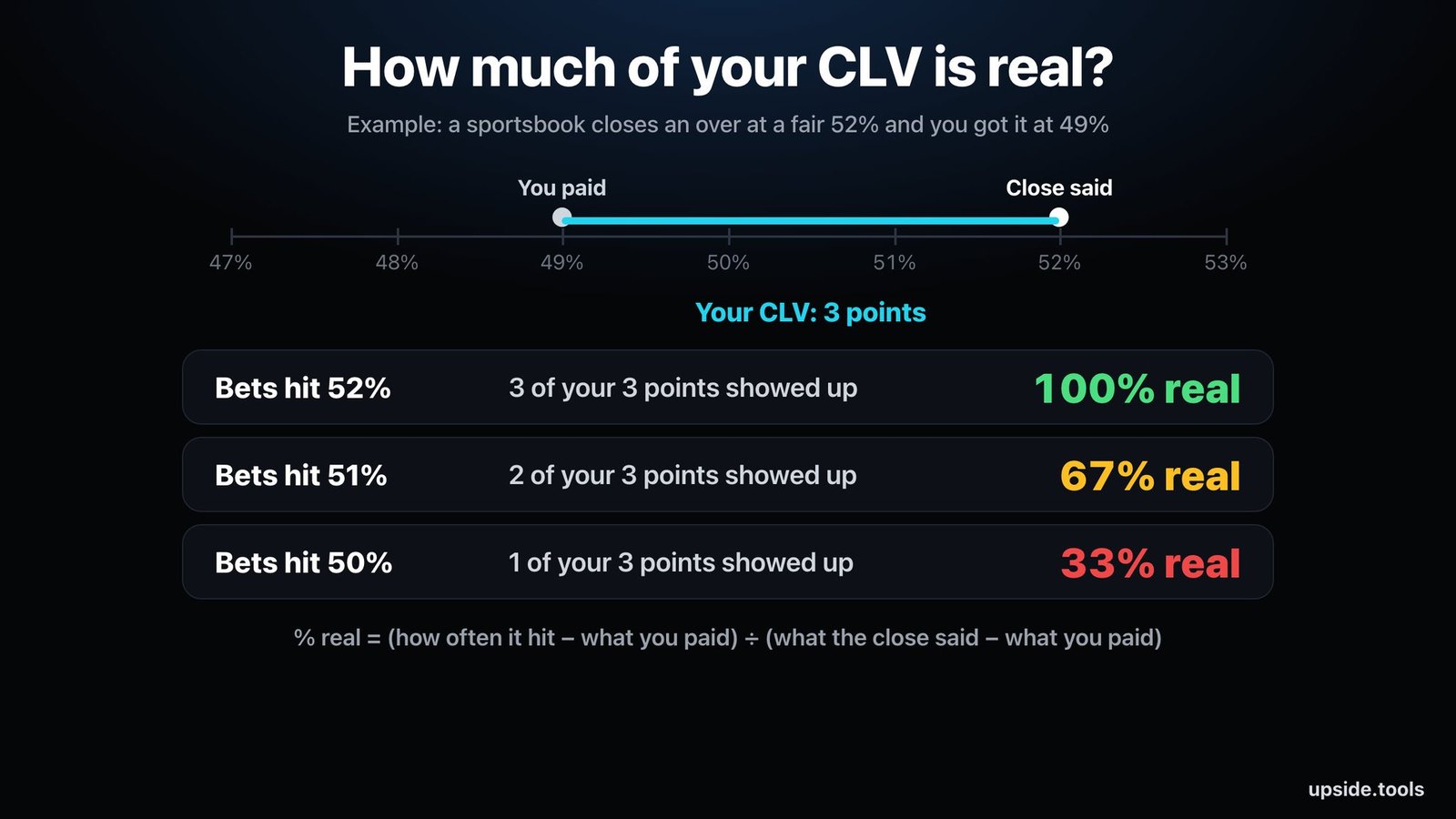
Here's the example. A sportsbook closes an over at a fair 52% and you got it at 49%, so your CLV says you have a 3 point edge. If those bets hit 52% of the time, all 3 points were real, which is 100%. If they hit 51%, 2 of the 3 points were real (67%), and at 50% only 1 was (33%). Over 100% means the edge was even bigger than the close said. The test ran on more than 100,000 bets that beat a sportsbook's close, each one graded against the box score. For the basics of CLV itself, see why positive CLV means you're making sharp bets.
The over tax is at every sportsbook
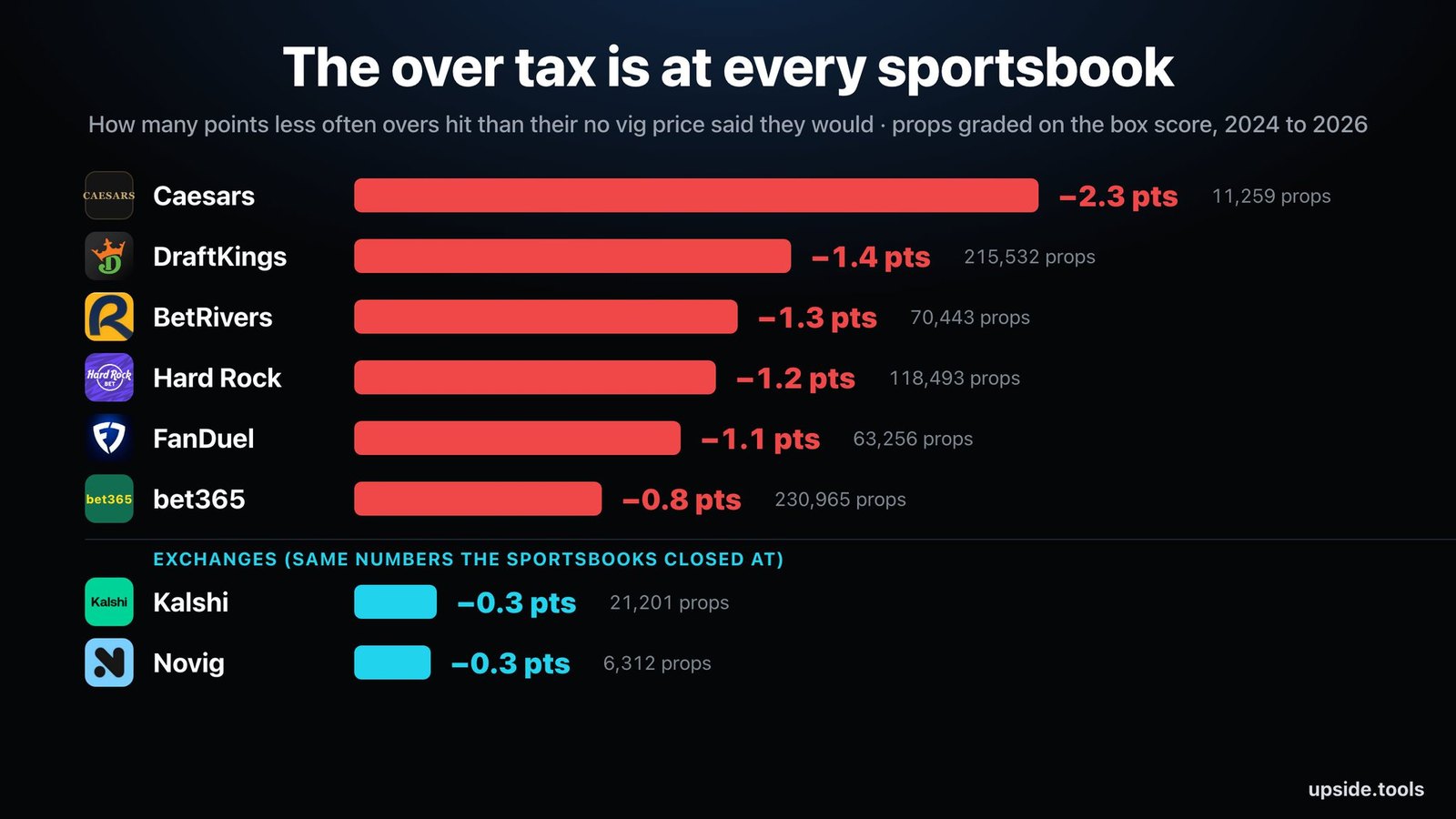
Checked one sportsbook at a time, overs hit less often than their no vig price said they would at every single book. Kalshi and Novig, priced on the exact same props, were within a third of a point. Novig's sample is smaller, so treat that one as early.
The likely reason is the public's love of overs. Nobody wants to root against their guy, so a sportsbook can charge more for the over and still get the action, and removing the vig with a no vig calculator doesn't remove that lean. On an exchange there's no house setting the price, so there's nothing to lean. It's the same pattern behind why unders beat overs on player props.
How many points less often overs hit than their no vig price
| Caesars | −2.3 | 11,259 props |
|---|---|---|
| DraftKings | −1.4 | 215,532 props |
| BetRivers | −1.3 | 70,443 props |
| Hard Rock | −1.2 | 118,493 props |
| FanDuel | −1.1 | 63,256 props |
| bet365 | −0.8 | 230,965 props |
| Kalshi (exchange) | −0.3 | 21,201 props |
| Novig (exchange) | −0.3 | 6,312 props |
Where the over tax is worst, by sport and by stat
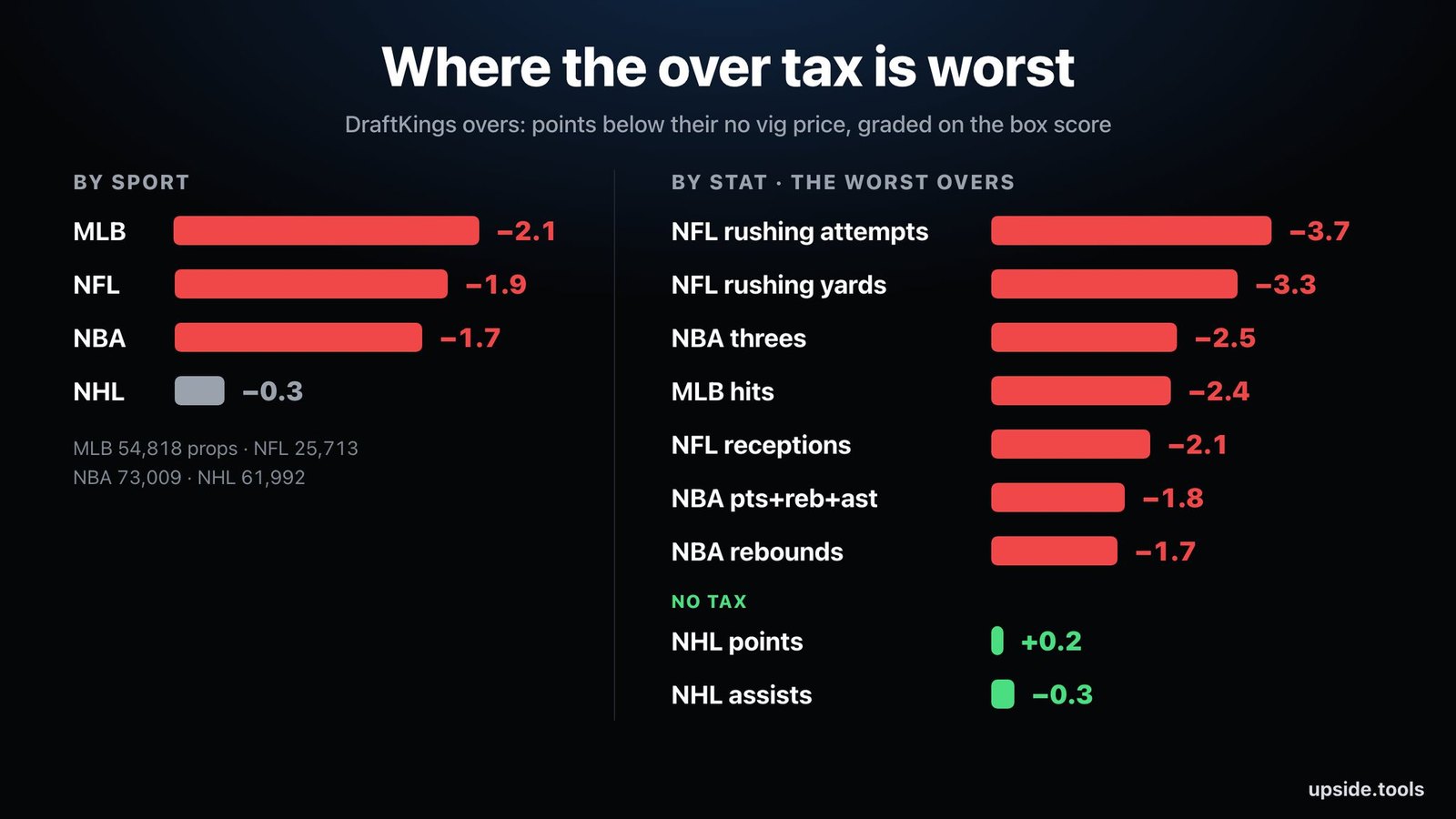
At DraftKings the over tax is 2.1 points in MLB, 1.9 in the NFL, 1.7 in the NBA, and basically nothing in the NHL (0.3). By stat, it's worst on exactly the overs the public loves: NFL rushing attempts (−3.7), NFL rushing yards (−3.3), NBA threes (−2.5), MLB hits (−2.4), NFL receptions (−2.1), NBA points plus rebounds plus assists (−1.8) and NBA rebounds (−1.7). NHL points and assists show no tax at all on 20,000+ props each.
In practice, an NFL rushing yards over that only sportsbooks are pricing is about 3 points less likely than the board says, which is roughly 6% of EV that was never there.
What the over tax does to your CLV
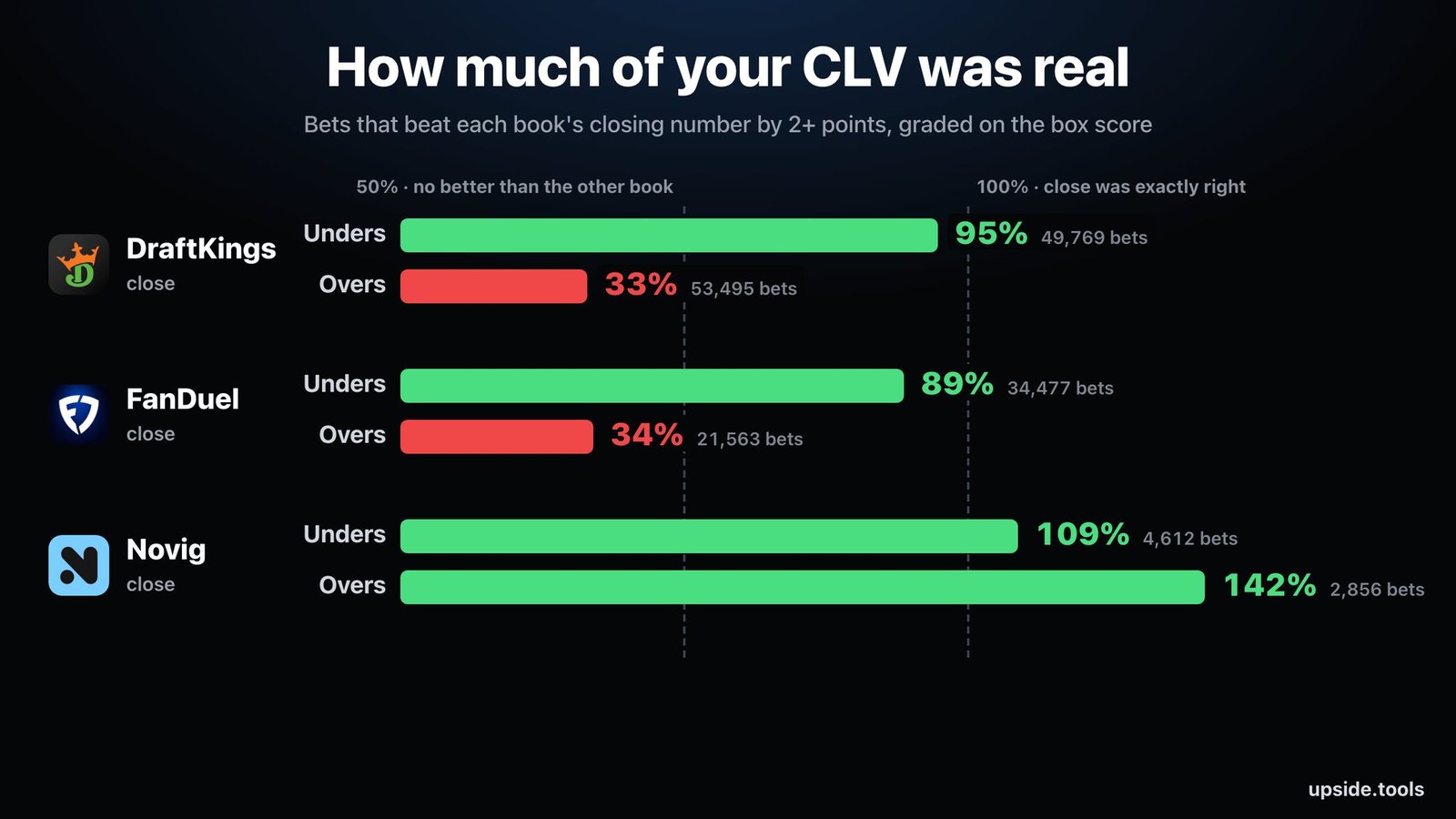
When a price beat DraftKings' closing number by 2 or more points, 95% of the edge was real on unders (49,769 bets) but only 33% on overs (53,495 bets). FanDuel's close told the same story: unders 89%, overs 34%. So 3% of CLV on an over, graded against a sportsbook close, was really about 1%.
When the closing number was Novig's instead, the over problem disappeared: overs came in at 142% (2,856 bets) and unders at 109% (4,612 bets). It's a smaller sample, but the gap is huge. The overs were never the problem. The sportsbook close was, and if you grade your overs against a sportsbook's closing line, your CLV is overstating your edge.
Share of CLV that was real, bets that beat the close by 2+ points
| DraftKings close, unders | 95% | 49,769 bets |
|---|---|---|
| DraftKings close, overs | 33% | 53,495 bets |
| FanDuel close, unders | 89% | |
| FanDuel close, overs | 34% | |
| Novig close, unders | 109% | 4,612 bets |
| Novig close, overs | 142% | 2,856 bets |
Matt's own receipts
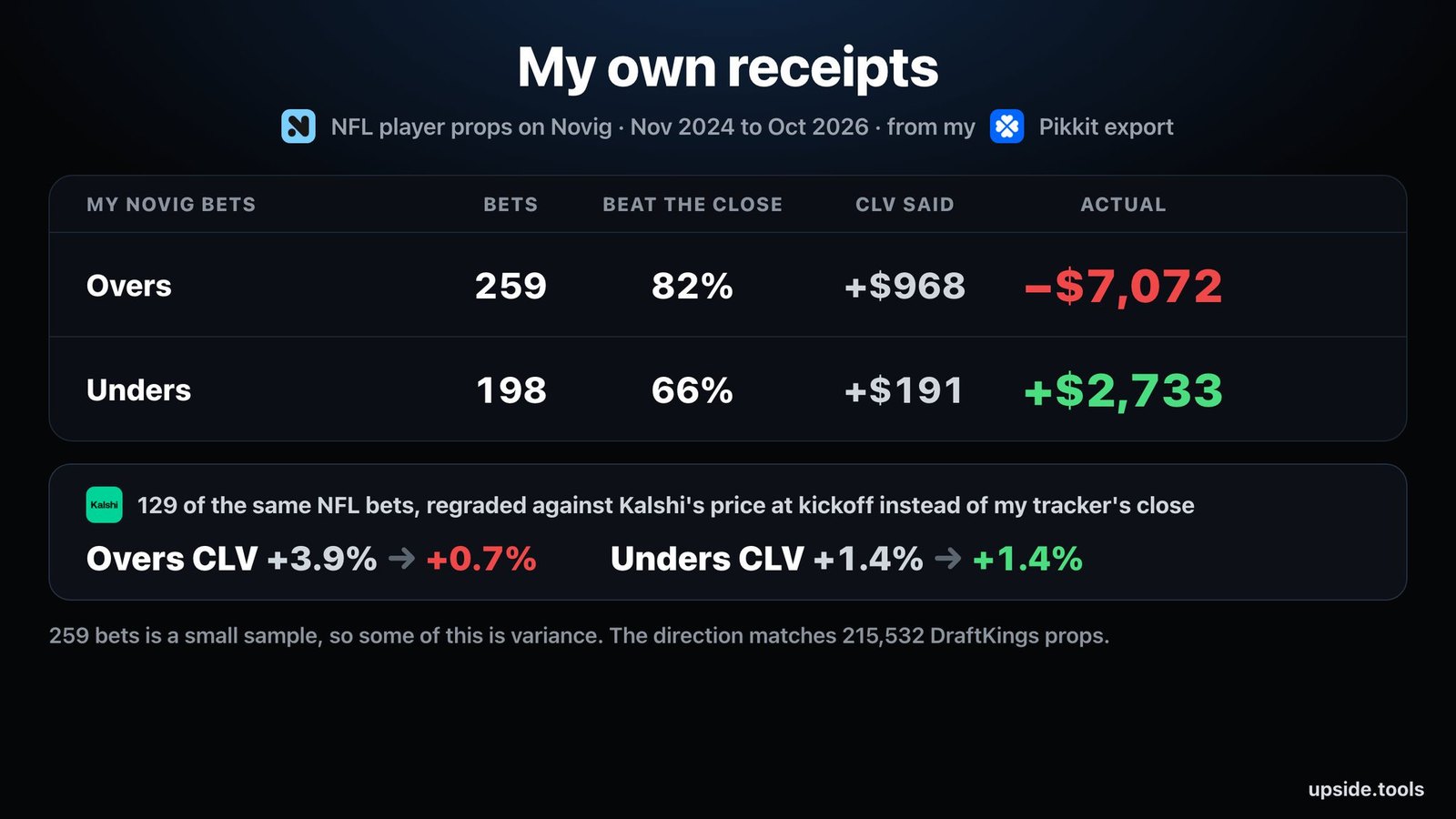
The same test on Matt's own Novig bets showed the same thing. On his NFL player prop overs he beat his tracker's closing line 82% of the time, and based on that CLV he should have made +$968 on $49,092 risked. He lost $7,072. His NFL unders beat the close 66% of the time, the CLV said +$191, and he made +$2,733.
That's a small sample of 259 overs, so some of it is variance, but it points the same way as 215,532 DraftKings props. When 129 of those NFL bets were regraded against Kalshi's price at kickoff instead of the tracker's close, the overs CLV dropped from +3.9% to +0.7% while the unders stayed at +1.4%. Same bets, same results; the only thing that changed was whose closing number they were graded against.
When does an exchange price actually count?
An exchange close is only as good as the money behind it, so every exchange close was split by how much traded on that market before the game. On ProphetX, markets with under $100 traded were 52% real and $100 to $1,000 was 47%, but $1,000+ was 133%. On Novig, under $1,000 was 79% (a smaller sample with wide error bars) and $1,000+ was 134%.
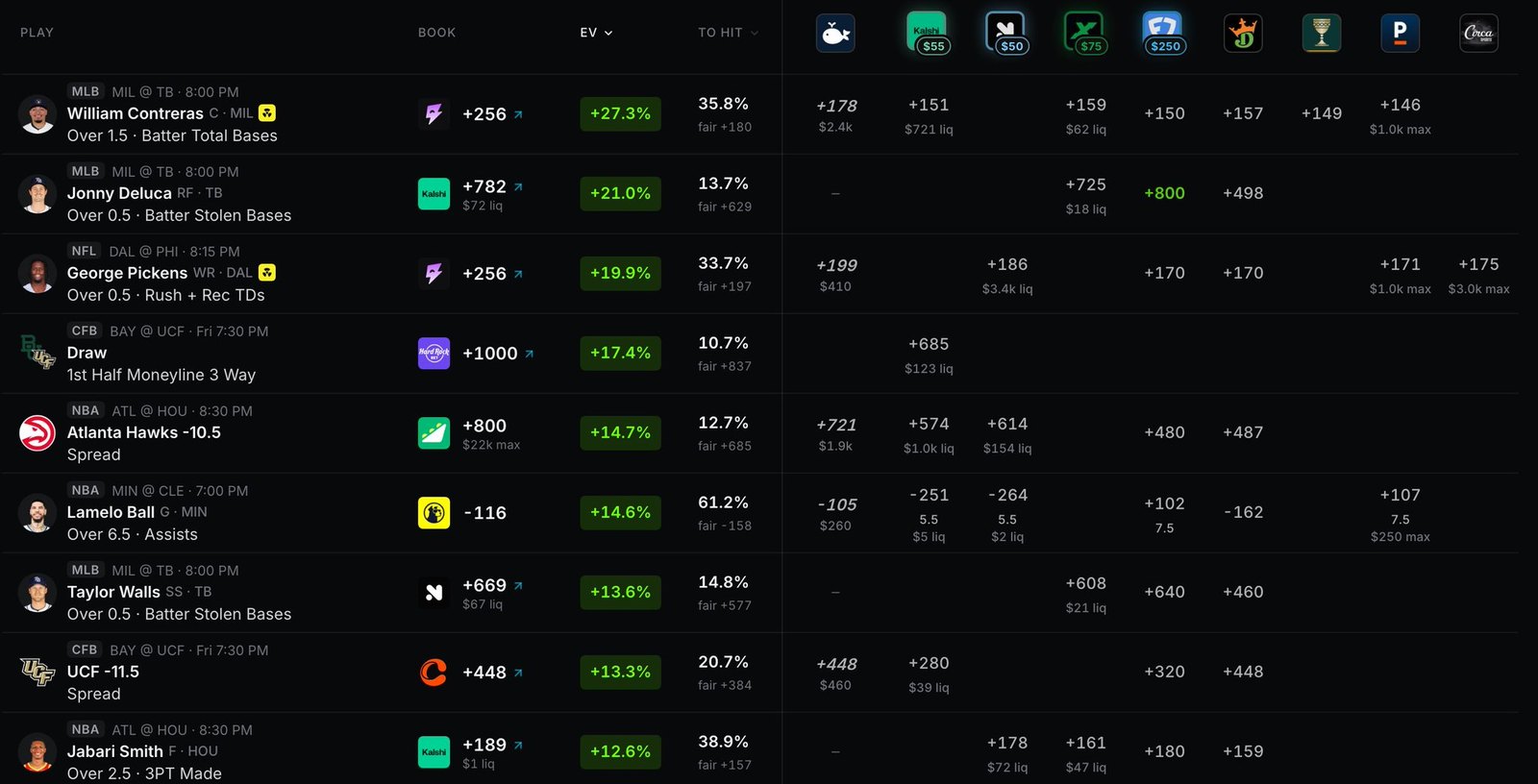
Once real money hits a market, the exchange close is the sharpest number out there. Before that, a thin ProphetX price was no better than the sportsbook it disagreed with. Most Novig props clear the bar: 62% had $1,000+ traded before the game, while the median ProphetX prop had $55. On the +EV Sniper, the number under each exchange price is how much you can bet at that price right now. That is money still available, not money already traded, so it can't tell you whether a market cleared the $1,000 bar, but a thin number is a reason to check the market before you trust the price.
Game lines: whose number to trust when you bet early
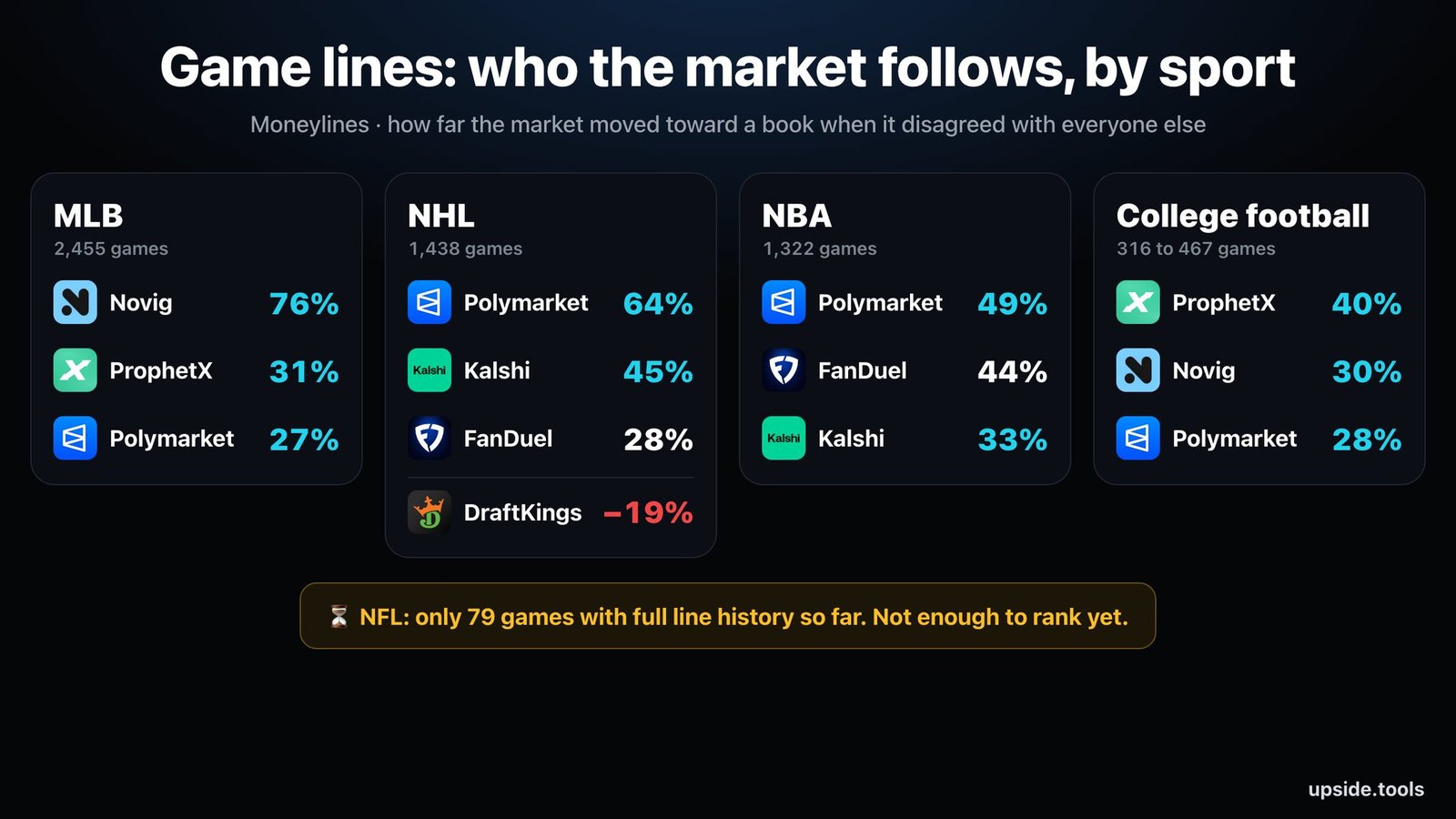
Part 1 ranked who the whole market follows on game lines, and split by sport the leader changes. The test: when a book disagreed with everyone else 24, 6 or 1 hour before the game, how far did the market move toward it by the close?
In MLB moneylines Novig led at 76%, then ProphetX 31% and Polymarket 27% (2,455 games). In the NHL, Polymarket led at 64%, then Kalshi 45% and FanDuel 28%, while DraftKings came in at −19%, so when it disagreed the market moved away from it (1,438 games). In the NBA, Polymarket (49%) and FanDuel (44%) were basically tied, then Kalshi at 33% (1,322 games). In college football, ProphetX led at 40%, then Novig 30% and Polymarket 28%. The NFL can't be ranked yet: only 79 games have full line history this season, so the error bars are around ±20 points. Novig and ProphetX trade history only starts this summer, so they're missing from the NBA and NHL numbers for now.
The part nobody wants to hear: variance
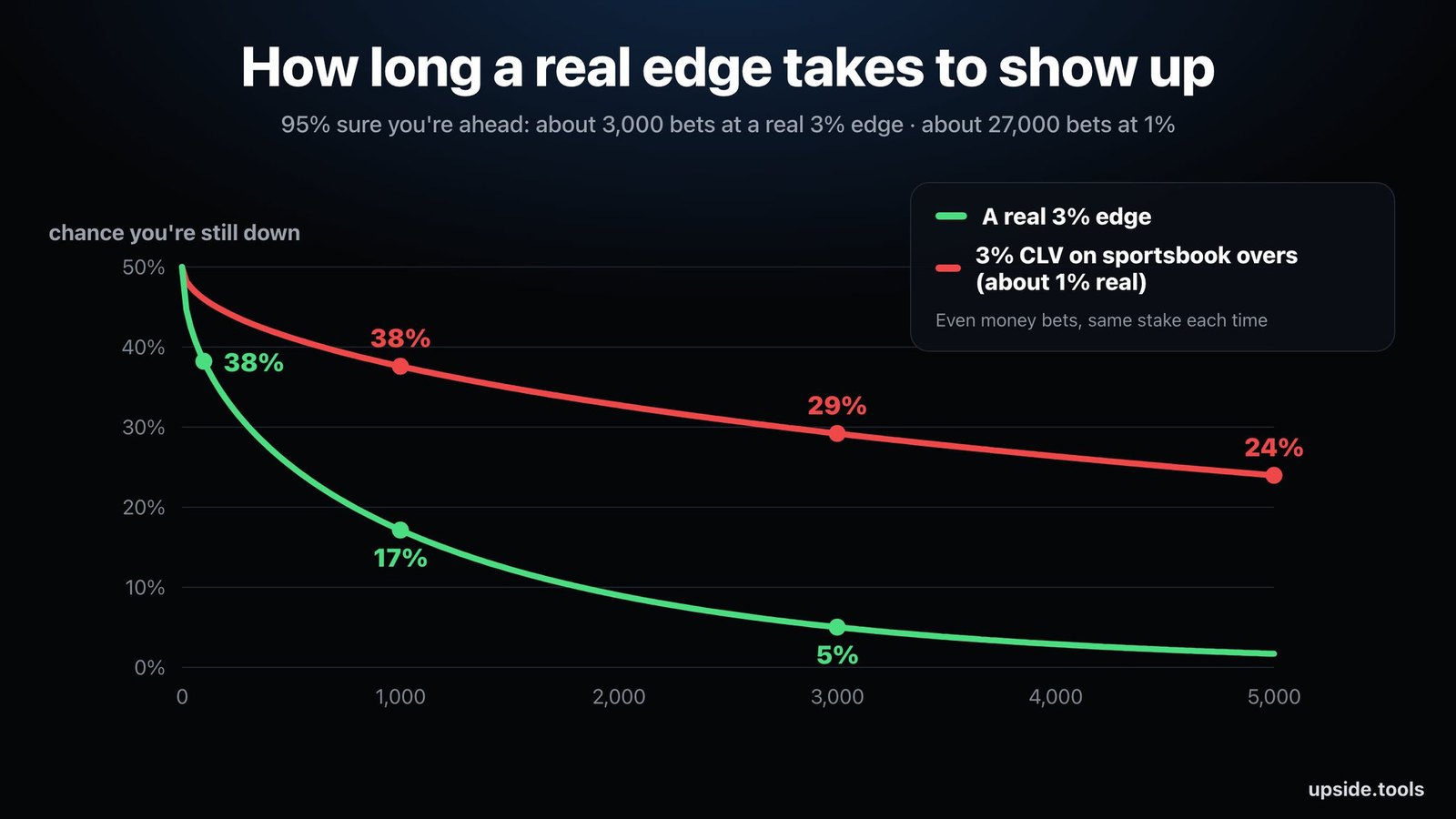
Even when an edge is 100% real, results take a long time to show up. With a real 3% edge at even money, there's a 38% chance you're still down after 100 bets, 17% after 1,000 and 5% after 3,000.
Take the same 3% CLV on sportsbook overs, where only about 1% was real, and you're still down 38% of the time after 1,000 bets and 29% after 3,000. It takes about 27,000 bets to be 95% sure you're ahead. More on that in how many bets it takes for variance to even out.
How to bet props with this
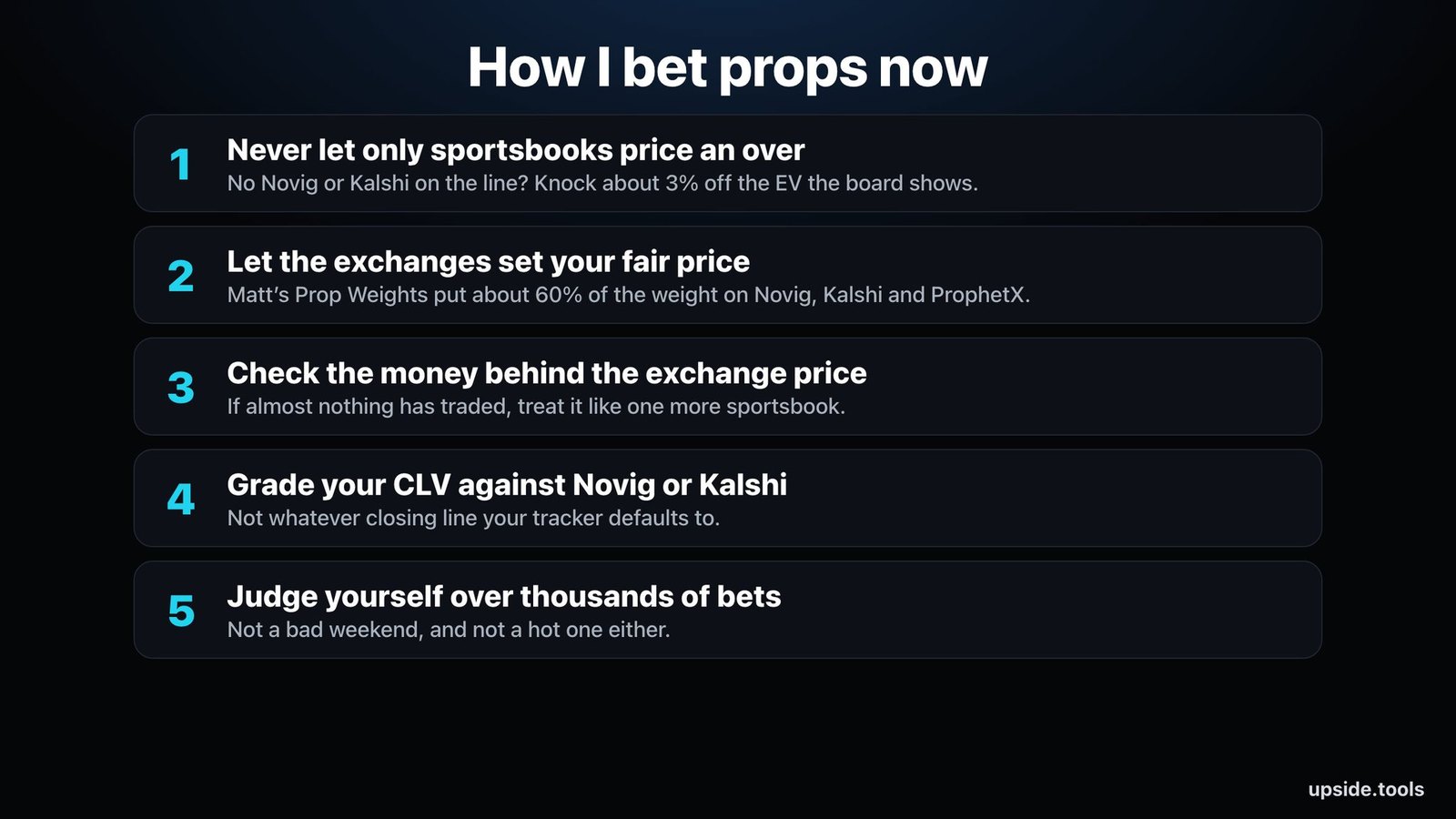
1. Never let only sportsbooks price an over. If Novig or Kalshi isn't on the line, knock about 3% off the EV the board shows (more on NFL rushing, almost nothing in the NHL). 2. Let the exchanges set your fair price. Matt's Prop Weights put about 60% of the weight on Novig, Kalshi and ProphetX for exactly this reason; see how consensus book weights set a fair price. 3. Check the money behind the exchange price. If almost nothing has traded, treat it like one more sportsbook. 4. Grade your CLV against Novig or Kalshi's close, not whatever closing line your tracker defaults to. 5. Judge yourself over thousands of bets.
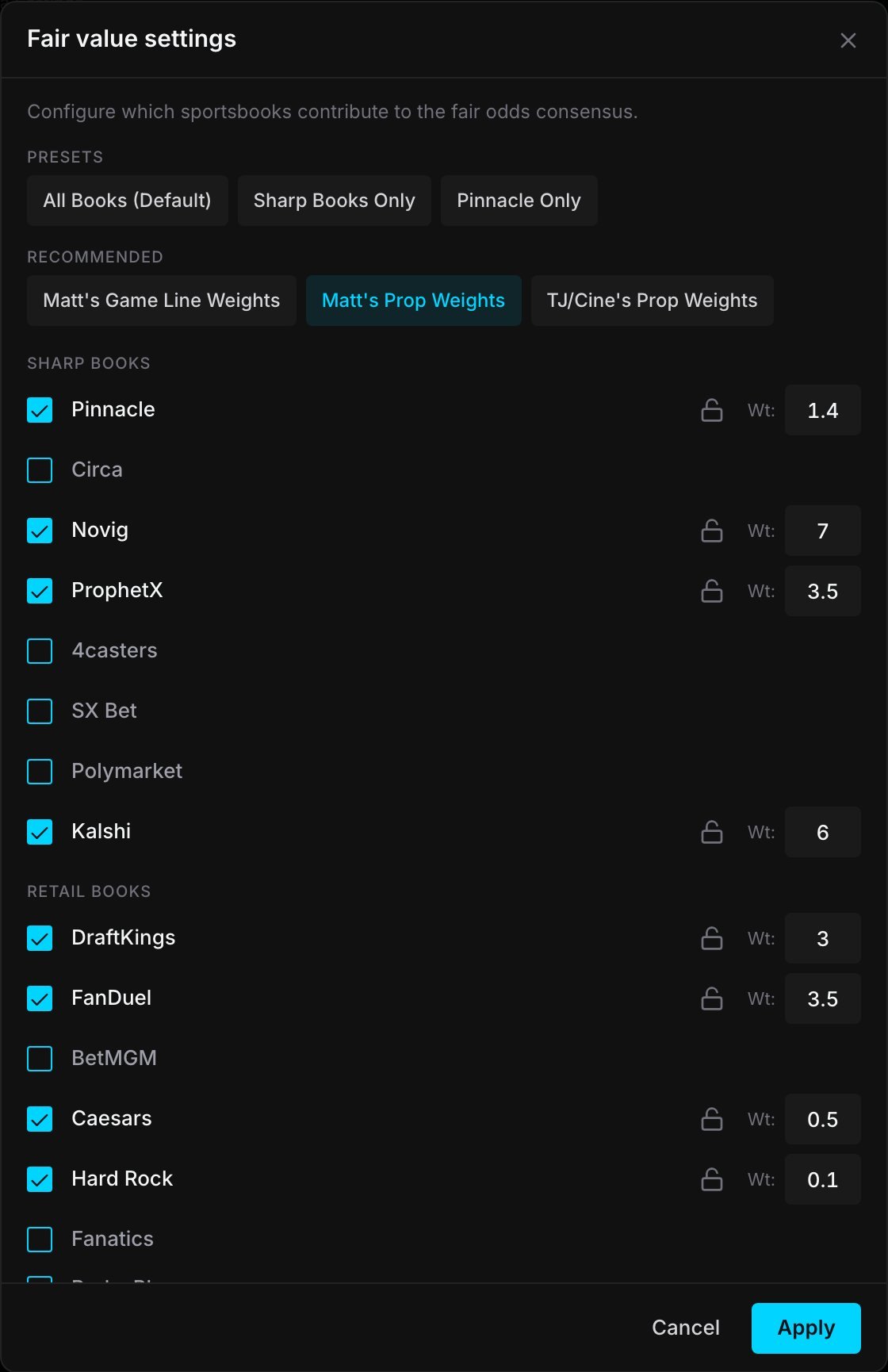
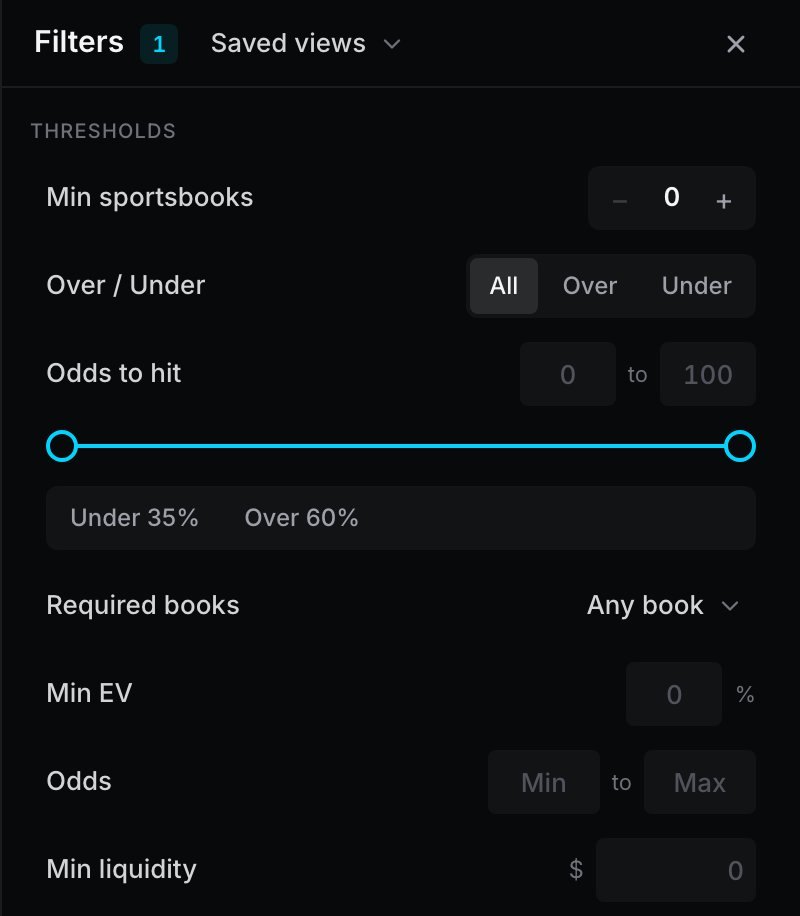
To set it up on Upside: open the +EV Sniper or the +EV Optimizer and click Filters. Next to Fair value, click Weights, pick Matt's Prop Weights, then Apply. Under Required books, pick Novig or Kalshi when you're betting overs, raise Min sportsbooks to 3 or more, then apply the filters. Every EV on the board is then measured against a fair price that's mostly exchange money.
Summary
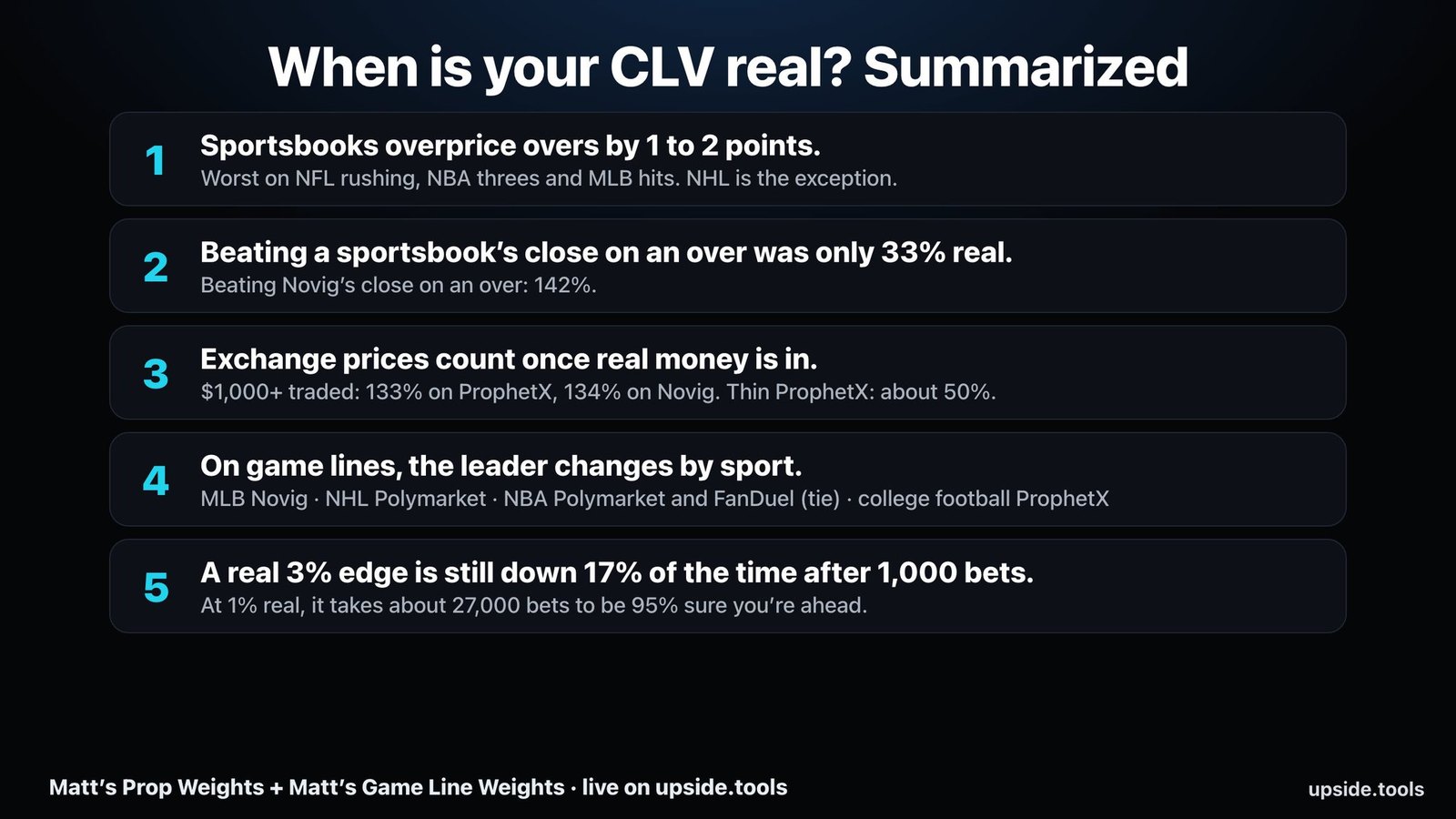
The closing line is still the best scoreboard in sports betting. You just have to know whose close you're reading. Sportsbooks overprice overs by 1 to 2 points, worst on NFL rushing, NBA threes and MLB hits, with the NHL the exception. Beating a sportsbook's close on an over was only 33% real, while beating Novig's close on an over was 142%. Exchange prices count once real money is in ($1,000+ traded: 133% on ProphetX, 134% on Novig), and thin ProphetX markets were about 50%. On game lines the leader changes by sport, and a real 3% edge is still down 17% of the time after 1,000 bets.
Frequently asked questions
Why do I beat the closing line and still lose money?
Usually because the closing line you beat was wrong, or because the sample is too small. Sportsbooks overprice overs on player props, so beating a sportsbook's close on an over was only about 33 percent real across 53,495 graded bets. Variance also matters: even a real 3 percent edge is still down 17 percent of the time after 1,000 bets.
What is the over tax in sports betting?
It is how much less often overs hit than their no vig price says they should. Across player props it ranged from 0.8 points at bet365 to 2.3 points at Caesars, and it was worst on NFL rushing attempts, NFL rushing yards, NBA threes and MLB hits. Exchanges like Kalshi and Novig were within a third of a point.
Which closing line should I grade my CLV against?
An exchange close with real money behind it, such as Novig or Kalshi. When the close was Novig's, overs that beat it were 142 percent real and unders 109 percent, while the same overs graded against a DraftKings close were only 33 percent real.
Is a Novig or ProphetX price sharp if only a little money traded?
Not until real money is in. Exchange closes with 1,000 dollars or more traded were 133 to 134 percent real, while ProphetX markets with under 1,000 dollars traded were only about 50 percent real, no better than the sportsbook they disagreed with.
How many bets does it take to know if my edge is real?
More than most people think. With a real 3 percent edge at even money there is still a 5 percent chance of being down after 3,000 bets, and with only 1 percent of real edge it takes about 27,000 bets to be 95 percent sure you are ahead.