How to Weight Sportsbooks When You Build a Fair Odds Consensus
By Matt Downs · August 24, 2026
Every +EV number you have ever seen is a subtraction. A model builds one fair price for a market, compares it to what a book is actually offering, and shows you the gap.
Which means the whole thing rests on that fair price. And a fair price is not handed down from anywhere. It is a blend of sportsbook prices that somebody chose, weighted the way somebody decided to weight them. Usually that somebody is not you, and usually you cannot see the choice at all.
What a fair odds consensus actually is
A sportsbook price contains two things: an estimate of how likely something is, and a margin the book keeps. Devigging strips the margin out and leaves the estimate, and you can do it by hand on any two-sided market with the no-vig calculator. Do that to several books and you have several estimates of the same event.
A consensus blends those estimates into one number. The naive version treats every book equally. That is rarely what you want, because the books are not equally informative, and some of them are copying the others.
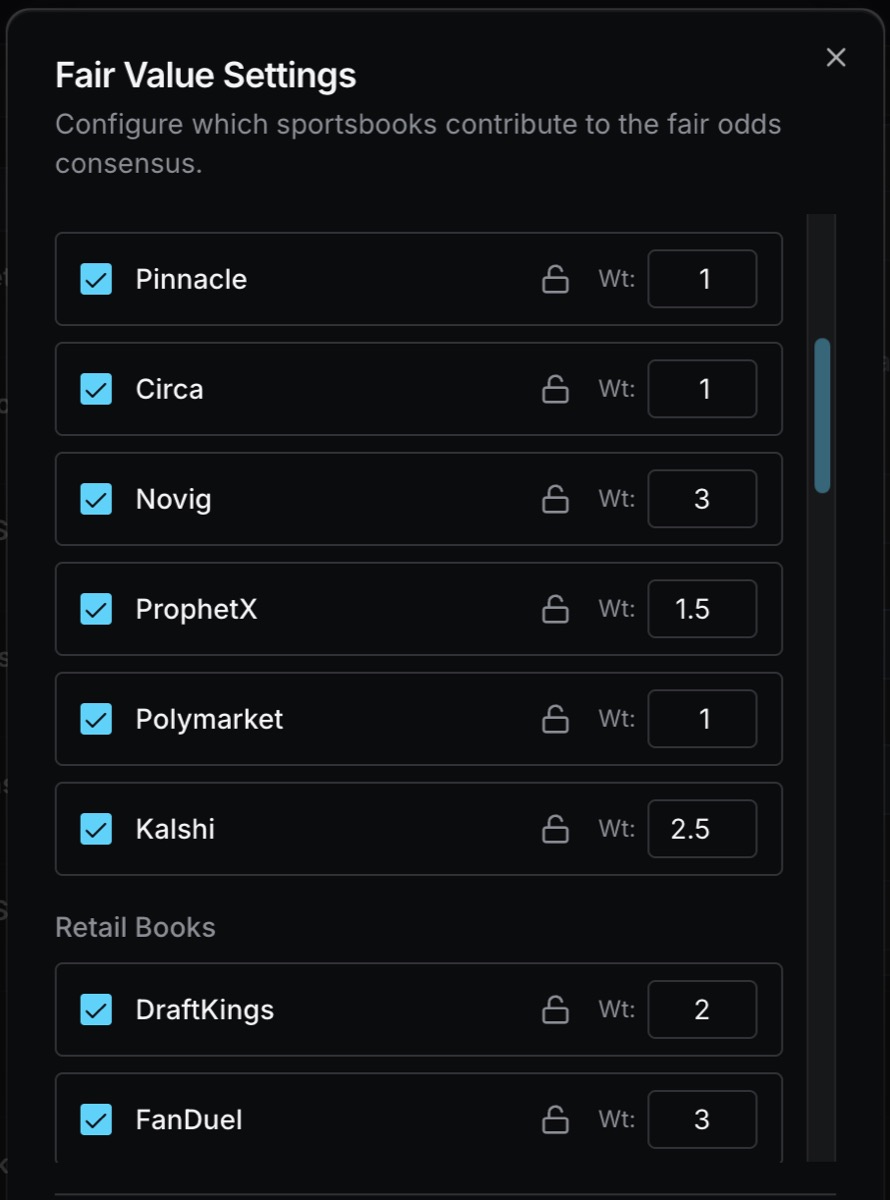
Weighting is how you say so. Give a book a weight of 3 and it pulls the blend three times as hard as a book at 1. Set a book to zero, or uncheck it, and it stops counting entirely.
Why equal weighting quietly breaks the number
Two failure modes matter. The first is copying. If several books all follow the same originator, an equal-weight average counts one opinion many times and then reports false agreement. The blend looks confident precisely where it is least independent.
The second is coverage. A book that posts a market late, or with a wide spread, is contributing an estimate it does not really hold. Including it does not add information, it adds noise with a vote.
Props and game lines need different weights
This is the part most people miss, and it is the reason a single global weighting is a mistake. A book that prices a spread or a total sharply is not automatically good at pricing a rebounds line or a strikeout total.
Game lines are the most watched markets in the industry. They get corrected fast, by many participants, and the books that lead them are well known. Player props are a different environment: far more markets, thinner attention per market, later posting, and wider variation in who bothers to price them well.
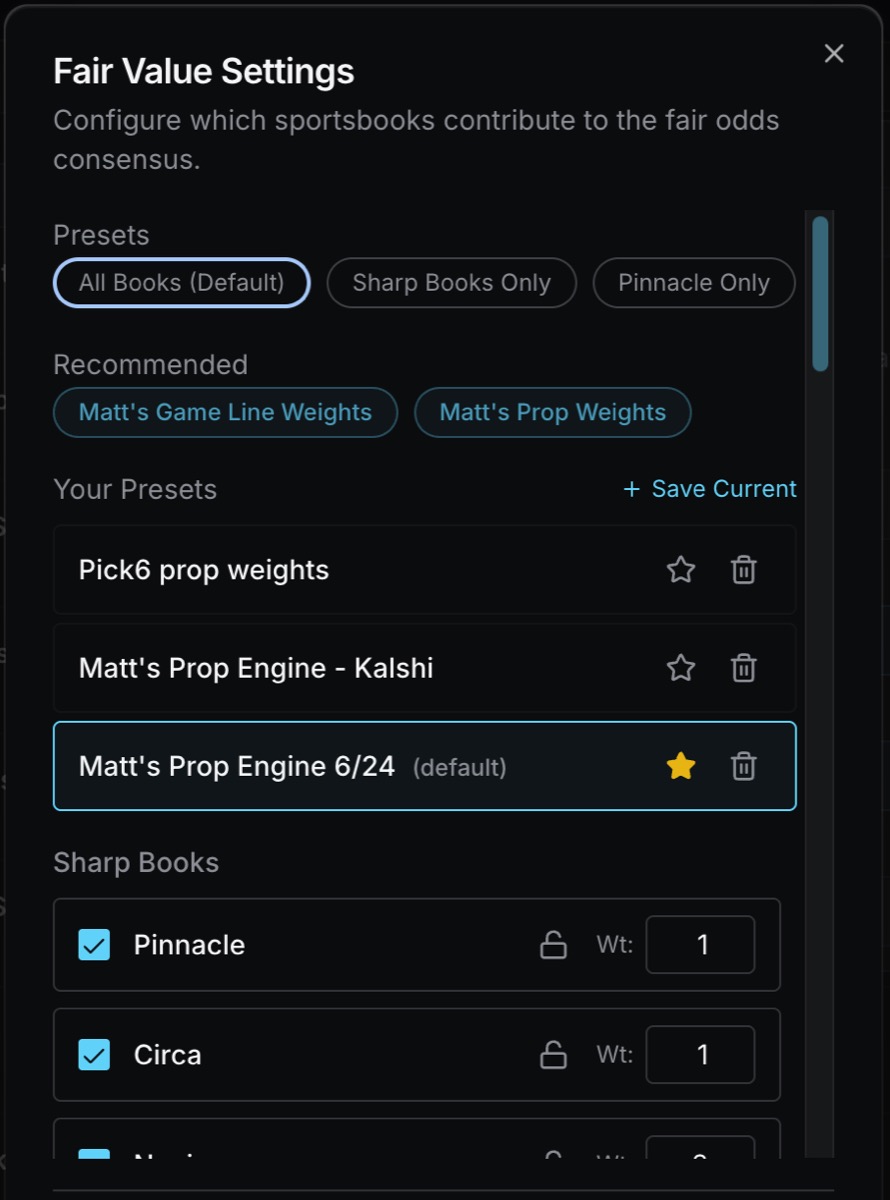
So the honest setup is two presets. One for game lines, one for player props, each weighted to the books that actually do the work in that market. The preset shown above is a prop preset, which is why its ordering will look wrong to anyone reading it as a game line model.
Game lines and player props are different environments
| Number of markets | Game lines: few per game. Props: dozens per game. | |
|---|---|---|
| Attention per market | Game lines: very high. Props: thin and uneven. | |
| Posting time | Game lines: early. Props: often late, sometimes minutes before lock. | |
| Who prices well | Different sets of books, which is the whole argument for two presets. |
Excluding a book changes the number as much as promoting one
Weighting conversations focus on which books to trust. The other half is which ones to remove, and it moves the blend just as hard.
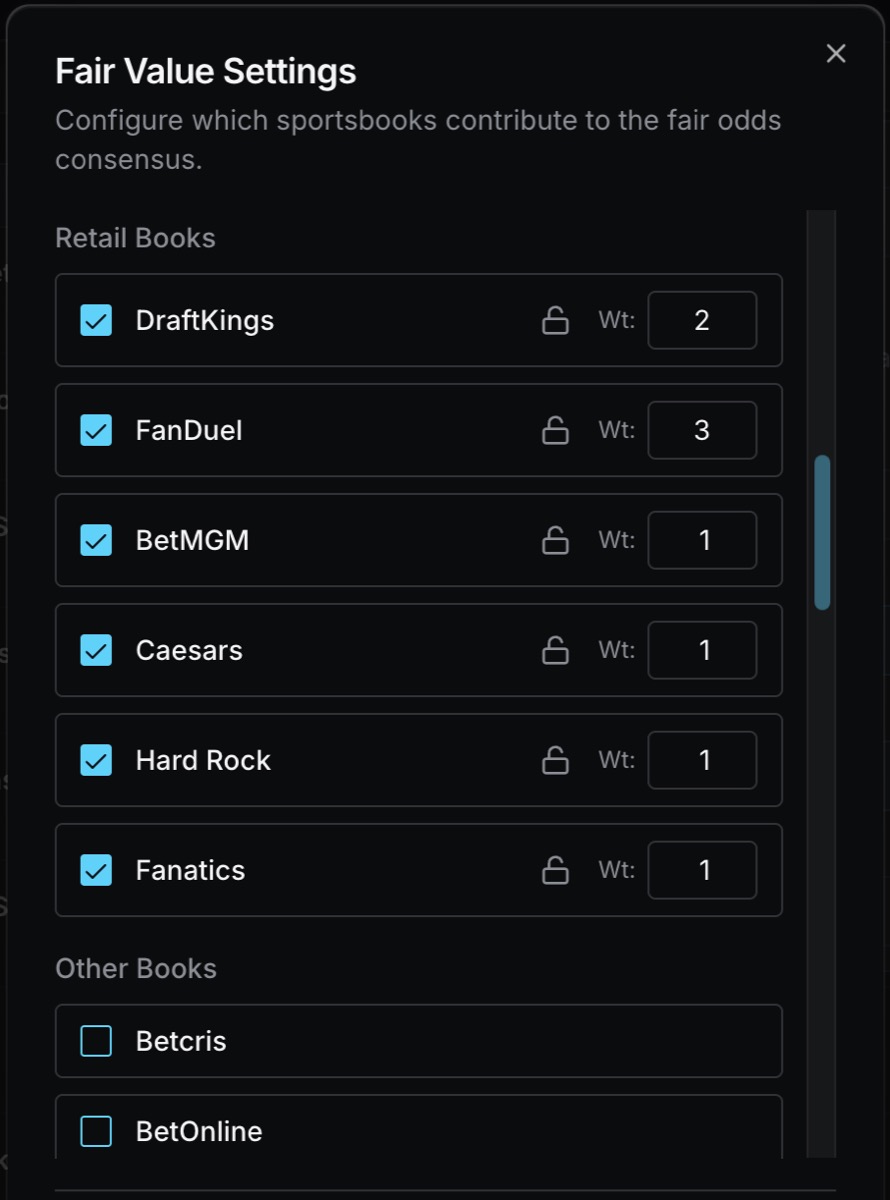
A book you never intend to bet at can still be worth including if it prices independently, because you are using it as information rather than as a destination. Equally, a book you bet at constantly can be worth excluding from the consensus, because measuring a price against a blend that already contains it drags the gap toward zero and hides real edges.
That last point is the one worth sitting with. If the book you are evaluating is inside your own fair price, you have partly asked it to grade its own work.
What to change first if you have never touched this
Start from a preset rather than a blank slate. Sharp Books Only is a reasonable first move, because it answers the copying problem bluntly, and it will show you immediately how far the fair price shifts when the retail books stop voting.
Then change one thing at a time and watch what happens to the board. If a weight change reshuffles your +EV rows dramatically, that is information about how thin those edges were, not a sign you found a better model.
Finally, save it. A weighting you cannot reproduce tomorrow is not a model, it is a mood. Saved presets are what make the setup testable over a season.
The honest limit on all of this
Weights are judgment. Nothing above proves a particular number is correct, and anyone who tells you their weighting is objectively right is overselling it.
What is true is narrower and still useful: the consensus is a choice, that choice changes every edge you are shown, and a tool that hides the choice from you is making it on your behalf. Being able to see it and set it is the difference between using a model and being used by one.
Frequently asked questions
What is a fair odds consensus?
It is a single estimate of an event's true probability, built by removing the margin from several sportsbooks' prices and blending the results. It is the baseline that any +EV or edge figure is measured against.
Should I just use Pinnacle for fair odds?
A single-book consensus is defensible for game lines and much weaker for player props, where coverage is thinner and posting is later. Using one book also means inheriting its blind spots with no second opinion to catch them.
Should the book I am betting at be included in my fair price?
Usually not. If the book you are evaluating helps build the consensus, the measured gap between its price and fair value is pulled toward zero, so real edges look smaller than they are.
Do I need different weights for player props and game lines?
Yes. The two markets differ in how many exist, how closely they are watched, and how early they post, and the books that price them well are not the same set. Separate presets are the practical answer.
How do I know if my weighting is any good?
Change one input at a time and track whether the edges it surfaces hold up over a meaningful sample. If small weight changes reshuffle your board completely, the edges were thin to begin with.