Original research · August 17, 2026
The Three Pick Card Needs a Higher Hit Rate Than the Six
By Matt Downs
Fewer legs feels safer. Three things have to go right instead of six, so the three pick card reads as the conservative version of the same bet. Almost everybody building a card believes this.
The pricing says the opposite. A three pick card demands a higher hit rate from every single leg than a six pick flex does, and on a normal board there are far fewer rows that meet the standard. This is that arithmetic, run against a live board capture from August 16, 2026.
What a PrizePicks price actually demands
Every leg on the PrizePicks board carries a price, and that price is a percentage in disguise. Convert it and you get the hit rate you need before the bet is worth taking.
A leg priced -119 breaks even at 119 divided by 219, which is 54.34%. Below that hit rate you lose money on the row no matter how good the player looks. The free implied odds calculator does this conversion in one box.
Card size changes the number, because the payout structure changes. A six pick flex still pays something when one leg misses, and that cushion lowers what each leg has to carry. A three pick card has nothing underneath it. Miss one and the card is gone.
Three pick against six pick, same board, same moment
| Six pick price per leg | -119 | |
|---|---|---|
| Six pick break even per leg | 54.2% | |
| Three pick price per leg | -122 | |
| Three pick break even per leg | 54.95% | |
| Props eligible on the board | 44 | |
| Rows clearing 54.2% (six pick) | 5 | |
| Rows clearing 54.95% (three pick) | 1 | |
| Six pick card the optimizer built | +2.81% EV | |
| Three pick card it was forced to build | -1.33% EV |
Why the smaller card is the harder one to fill
The three pick card is priced -122 per leg rather than -119, and -122 breaks even at 54.95%. That is three quarters of a point more required from every leg than the six pick flex asks for.
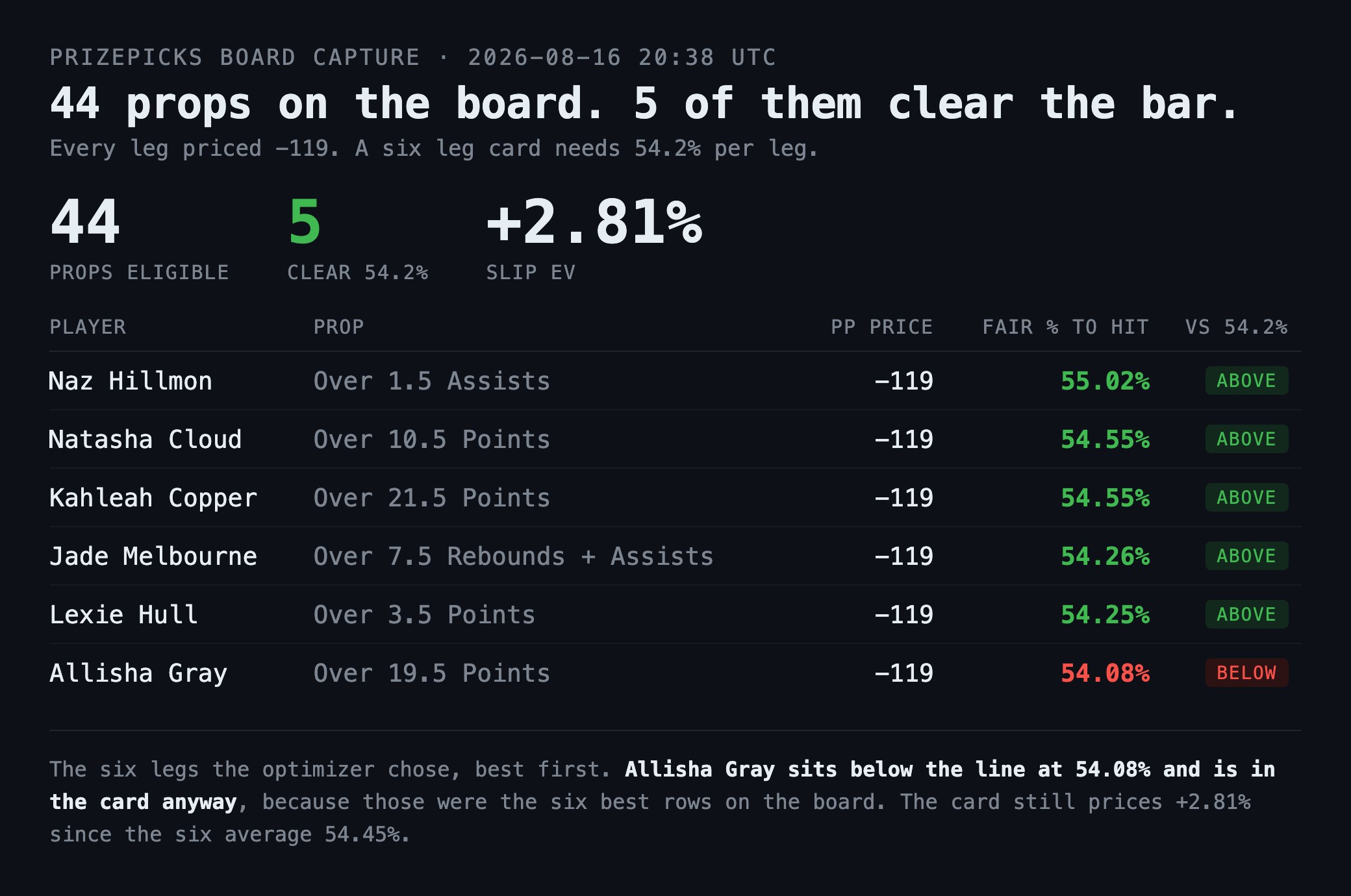
Three quarters of a point sounds like nothing until you count rows. On the board captured at 20:38 UTC on August 16, 2026, there were 44 props eligible to play. Five of them were priced above 54.2%. Exactly one was priced above 54.95%.
So the six pick card could be built out of real rows. The three pick card could not. The optimizer filled it anyway, because it was asked to, and the version it produced priced -1.33%. That is the honest cost of building a card the board does not support.
How much of the board clears the bar on a normal night
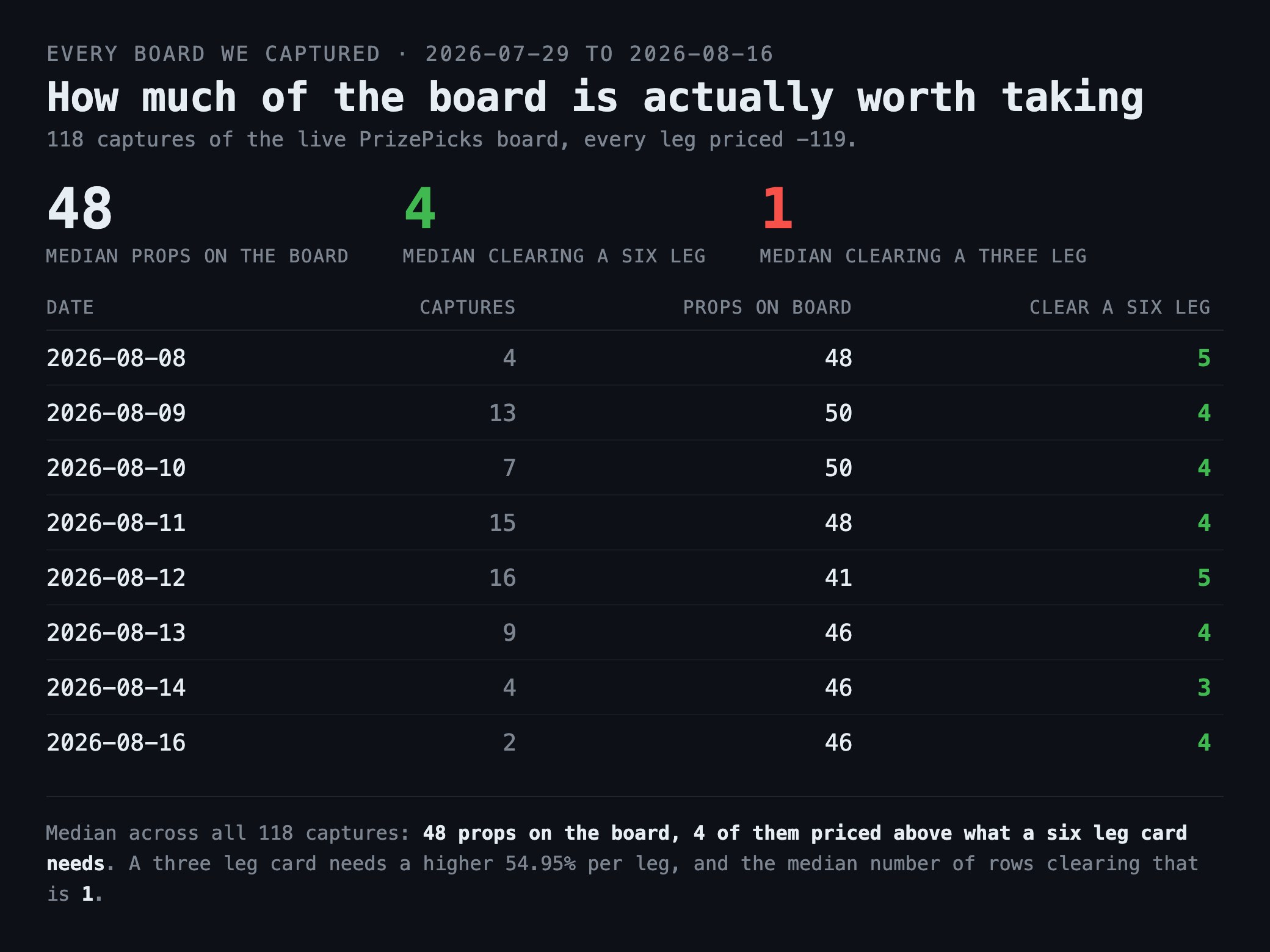
One capture proves nothing on its own, so here is the pattern across 118 captures of the live board taken between July 29 and August 16, 2026.
The median board held 48 props. The median number priced above what a six pick card needs was four, which is 8% of what a player is looking at. The median number clearing the three pick requirement was one.
That is the shape of it most nights. The board is large, the number of rows priced above break even is small, and the stricter the card structure the smaller that number gets.
The mistake that makes a bad row look like the best one
There is a trap in checking these rows by hand, and it is worth more than the rest of this article.
Take Allisha Gray over 19.5 points off that same board. PrizePicks had it at -119. Twenty one other books priced the same row, from -110 at stnsports out to -167 at kambi. Quoting the -167 against the -119 would let anybody claim an 8.21 point edge, and every number in that sentence is true.
It is still wrong, because one book is never the market. Devig all twenty one and the fair price on that row is 54.08%, which is below the 54.34% the -119 demands. The honest edge is negative. The row is a pass, and it is the one the optimizer marked below the line.
The rule that falls out of it: whenever a single book is cited as evidence of an edge, the fair price across the whole market has to be cited next to it. The free odds screen shows both sides of a market across 20 plus books, which is what makes the fair price checkable rather than something you take on faith.
The check, in full
Take the price your app is charging and turn it into the percentage it demands. On PrizePicks that is -119, so 54.34%.
Then find what the rest of the market says the same bet is worth. If the market's fair price is higher than what your price demands, the row qualifies. If it is not, the row is one of the other 43.
Adjust the bar for the card you are building. A six pick flex needs 54.2% per leg. A three pick card needs 54.95%. The stricter card is the one that needs the better rows, and on most boards those rows are not there.
Frequently asked questions
Is a 3 pick or 6 pick better on PrizePicks?
It depends on whether the board has rows priced well enough to fill it. A 3 pick card is priced around -122 per leg and needs 54.95% per leg to break even, while a 6 pick flex is priced -119 and needs 54.2%, because the flex payout still returns something when one leg misses. On a board captured on August 16, 2026, five of 44 props cleared the 6 pick requirement and only one cleared the 3 pick requirement.
What hit rate do you need to break even on PrizePicks?
At -119 per leg the break even hit rate is 54.34%, which is 119 divided by 219. The requirement per leg changes with card size and payout structure: about 54.2% for a 6 pick flex and about 54.95% for a 3 pick card. Anything below those numbers loses money over enough entries regardless of how the individual picks look.
Why does a smaller card need a higher hit rate?
Because there is no partial payout underneath it. A 6 pick flex pays out on 5 of 6 and on 4 of 6, so a single miss does not zero the card, and that cushion lowers what each leg has to carry. A 3 pick card pays only if all three land, so every leg has to be stronger to reach the same break even.
How many props on a PrizePicks board are actually worth taking?
Across 118 captures of the live board between July 29 and August 16, 2026, the median board held 48 props and the median number priced above what a 6 pick card needs was four, about 8%. For a 3 pick card the median was one.
Can one sportsbook's odds tell you a prop has an edge?
No. A single book can sit far off the market, and quoting it produces an edge figure that is arithmetically true and practically wrong. On Allisha Gray over 19.5 points, kambi's -167 against PrizePicks' -119 implies an 8.21 point gap, but the fair price devigged across all 21 books that posted the row was 54.08%, below the 54.34% the -119 demands. The edge was negative.