PrizePicks NFL Strategy: The Five-Part Process, With the Screens
By Matt Downs · September 6, 2026
This is the PrizePicks NFL process I will be running all season, in the order I actually run it. It has five parts: find where the apps disagree, decide which side of the disagreement is worth taking, check whether correlated legs still pay, let a scanner do the searching, and look at where large tracked bets landed before committing. Every screen below is a live capture from Upside on September 6, 2026, four days before Week 1.
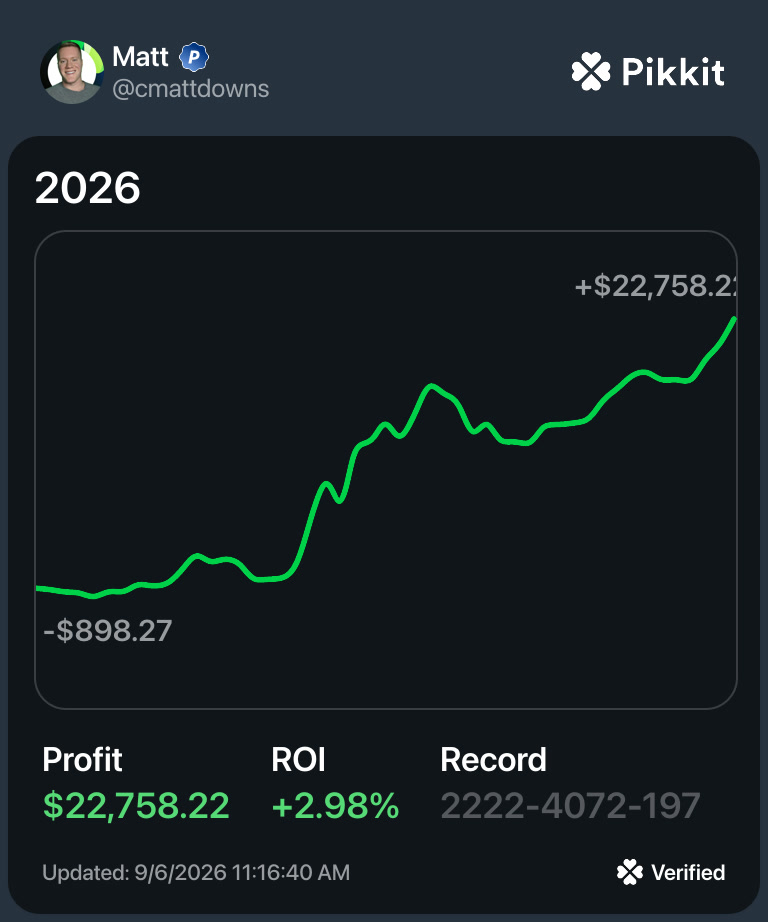
The numbers behind the process are on this page too, because a strategy article that hides the record is selling something. My tracked 2026 is up $22,758.22 on 6,491 outcomes at a 2.98% ROI, and PrizePicks currently limits me to $5 an entry. Both of those facts belong together.
1. Prop discrepancies: one player, two winning picks on opposite sides
Last season the clean example was Cam Skattebo's receiving yards against Dallas. Betr posted 12.5. PrizePicks posted 15.5. More than 12.5 on Betr and Less than 15.5 on PrizePicks both win at 13, 14 or 15 yards. He finished with 14. That is a middle: a range of finishing totals where both selections cash.
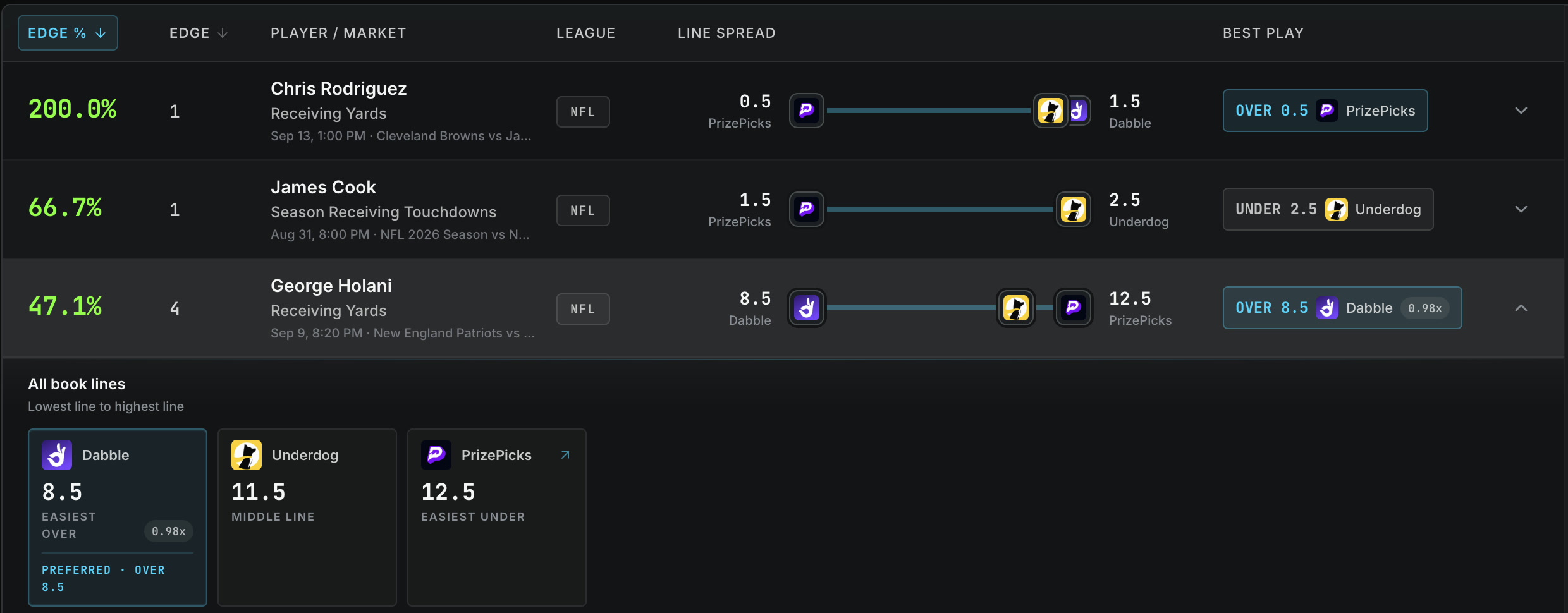
The same shape is on this week's board. George Holani, receiving yards, Patriots at Seahawks on Wednesday night. Dabble has 8.5, Underdog has 11.5, and PrizePicks has 12.5. Over 8.5 on Dabble and Under 12.5 on PrizePicks both win at 9, 10, 11 and 12 yards, four whole-yard totals. Eight or fewer and only the Under wins. Thirteen or more and only the Over wins.
Three finishing totals, or four, does not tell you how likely the middle is. A wider gap is worth investigating, and its value still depends on how likely the player is to land inside it and what the two sides cost. The place people give the advantage back is the rest of the entry: if the PrizePicks Under sits in a Power Play with another player who misses, the entry loses even though Holani did exactly what you wanted. Check the complete entries, the amounts and the payouts before playing both sides, and know what happens to the money if he finishes outside the window.
2. Line comparison: find the middle, then play only one side
If you are building specifically on PrizePicks, the Holani gap gives you a reason to investigate Under 12.5 on its own. Three other platforms have him lower. That is useful information rather than a pick, because the wider market and the payout still have to be checked.
The reason to compare before committing is that the exact threshold settles the entry and a good game does not. Suppose he finishes with 10. Over 8.5 wins. Over 12.5 loses. Same player, same performance, opposite result. It is easy to spend twenty minutes deciding a player will have a good game and then accept whatever projection is sitting on your app.
Four checks make a comparison trustworthy. Same market: same player, game, stat and period, since full-game and first-half receiving yards should carry different numbers. Current information, since a projection that moved an hour ago makes the comparison stale. Market support, since one outlying book is different from several reliable books on the same side of PrizePicks. And the odds beside the sportsbook lines, since a book can post a number while pricing one side much higher than the other, and those prices carry the book's margin. The no-vig calculator strips that margin out so a listed price can be read as a probability.
A disagreement is a candidate, not proof that PrizePicks is wrong. If the comparison holds after those checks the selection goes in. If it does not, leave the slot empty rather than fill a four-pick entry with a weak leg.
3. Positive correlation, and whether the payout charges you for it
A completed pass adds passing yards for the quarterback and receiving yards for the receiver, so those two outcomes move together. When every leg of an entry has to win, connected legs help. PrizePicks knows this too, and positive correlation does nerf the standard payout: a quarterback's passing yards Over in the same entry as his receiver's receiving yards Over pays a lower multiplier than an uncorrelated pair. The obvious combination is already priced, so the work is playing around with the combinations, and the multiplier on the entry actually being built is the number that decides it.
Teaching numbers, not a claimed hit rate: a four-pick entry with a 12% chance of every leg hitting returns an average of $1.20 per $1 at a 10x payout. Cut the payout to 8x with the same 12% and the average return is $0.96. The probability did not change. The price did. Flex entries need the partial-payout outcomes included as well, because correlation changes how often each combination of wins and losses occurs. The parlay calculator handles the structure; the correlation article covers which PrizePicks pairings get repriced.
In NFL the pairings worth researching are the ones with a football explanation, supporting evidence, and a payout that survives the nerf. The quarterback and receiver pair is the one PrizePicks reprices first, so a combination whose payout stays unchanged is worth noticing. A lead back's rushing attempts Over with the opposing quarterback's passing attempts Over describes a team playing from ahead and a team throwing to catch up. That back's attempts Over with the opposing lead back's attempts Under describes the same script from the other side. Each story breaks in specific ways: a committee backfield, a quarterback projection that already assumes a huge passing workload, a backup taking the late carries, one explosive play changing both game plans. The explanation gives you something to test. It does not establish an edge, and it never justifies taking the worst available number on one of the legs.
4. Automate the search with the +EV Sniper
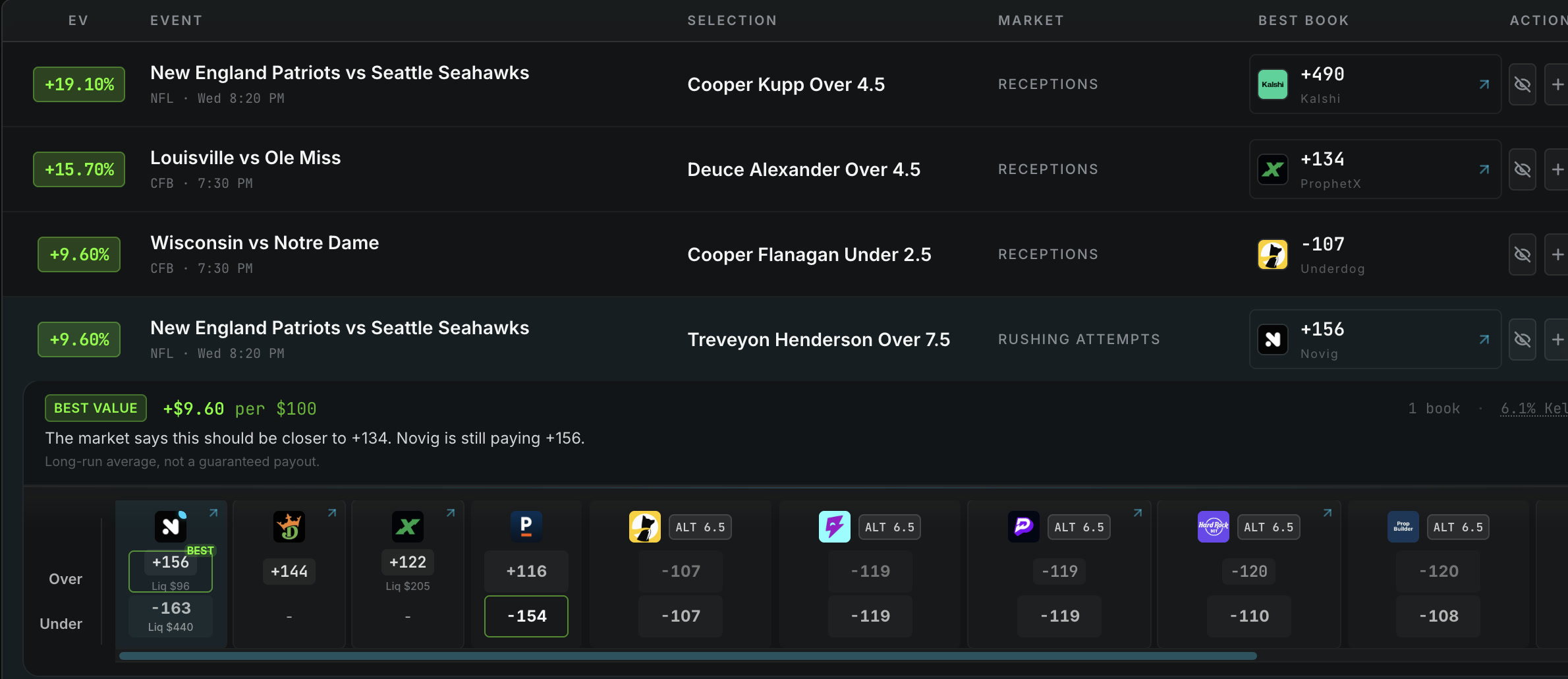
Doing the comparison work by hand is repetitive: open a player, check several books, inspect the odds, look for compatible legs, come back and find the projection moved. The +EV Sniper scans the supported markets and surfaces prices sitting above its fair-value estimate, so the work starts from a result instead of a blank search.
The expanded Treveyon Henderson row above is the check in practice. Novig is paying +156 on Over 7.5 rushing attempts. The devigged market across the books on the right says the price should be closer to +134, which the tool rates at about $9.60 per $100, with the reminder that the figure is a long-run average rather than a promised payout. Slide right and PrizePicks is at 6.5, a full carry below every sportsbook at 7.5, at its usual -119. That is line comparison happening inside the scanner: the Over on 6.5 is a PrizePicks candidate precisely because the whole sportsbook market has him at 7.5.
An estimated edge percentage is not the probability that a whole lineup wins. It depends on the prices and the calculation behind it, which is why the row has to be inspectable, and why the minimum-books filter stays on. Once a lineup is selected, one click prefills it on PrizePicks. Before submitting, confirm the players, sides and projections match, check the payout, choose the amount, and submit it yourself. If a line moved during the transfer, reassess. Over 6.5 researched and Over 7.5 offered is a different opportunity, and speed does not make it the same one. If nothing qualifies, pass.
5. Whale Watch: where the bigger tracked bets landed, and at what price
A large dollar amount catches the eye. The price beside it is what matters. Which side, at what number, at what odds, and what is still available to you. Suppose someone takes a receiver's Over 49.5 yards, and by the time you open PrizePicks he is at 59.5. You are backing the same player and now need ten more yards. At 55, their bet wins and yours loses.
Connecting Whale Watch to PrizePicks means matching the same player, stat, period and side against what PrizePicks is actually offering, then checking the entry payout. Tracked bets at other prices, and a wider market that does not support the move, both go into the decision. One large bet does not establish that anyone knows the outcome, and if the number has moved too far, pass.
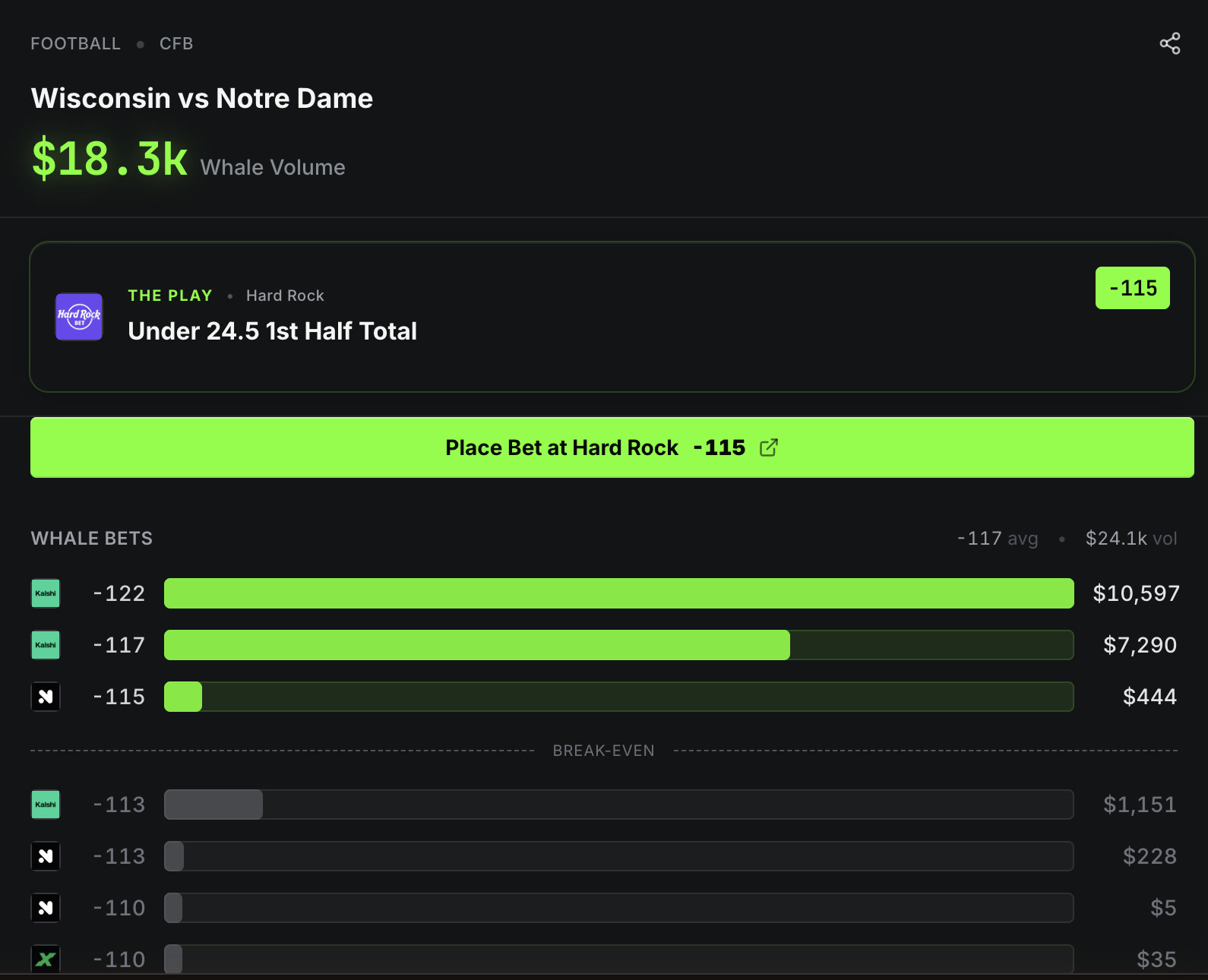
The signal below is what the check looks like in practice. The feed was empty at 1pm on the Sunday before Week 1, and by 2:30pm, with the evening college games approaching, $18.3k of tracked money had landed on Under 24.5 first-half points in Wisconsin at Notre Dame. Read the prices before the total: $10,597 went in at -122 and $7,290 at -117 on Kalshi, the whale average is -117, and Hard Rock was still offering -115. A better price than the whales paid, on the same side of the same market, is the only version of this worth acting on. Below the break-even line the tool also shows the smaller tracked bets at worse prices, so you can see the whole distribution rather than the headline.
What the profit numbers look like underneath
| 2026 year to date | +$22,758.22 | 2,222-4,072-197, ROI 2.98% |
|---|---|---|
| November 2025 | +$14,083.76 | 1,603-1,915-14, ROI 1.81% |
| Worst point inside November | -$1,432.37 | after being well up, before finishing green |
| Current PrizePicks entry limit | $5 | and limited at most major sportsbooks |
What repeatedly looks like in the results
November's $14,083 sits on 3,532 outcomes at a 1.81% ROI, and the path through the month includes a drop to -$1,432 and another late drop from over $17,000. Nobody experiences that month as a smooth climb. This year's $22,758 sits on 6,491 outcomes at 2.98%, with 4,072 losses in it. The results cover tracked betting across platforms, so not every historical wager was $5, and the current $5 PrizePicks cap is covered in the limits article.
Volume does not fix selection. More entries at unfavorable prices make losses accumulate faster. The opportunities have to justify the volume, and if fewer qualify, fewer get placed. With limits in place, finding worthwhile opportunities that are still accessible is most of the work, which is the reason the search is automated and the reason the final number gets checked one more time before submission.
The part of this anyone can start today without a tool: before the next entry, compare one player's exact prop across the market, find out whether the number is competitive, check the payout, and make sure the projection is still there before submitting. Keep stakes inside what you can afford to lose. A favorable estimate does not remove the losing stretches, and if the number that created the edge is gone, let the lineup go.
Frequently asked questions
What is a middle on PrizePicks?
A middle is when two platforms post different lines on the same prop and you take the Over on the lower line and the Under on the higher one, in separate entries. Every finishing total between the two lines wins both. On September 6, 2026, George Holani's receiving yards were 8.5 on Dabble and 12.5 on PrizePicks, so 9 through 12 yards would win both sides. The middle only pays if the complete entries around each leg also win, so the other legs and payouts have to be checked first.
Is line shopping possible on PrizePicks if every pick pays the same?
Yes, but the shopping happens on the projection rather than the price. PrizePicks prices every leg at roughly -119, so the edge comes from finding projections the wider market has set differently. Treveyon Henderson's rushing attempts were 6.5 on PrizePicks and 7.5 at every sportsbook on September 6, which makes the PrizePicks Over a candidate worth investigating.
Does correlation help on PrizePicks NFL entries?
Correlated legs raise the chance every leg hits, which helps entries that need all legs to win. PrizePicks can lower the multiplier on certain same-game combinations, and a lower payout can erase the benefit. A four-pick entry with a 12% chance of hitting returns $1.20 per $1 at 10x and $0.96 at 8x. Check the actual multiplier on the entry being built, and run Flex structures with the partial payouts included.
What does the +EV Sniper's edge percentage mean for a PrizePicks lineup?
It is an estimate of how far a single price sits above the devigged market consensus for that outcome, expressed as expected return per dollar. It is not the probability that a whole lineup wins, and it depends on the prices and weights behind the calculation, which is why the row can be expanded to see the book comparison. Lineups can be prefilled on PrizePicks with one click, but the players, sides, projections and payout should be confirmed before submitting.
How much profit should a PrizePicks NFL strategy produce?
Less than the headline numbers suggest, and with real drawdowns. Matt's verified 2026 is $22,758.22 on 6,491 outcomes, a 2.98% ROI with 4,072 losing bets in it, and November 2025 spent part of the month at -$1,432 before finishing at $14,083. PrizePicks now limits the account to $5 per entry. Expect small edges, high volume, losing stretches, and limits if it works.