What Sportsbook or Exchange Is the Sharpest? Two Years of CLV Data
By Matt Downs · October 14, 2026
The sharpest book is the one whose price is right the most often and that the rest of the market follows when it disagrees. To find out which one that is, Matt Downs graded the closing prices and hit rates on 27,579 games, 252,387 player props, 22.5 million Novig trades and more than 1.1 million line moves, across a little more than two years of data.
The short answer: Novig was the sharpest price measured on both game lines and player props, Kalshi tied it on props, and FanDuel and DraftKings were the two sportsbooks that earned a real seat. Books that limit winning bettors quickly graded at the bottom. This article walks through how each book was tested, what the results were, and the exact fair value weights that came out of it.
How to tell if a sportsbook or exchange is sharp
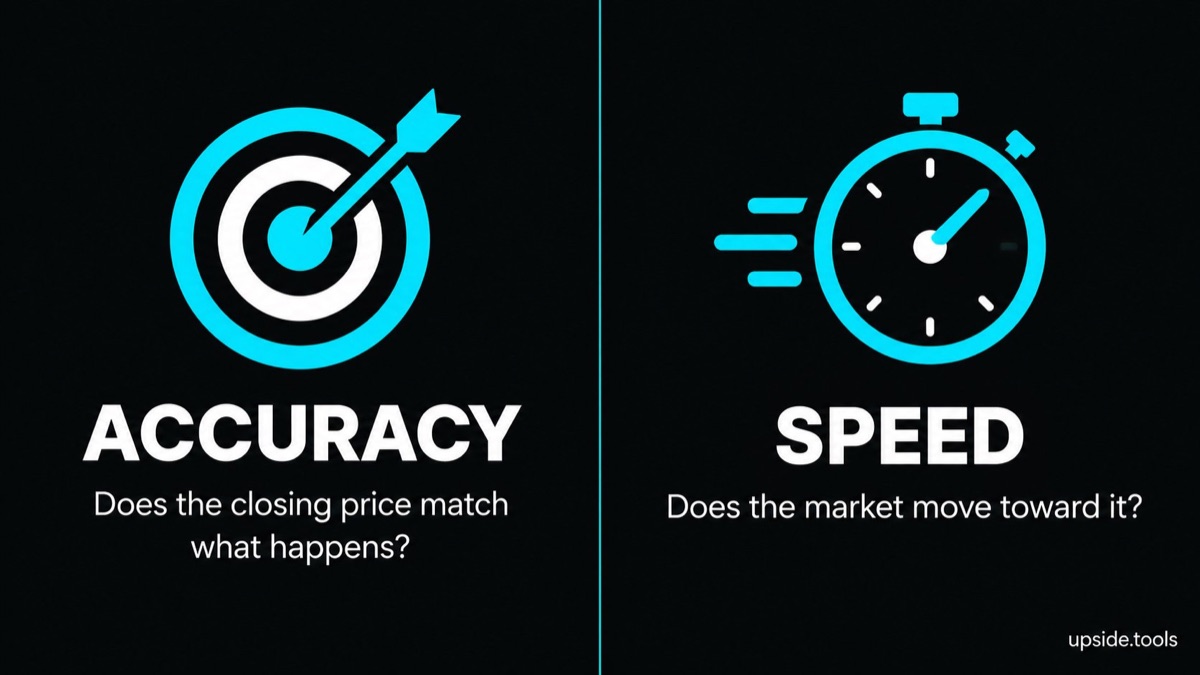
A book earns trust in two ways. Its closing price has to match what actually happens, which is accuracy, and the rest of the market has to move toward it when they disagree, which is speed. A book that is accurate and gets followed after it moves is a sharp data point, and following it becomes a pattern rather than a guess.
Every closing price in this study had the vig removed first, so each book's number is a fair percent chance rather than a price with margin built in. The no vig calculator does the same thing for a single two way market.
The closing line is accurate at every major book
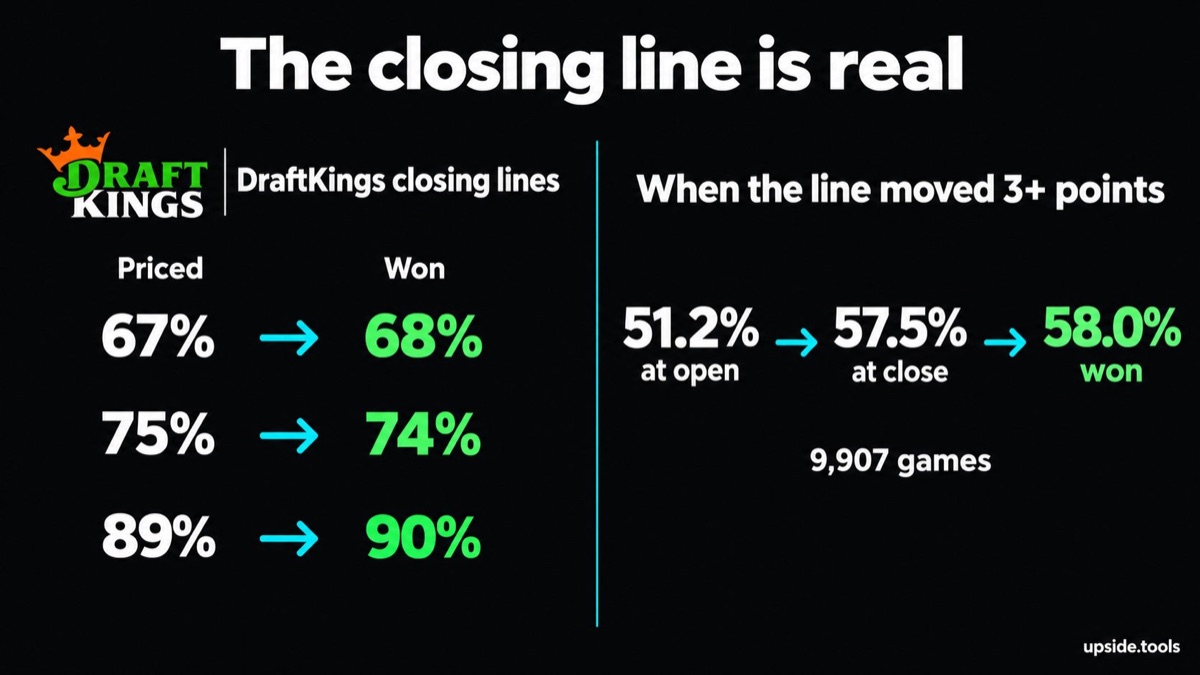
At DraftKings, sides that closed around 67 percent won 68 percent of the time, and sides that closed around 89 percent won 90 percent of the time. The strongest proof came from line movement: in the 9,907 games where the line moved 3 points or more, the side it moved toward was priced at 51.2 percent at the open and 57.5 percent at the close, and it won 58.0 percent of the time.
That is why beating the closing number matters so much, as covered in why positive CLV means you're making sharp bets. The catch is that every major book passed this test, and FanDuel and DraftKings closed 12,883 pro games with nearly identical accuracy. Accuracy alone could not rank the books, so speed became the deciding test.
Who the market follows on game lines
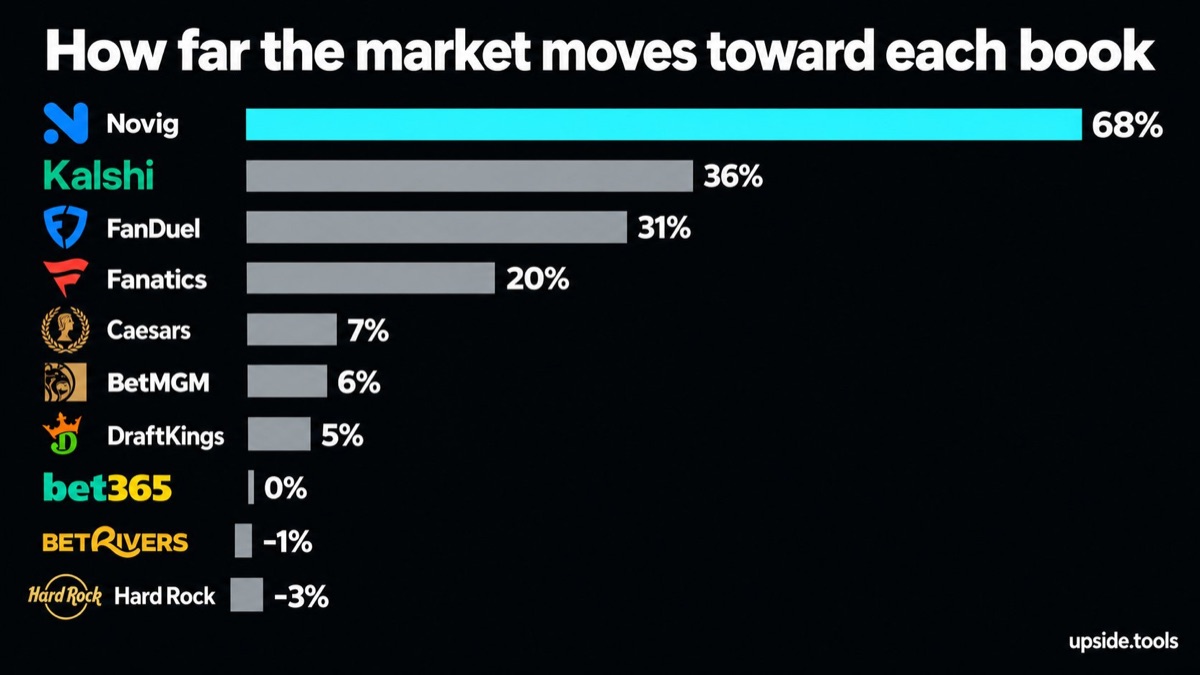
Every line move on 6,087 games was pulled and timed to the second. For each game, each book's price 24 hours, 6 hours and 1 hour before the start was compared with everyone else's, and when a book disagreed with the rest, the study measured how far the rest of the market moved toward it by the close. At 100 percent the market always ends up where that book already was, and at 0 percent the market never moves toward it.
Novig came in at 68 percent, and six hours before a game the market closed 89 percent of its gap toward Novig. Kalshi was at 36 percent and FanDuel at 31 percent, while bet365, BetRivers and Hard Rock sat at zero or below, which means the rest of the market almost never followed them.
The sharpest books for player props
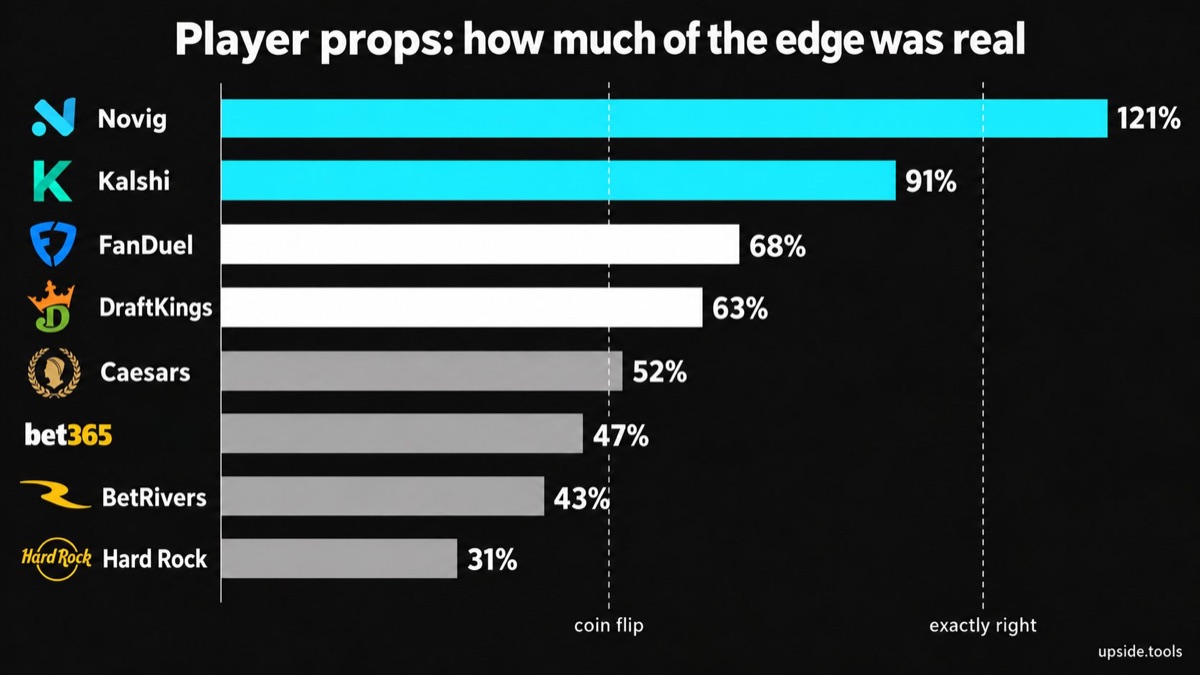
On props, the books were put head to head. When two books close the same player at the same number with different prices, the box score decides which one was closer. That comparison was graded every time two books were 2 points or more apart, which happened more than 400,000 times.
The result reads as how much of the edge was real when a price beat each book's closing number. Novig came in at 121 percent across 7,468 matchups, which means bets that beat its close won even more often than Novig itself expected. Kalshi was at 91 percent, FanDuel at 68 and DraftKings at 63, while bet365, BetRivers and Hard Rock all finished under 50 percent, so whenever they disagreed with another book, the other book had the better number.
The over tax on player props
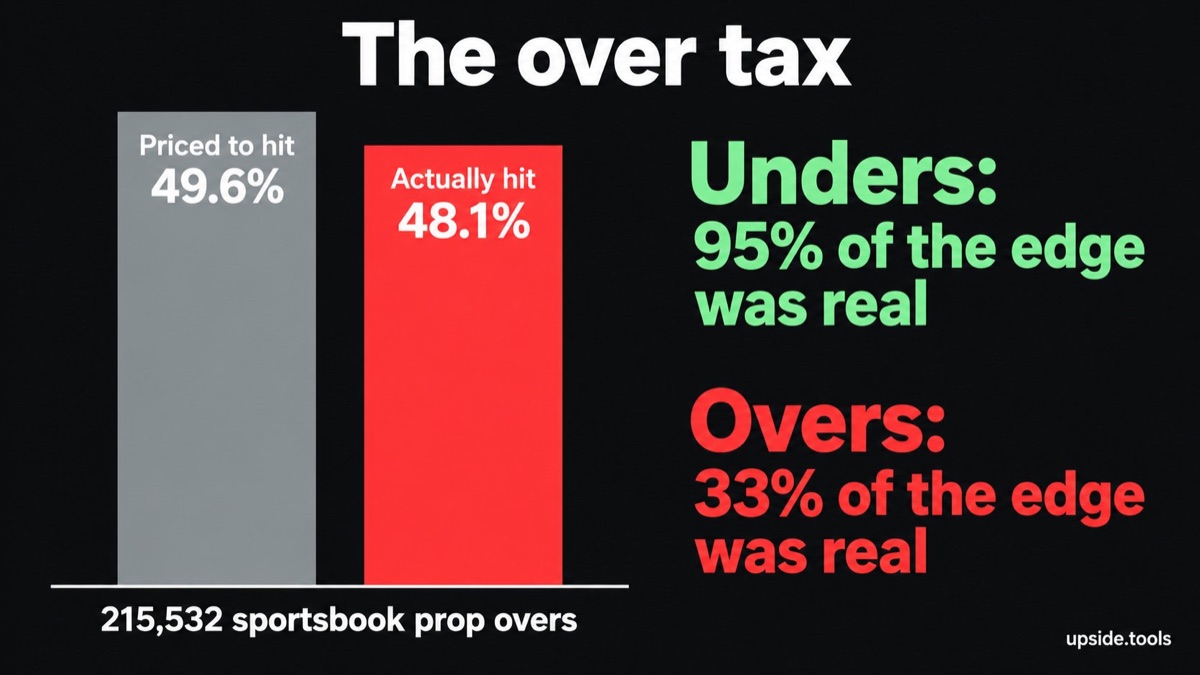
The biggest surprise was hiding inside the player props. Across 215,532 DraftKings props, overs were priced to hit 49.6 percent after removing the vig, and they hit 48.1 percent. The same lean showed up at every major sportsbook graded.
That changes what CLV is worth. When a bet beat a sportsbook's closing price on an under, 95 percent of that edge showed up in the results. When it beat the close on an over, about a third of the edge showed up. Neither figure is a win rate: it is the share of the expected edge that turned into real wins. Kalshi showed none of that lean and Novig about half of it, which is a big reason the exchanges carry the weight on props. More on the over and under split is in unders vs overs on player props.
The sharpest books, ranked
| Novig | 68% / 121% | Game lines followed / prop edge that was real |
|---|---|---|
| Kalshi | 36% / 91% | Tied Novig head to head on props |
| FanDuel | 31% / 68% | Strongest sportsbook on both |
| DraftKings | 5% / 63% | Real seat on props |
| bet365, BetRivers, Hard Rock | 0% or less / under 50% | The market did not follow them |
How the results set fair value weights
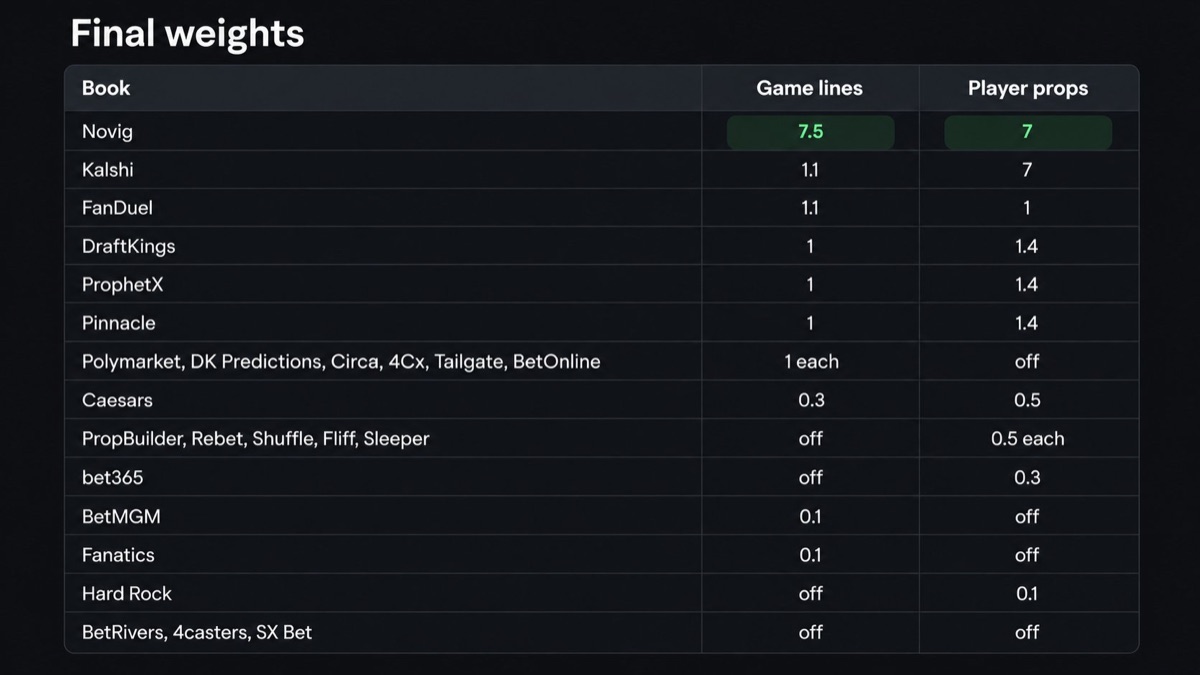
Every EV number on Upside is measured against a fair price, and that fair price is a weighted blend of the books. The last step of the study was a formula that finds the blend whose fair price lands closest to the close, where a book earns weight for being early and right and earns nothing for repeating what another book already says.
On game lines that put Novig at 7.5, with FanDuel at 1.1, Kalshi at 1.1 and DraftKings at 1. On player props Novig and Kalshi both went to 7, with DraftKings at 1.4 and FanDuel at 1. Books that limit winning bettors fast, like Hard Rock, BetMGM, BetRivers and Fanatics, sit at 0.1 or are turned off no matter how their lines graded, because a price that sharp money is barely allowed to bet has never really been tested. ProphetX, Pinnacle, Polymarket, Circa and the other books with about a week of history are parked near FanDuel and DraftKings until there is enough data to rank them.
How to use these exact weights
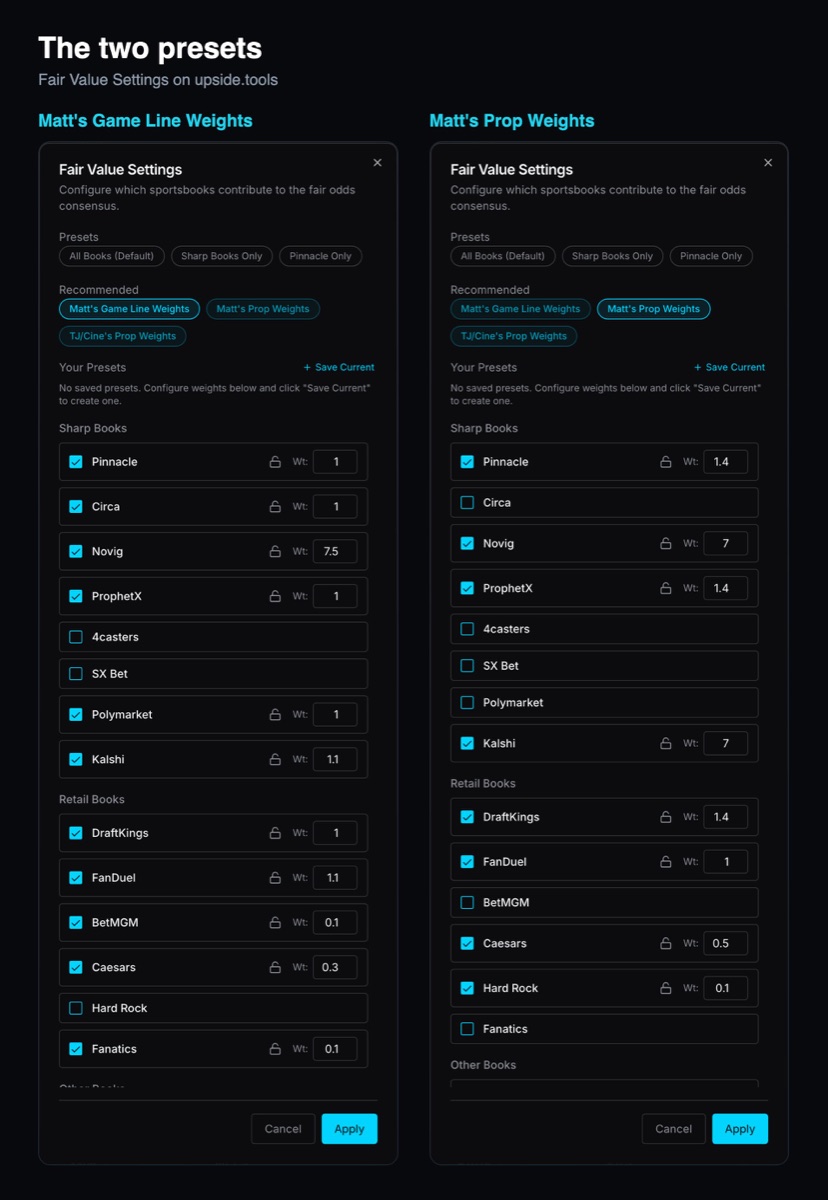
Both sets are saved as presets, so nothing has to be typed in. Open the +EV Optimizer or the +EV Sniper, click Filters, and at the top next to Fair value click Weights. Under Recommended, pick Matt's Game Line Weights for sides and totals or Matt's Prop Weights for player props, then click Apply and Apply filters. Every EV number on the board is then measured against that weighted fair price.
Three settings help make sure the edge on the board is real. Set Required book to Novig, or Kalshi on props, so the book carrying the weight is actually pricing that line. Raise Min sportsbooks to 3 or more, so one stale price cannot create an edge by itself. And be careful with prop overs at a sportsbook, because unless Novig or Kalshi is on that line, the over tax is baked into the fair price.
Frequently asked questions
What is the sharpest sportsbook or exchange?
In this study Novig was the sharpest on both game lines and player props. The rest of the market closed 68 percent of its gap toward Novig on game lines, and on props bets that beat Novig's close won more often than any other book's. Kalshi tied Novig on props.
Which traditional sportsbook is the sharpest?
FanDuel was the strongest sportsbook on both game lines and props, with DraftKings close behind on props. bet365, BetRivers and Hard Rock graded at the bottom on both tests.
Are sportsbook closing lines accurate?
Yes. Every major book's closing line matched results closely, for example DraftKings sides that closed near 89 percent won 90 percent of the time. Because they were all accurate, speed was used to separate them.
Why are player prop overs overpriced?
Across 215,532 DraftKings props, overs were priced to hit 49.6 percent after removing the vig and hit 48.1 percent. The same lean appeared at every major sportsbook. Kalshi showed no lean and Novig about half of it.
How do I use these weights on Upside?
Open the +EV Optimizer or the +EV Sniper, click Filters, click Weights next to Fair value, and under Recommended pick Matt's Game Line Weights or Matt's Prop Weights. Then click Apply and Apply filters.