Positive CLV: Why It Means You're Making Sharp Bets
By Matt Downs · October 13, 2026
Positive CLV means you placed a bet at a better price than the price the market closed at. CLV stands for closing line value, and the closing line is the last price available right before the game starts. If you take an under at -119 and the same under costs -155 at kickoff, you have positive CLV, because you bought the bet for less than it cost at the end.
It is the best single sign that a bet was sharp, and it shows up long before your win and loss record can tell you anything. This article explains why, using one real bet. On Thursday, October 8, 2026, Matt Downs posted David Montgomery under 0.5 touchdowns on PrizePicks at -119. By kickoff on Sunday the sharpest books had the same under between -153 and -160.
One under, five prices
| PrizePicks, when the bet was posted | -119 | One leg of a six pick Flex, Thursday 10:38 AM |
|---|---|---|
| Novig at kickoff | -153 | Sunday, 1:00 PM Eastern |
| Pinnacle at kickoff | -154 | Sunday, 1:00 PM Eastern |
| ProphetX at kickoff | -157 | Sunday, 1:00 PM Eastern |
| Circa at kickoff | -160 | Sunday, 1:00 PM Eastern |
What positive CLV means
The closing line is the last price a market offers on a bet before the game starts. By then every injury report, every lineup change and every large bet has already moved that number, so it is the best estimate of the real chance that the market is going to give you.
CLV is the gap between the price you took and that closing price. When your price is better than the close, the CLV is positive. When the market closes at a better price than the one you took, the CLV is negative. The basics, with a winning bet that was priced badly and a losing bet that was priced well, are in closing line value explained.
Why positive CLV means the bet was sharp
Think about what moves a line. The books and exchanges that set the market change their prices when large, respected money shows up on one side. That is the main reason betting odds change during the day.
So when a price moves toward your side after you bet it, the sharpest money in the market ended up agreeing with you, and you were in before the price changed. Beating the closing number is the first thing professional bettors grade themselves on for that reason. A bettor who keeps getting a better price than the close is beating the market, and beating the market is what makes money over the long term.
The bet when it was placed
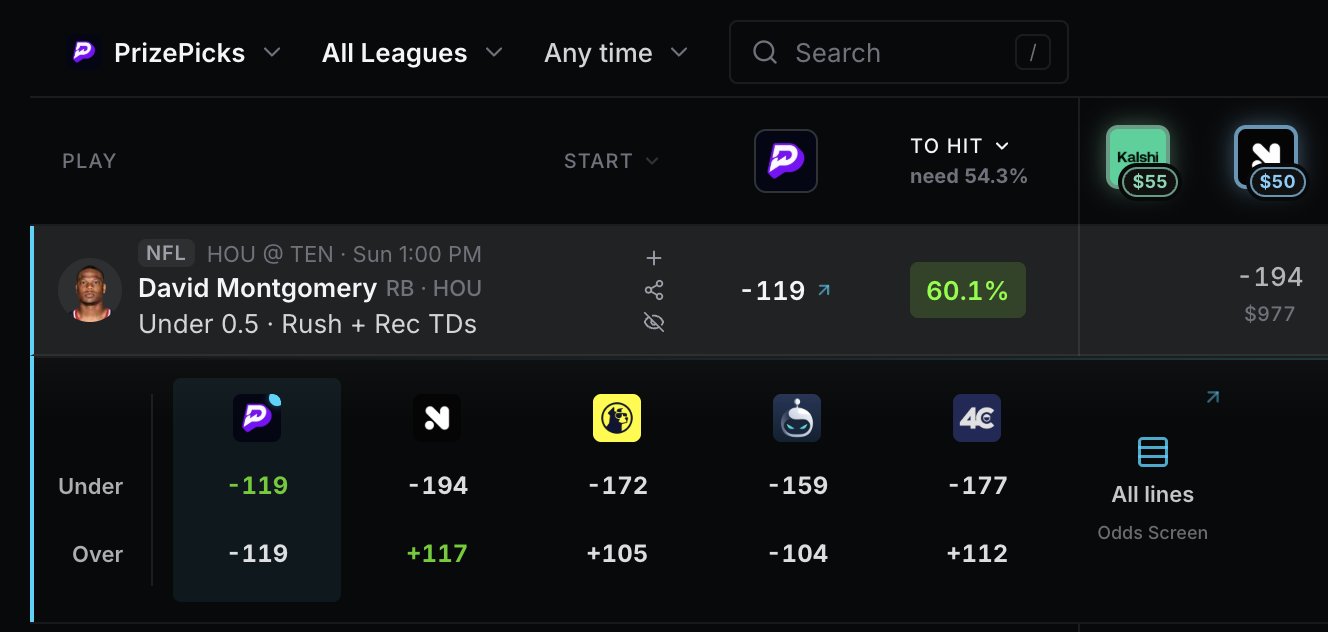
PrizePicks charges the same price on every leg of a six pick Flex. It works out to -119, which is a break even of 54.3%. The math is in how PrizePicks prices a leg at -119.
On Thursday at 10:38 AM the Props Optimizer had Montgomery under 0.5 touchdowns at 60.1% to hit. Novig was charging -194 for that under and three other books were at -172, -159 and -177. The under was on the PrizePicks board at -119 while every other price on the screen was more expensive.
What the market did by kickoff
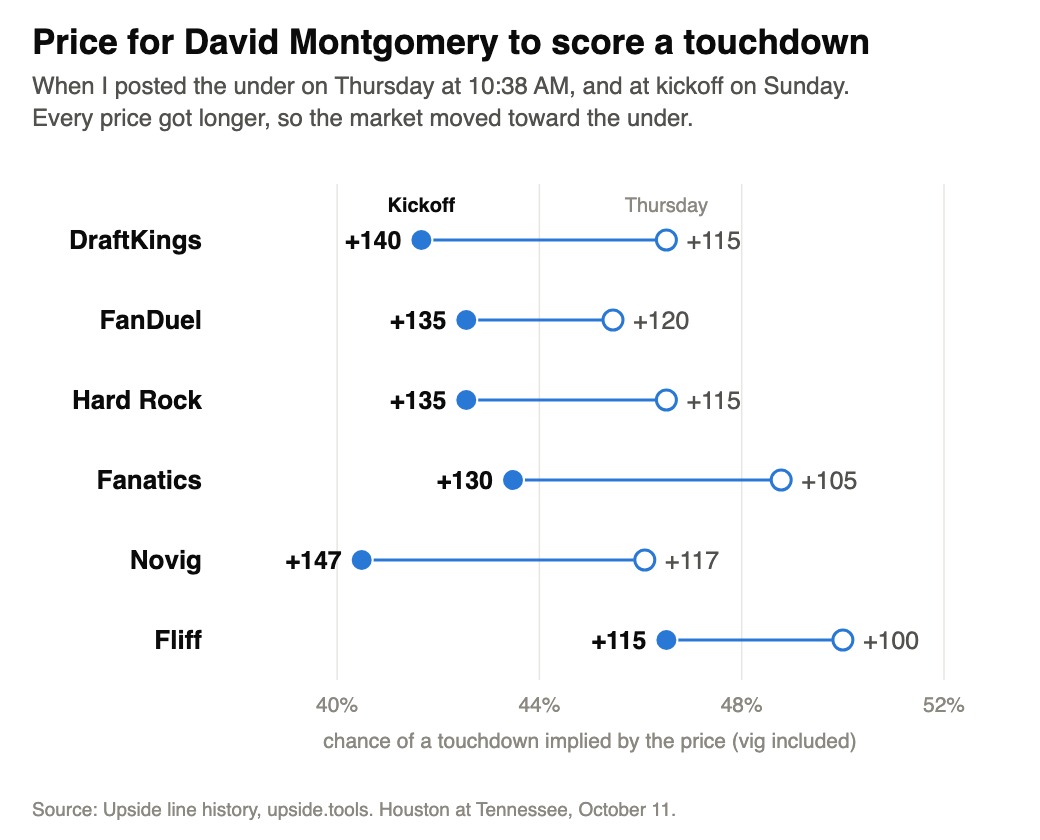
Most sportsbooks only post the yes side of a touchdown prop, so the chart tracks the price for Montgomery to score. Every book on it raised that price between Thursday morning and Sunday at 1:00 PM. DraftKings went from +115 to +140, FanDuel from +120 to +135, Hard Rock from +115 to +135, Fanatics from +105 to +130 and Novig from +117 to +147. A longer price on the touchdown is the market saying a touchdown got less likely, which is the side the under was on.
Four places posted a price on the under itself at kickoff. Circa closed at -160, ProphetX at -157, Pinnacle at -154 and Novig at -153. The same bet had been available at -119.
To measure the CLV properly you remove the vig from the closing prices first. Put each closing pair through the no vig calculator and the under comes out at 59.9% on Novig, 59.6% at Circa, 58.0% on ProphetX and 57.9% at Pinnacle. That averages about 59%. A six pick Flex leg needs about 54.3%, so the bet beat the no vig close by about 4.5 points.
The under at the close, with the vig removed
| Novig | 59.9% | -153 under, +147 over |
|---|---|---|
| Circa | 59.6% | -160 under, +140 over |
| ProphetX | 58.0% | -157 under, +126 over |
| Pinnacle | 57.9% | -154 under, +127 over |
| What the PrizePicks leg needed | 54.3% | Break even at -119 |
The result is not the grade
Montgomery finished with zero touchdowns, so the leg won. The slip it was on lost a different leg on Monday night. Neither result says much about whether the bet was good, because one game is one draw from the odds.
The closing price is what graded the bet. On Sunday at 1:00 PM, before a single snap, the market had the under at about 59% and the bet had been made at a price that needed 54.3%. That would still have been true if Montgomery had scored twice.
Why CLV is a faster test than your record
Results are noisy. A bettor with a real 5% edge needs several thousand bets before the win and loss record can prove the profit was skill and not luck. CLV can show the same edge in about 50 bets, because results swing about ten times as much from bet to bet as CLV does.
CLV also holds up on large samples of closing prices. The amount a bet beat the no vig closing line by matches the actual return almost one for one, so a bettor who beats the close by 3% on average ends up making about 3% over time.
How sportsbooks use CLV
Sportsbooks read CLV the same way bettors do. Their risk teams use it to spot sharp accounts, and it counts for more than wins and losses when they decide who to limit. A customer on a hot streak with poor prices is welcome. A customer who keeps beating the close gets a smaller maximum bet, even during a losing month.
That is one reason large bettors move their volume to exchanges, and why tools such as Whale Watch read exchange prices to see where that money went.
When positive CLV is not enough
Positive CLV is a strong indicator and it does not guarantee a profit by itself. A small amount of CLV does not cover the vig. If you take -108 and the bet closes at -110 on both sides, you beat the closing price and you still paid more than the fair price of +100. The bets that make real money are the ones that beat the close by enough to clear the book's margin.
Two things matter when you measure it. First, compare your price with the no vig closing price, taken from sharp books and exchanges. Which books to trust and how to remove the vig are covered in the most accurate devig method. Second, the gap has to clear the break even on the bet you actually placed. On PrizePicks that means the no vig close has to sit above 54.3% for a six pick Flex leg.
How to track your own CLV
Write down the price and the time on every bet you place. Right before the game starts, look up the same bet at the sharpest places you can find. In the example above those were Novig, ProphetX, Pinnacle and Circa. The odds screen keeps a line history for each book, which is where the closing prices in this article came from.
Remove the vig from the closing prices with the no vig calculator and compare the result with the break even on your bet. The implied odds calculator converts any price to a break even.
Do that for 50 bets. If your price beats the no vig close on most of them, you are making sharp bets, whatever your record says this week. If it does not, a hot streak is unlikely to last.
Frequently asked questions
What is positive CLV?
Positive CLV means you bet at a better price than the closing price, which is the last price available before the game starts. An under taken at -119 that closes at -155 has positive CLV because the same bet cost more at the end.
Is positive CLV a good indicator that a bet was sharp?
Yes. Prices move when large, respected money comes in, so a price that moves toward your side after you bet means the sharpest money in the market ended up agreeing with you. In this article's example the under was taken at -119 and closed between -153 and -160 at four sharp books.
Does positive CLV guarantee you will win?
No. A single bet with positive CLV still loses often, and a small amount of CLV does not cover the vig. You need to beat the no vig closing price by enough to clear the break even on the bet you placed.
How many bets do you need before CLV means something?
About 50 bets is enough to see whether you are beating the close. A win and loss record needs several thousand bets to prove a 5 percent edge, because results swing about ten times as much from bet to bet as CLV does.
How do you calculate CLV?
Record the price you took, then look up the closing price on both sides at a sharp book or exchange and remove the vig. Compare that no vig closing percentage with the break even of your price. In the example the no vig close was about 59 percent and the bet needed 54.3 percent, a gap of about 4.5 points.
Which closing line should you measure against?
Use the closing prices at the sharpest books and exchanges you can see, with the vig removed. The example in this article used Novig, ProphetX, Pinnacle and Circa. Pick'em apps and slow sportsbooks do not move enough to be a useful closing line.
Can a losing bet have positive CLV?
Yes. CLV grades the price and the result is one game. A bet that beat the close and lost was still a good bet, and a bet that won at a worse price than the close was still a bad one.