PrizePicks Sharp Bets: How to Spot One With Whale Money
By Matt Downs · October 10, 2026
A sharp bet on PrizePicks is a leg that costs less on PrizePicks than large bettors paid for the same outcome somewhere else. PrizePicks charges the same price on every leg, so when big money on an exchange has paid more than that price, the PrizePicks leg is the better deal.
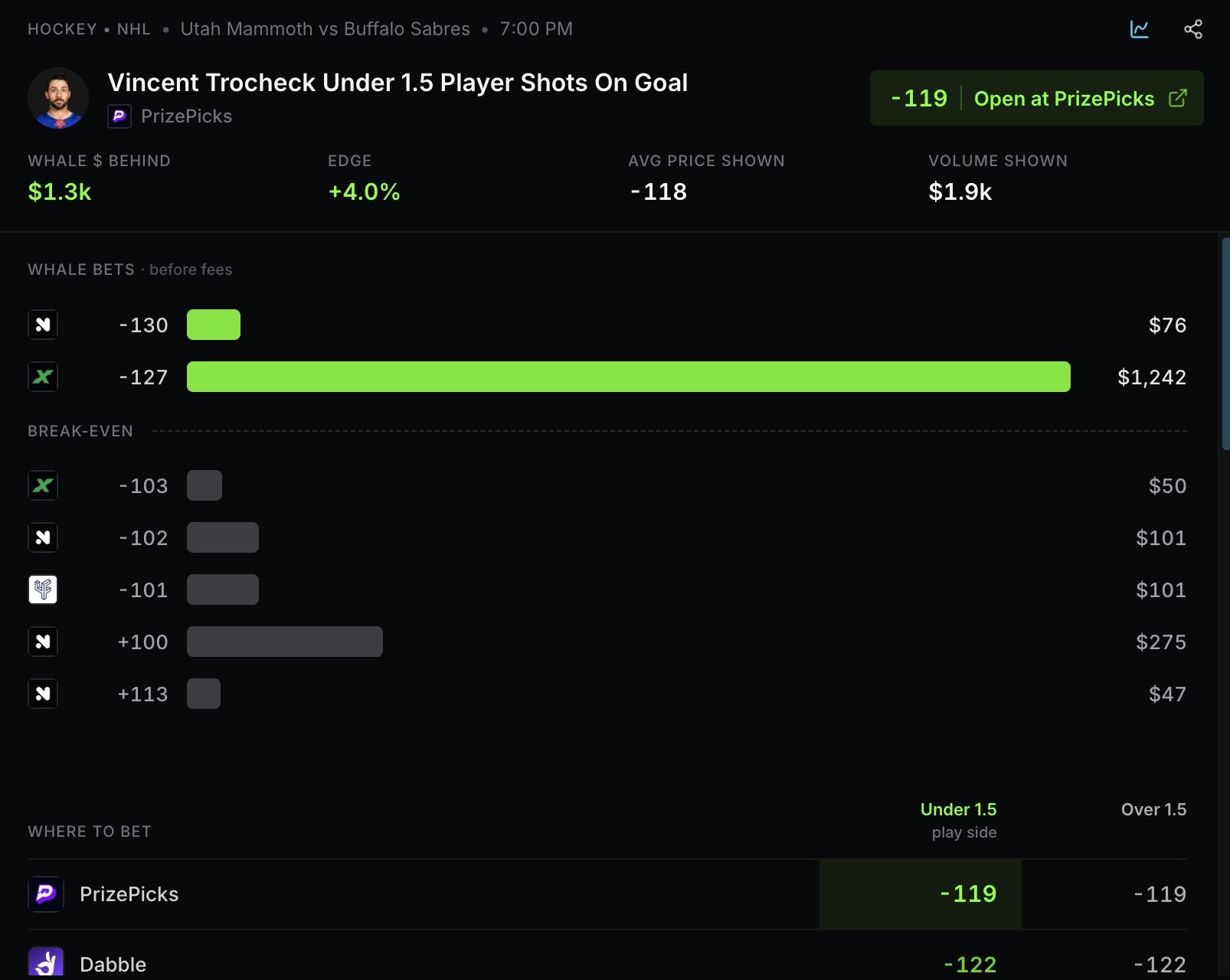
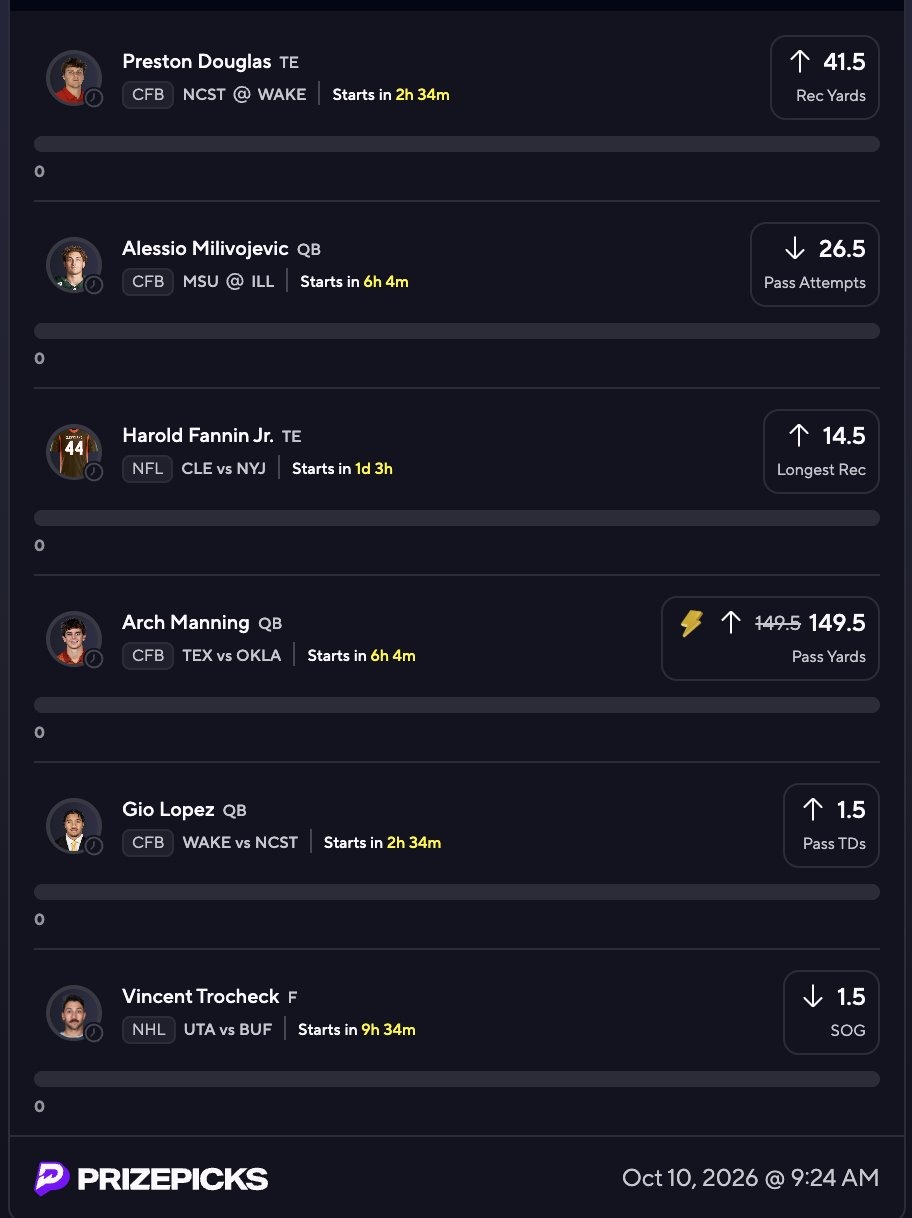
This article walks through one real example. On Saturday, October 10, 2026, Matt Downs posted a six pick PrizePicks slip before any of the games started. One leg was Vincent Trocheck under 1.5 shots on goal. On ProphetX, an exchange, $1,242 had gone in on that under at -127, and PrizePicks was selling the same under at -119. The slip was posted before the games, so this is about how the leg was chosen and it says nothing about how the slip finished.
One under, three prices
| Highest price a whale paid | -130 | $76 on an exchange |
|---|---|---|
| Biggest whale bet | -127 | $1,242 on ProphetX |
| PrizePicks | -119 | The same under 1.5 as one leg of a six pick Flex |
What a sharp bet on PrizePicks is
PrizePicks does not move the price on a leg the way a sportsbook does. In a six pick Flex every leg works out to -119, which is a break-even of 54.34%. You can check that conversion on the implied odds calculator, and the full math is in how PrizePicks prices a leg at -119.
That fixed price is the opening. The rest of the market reprices a prop all day as money comes in. If the people betting real money on that prop are paying -127 or -130 for it, they are saying it lands more often than 54.34% of the time, and PrizePicks is still selling it at -119. A leg like that is what bettors mean by a sharp bet on PrizePicks.
Where the whale money shows up
Large bets are easiest to see on exchanges and prediction markets such as ProphetX, Novig and Kalshi. Prices there are set by people betting against each other, and the size of each bet is visible. Bettors who get limited at regular sportsbooks tend to move their volume to these markets.
Whale Watch collects those bets and lines them up against the price you can still get. The idea is the same one behind following sharp money on player props: there is no handicapping of the game involved. You are checking what someone else was willing to risk and at what price.
What the Whale Watch card shows
The top of the card names the play, Vincent Trocheck under 1.5 shots on goal in Utah against Buffalo, and the best place to take it, which was PrizePicks at -119. Under that are four numbers: $1.3k of whale money behind the play, an edge of +4.0%, an average price of -118 across the bets shown, and $1.9k of total volume shown.
The part that matters most is the list of individual bets, shown by itself below.
How to read the whale bets
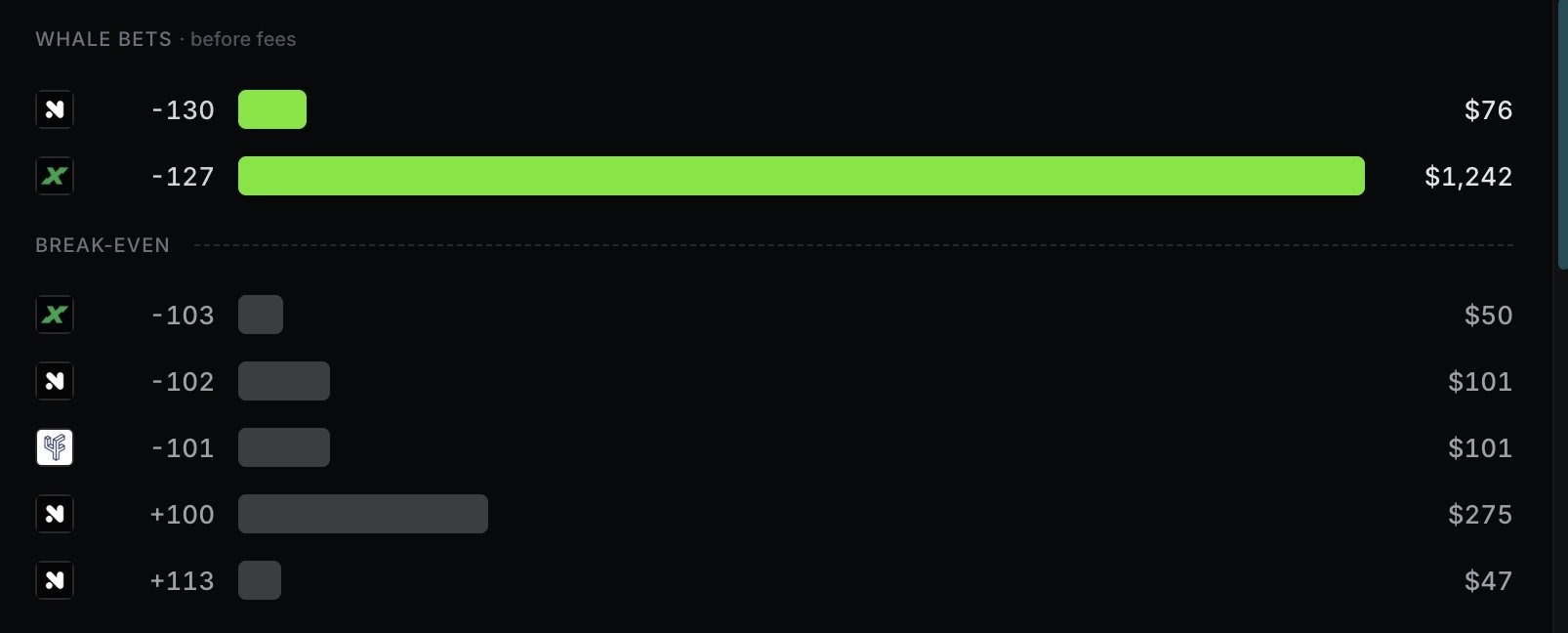
Each bar is a real bet on Trocheck's under. The two green bars sit above the break-even line: $76 at -130 and $1,242 at -127. Those bettors paid a worse price than the -119 you can still get on PrizePicks, and the tool adds them up as $1.3k of whale money behind the play.
The gray bars under the line are bets that got a better price than what is left, such as $275 at +100 and $101 at -102. The tool shows them and leaves them out of the count, because someone who got +100 has not told you anything about whether -119 is a good price.
So the read is simple. The largest bet on this under paid -127, the most anyone paid was -130, and the same under was available at -119.
Why -119 against -127 matters
Put both prices through the implied odds calculator. A price of -127 is 55.95% and -119 is 54.34%. The $1,242 bet needed the under to land about 56 times in 100 to break even, and the PrizePicks leg needs about 54.
That gap of roughly a point and a half is the whole edge on this leg. It is small. The card showed an edge of +4.0%, and for reference the highest whale price of -130 is 56.52%, which is 1.04 times the 54.34% break-even. Edges this size lose often on any single entry and only add up over many of them.
How the leg fits into a six pick
The Trocheck under was one of six legs in a Flex that pays 25X when all six land. Every leg in the slip went through the same kind of check, which is lining up what PrizePicks is charging against what the rest of the market is charging for the same outcome.
One leg came from a promotion. PrizePicks ran a college football flash sale that cut Arch Manning's passing yards line from 210.5 to 149.5, and the slip took the over on the lower number. Promos like that are value the app hands out on purpose, and they are worth checking every day.
The comparison between slip sizes is covered in 3 pick vs 6 pick on PrizePicks.
What whale money does not tell you
This was a thin market. $1.3k is a small amount of money, and almost all of it went in at one price on one exchange. Other plays on the same tool have shown hundreds of thousands of dollars behind one side. A single large bet can also be a hedge against another position, so treat it as evidence that can be wrong.
A six pick loses more often than it wins even when every leg is priced well, so the entry size should be one you are comfortable losing. Prices move too. If PrizePicks changes the line, or the exchange price drops back toward -119, the edge on that leg is gone.
The steps are the same on any day. Find a prop where large bets have gone in on an exchange, read the price they paid, and take the PrizePicks leg only when its -119 is the better price.
Frequently asked questions
What is a sharp bet on PrizePicks?
A sharp bet on PrizePicks is a leg that costs less on PrizePicks than large, informed bettors paid for the same outcome elsewhere. In the example in this article $1,242 went in on an under at -127 on an exchange while PrizePicks sold the same under at -119.
How do you find sharp bets on PrizePicks?
Look for props where large bets have been placed on exchanges or prediction markets such as ProphetX, Novig and Kalshi, read the price those bettors paid, and compare it with the PrizePicks price. If the big money paid more than -119, the PrizePicks leg is the better price.
What does -119 mean on a PrizePicks leg?
In a six pick Flex each PrizePicks leg works out to a price of -119, which is a break-even of 54.34%. A leg is worth taking when the real chance of it landing is higher than that.
What is whale money in sports betting?
Whale money is large bets placed by individual bettors, usually on exchanges and prediction markets where the size of each bet is visible. Following it means taking the same side at the same price or a better one.
Does following whale money guarantee a win?
No. A large bet can lose, and it can be a hedge against another position. In this example the whale money was only $1.3k and the edge was about a point and a half of break-even, so the leg still loses often.
How much whale money is enough to trust?
There is no fixed number. More money at a worse price than yours is stronger evidence. The example in this article had $1.3k behind it, which is thin, while other plays have shown hundreds of thousands of dollars.