Original research · August 12, 2026
Why Betting Odds Change During the Day
By Matt Downs
A price on a sportsbook is not a fact about the game. It is the number that happened to be up when you looked, and on a normal weekday it changes several times before most people have had coffee.
Here is that measured rather than asserted. On the morning of 12 August 2026 we pulled every moneyline price change across an 18-game MLB slate at nine sportsbooks, from midnight to 9am Eastern. 175 prices had already moved. Half of them had moved by a full point of break-even or worse, and the typical line had changed five separate times.
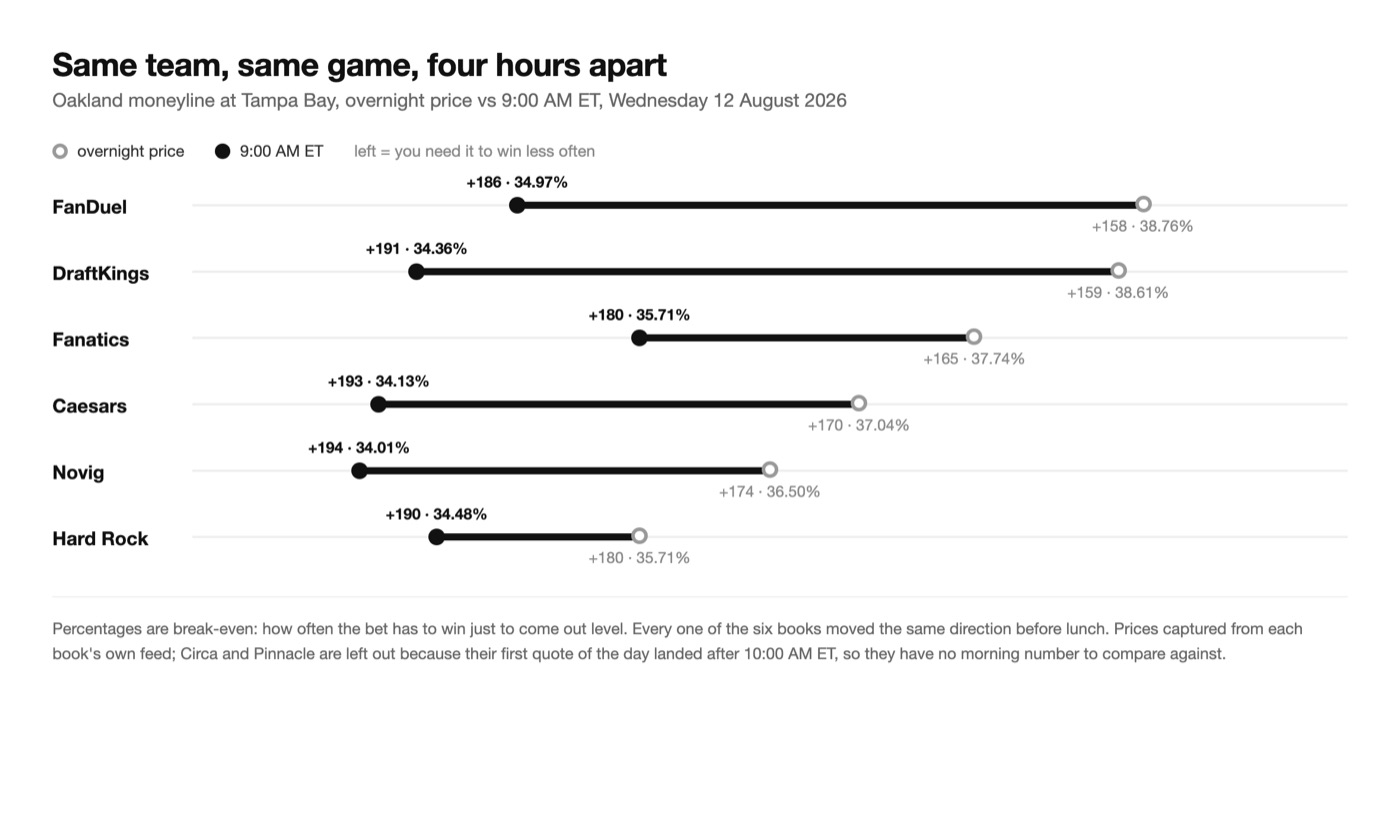
One team, four hours, six books
Oakland were at Tampa Bay that night. Overnight, DraftKings priced Oakland at +159. By 9am the same team in the same game was +191. There was no injury and no news attached to the move.
It was not one book having an opinion, either. FanDuel went +158 to +186, Fanatics +165 to +180, Caesars +170 to +193, Novig +174 to +194 and Hard Rock +180 to +190. Six books, one direction, one morning.
Two books were left out of that chart on purpose. Circa and Pinnacle did not post their first quote of the day until after 10am Eastern, so they have no morning number to compare against, and including them would have drawn a flat line that meant nothing.
What a four-point move is actually worth
Odds are a break-even percentage in disguise: the share of the time a bet has to land for you to come out level. Run +159 through the implied odds calculator and it returns 38.61%. +191 returns 34.36%.
So the same team, in the same game, four hours apart, went from needing to win about 39 times in 100 to needing about 34. That is 4.25 points of break-even, and it is larger than almost any edge a bettor will genuinely hold on a single baseball game.
The clearest way to see the damage is to hold the opinion fixed. Say you had done the work and concluded Oakland win 37 times in 100. Put 37% and +159 into the EV calculator on a $100 stake and it returns minus $4.17, an ROI of minus 4.17%. Change the price to +191, leaving the 37% exactly where it is, and the same view returns plus $7.67, an ROI of plus 7.67%.
Nothing was learned between those two numbers. The read on the game never changed. The price did all of it.
The same 37% opinion at two prices
| Overnight price | +159 · break-even 38.61% · EV on $100 = minus $4.17 | |
|---|---|---|
| 9:00am price | +191 · break-even 34.36% · EV on $100 = plus $7.67 | |
| What changed | The price. The opinion was held at 37% in both rows. |
So should you bet early or late?
Neither, as a rule, and anyone selling you a rule here is guessing. Oakland got cheaper all morning, so waiting was correct on that side. Tampa Bay moved from -188 to -205 at FanDuel over the same window, so waiting was wrong on the other side of the identical market.
Both sides of one game moved in opposite directions on the same morning. That is what makes 'always bet early' and 'always wait for the closing number' equally unhelpful as instructions.
What you can control is the order you do things in. Decide what the price needs to be before you look at what is being offered. 'I like Oakland tonight' is an opinion. 'I like Oakland at +191 or better' is a bet, because it can be priced and it can be declined.
How to run this check yourself
Write down the price you need before you open the app. Convert it to a break-even percentage so it is a number you can compare rather than a symbol.
Then look at what is on the board across several books at once, not one. If the best available price is worse than the number you wrote down, you do not have a bet yet. You have an opinion, and opinions keep.
Every figure in this article was produced on public tools: the break-even conversions on the implied odds calculator, the dollar figures on the EV calculator, and the price history from the books' own published feeds.
Frequently asked questions
Why do betting odds change during the day?
Books adjust prices as money comes in and as other books move. A price is the book's current position, not a fixed valuation of the game, so it updates continuously. On the slate measured here the typical moneyline changed five separate times between midnight and 9am.
Is it better to bet early or wait?
Neither is reliably better. On one game measured here, one side got 4.25 points of break-even cheaper through the morning while the other side got more expensive over the identical window. The useful habit is deciding what price you need before you look, rather than deciding when to look.
How much does a four-point move in break-even matter?
Enough to flip a bet from losing to winning without changing your opinion. Holding a 37% read on a team fixed, +159 returns minus $4.17 per $100 and +191 returns plus $7.67 per $100.
Why do some sportsbooks move less than others?
Books that price closer to the true number at open have less correcting to do later. In this sample Pinnacle's median move was 0.48 points of break-even against 1.48 at FanDuel and 1.31 at DraftKings.